You Were Made to Rise: Turning Childhood Pain into Purpose

By Grandpa Eli

Come closer, dear heart.

I want to tell you a story.

There was a little boy who was often scolded, ignored, and shamed by the woman who should have been his greatest source of comfort. His name? Warren Buffett. Yes, that Warren Buffett. One of the most successful investors the world has ever known.

He and his sister were verbally abused for years. But strangely, their youngest sibling—born later—was loved and nurtured.

Why the difference? Why did the mother show kindness to one child and cruelty to the others?

No one knows. But here’s what matters: Warren did not stay in that pain. He used it. Transformed it. Rose above it.

And you can too.

What Happened to You Was Never Fair

Let’s get one thing straight: childhood abuse, neglect, or emotional abandonment are never justified.

If you were criticized more than comforted, If you were punished more than protected, If you were silenced when you needed to be seen…

Then yes, you carry wounds. But those wounds don’t have to be where your story ends.

They can be the place where something new begins.

The Hidden Gift in Pain

Now, I would never call your pain a “gift” lightly. I know how deep it runs. I know how long it lingers.

But sometimes, pain is what cracks us open just enough to let something divine grow.

Perhaps your heartbreak became the birthplace of your compassion. The sting of rejection might be what sharpened your empathy. And through silence, you may have learned how to truly listen.

Every scar has a lesson. Every wound can become wisdom.

But only if you choose to rise.

Purpose Isn’t Found. It’s Forged.

Some people wait for purpose to knock on their door. But child, real purpose is built. Brick by brick. Out of tears, trials, and tiny victories.

You build it when you:

  • Choose kindness, even when you were raised in cruelty.
  • Speak gently, though you were spoken to harshly.
  • Protect others, even if no one ever protected you.

That’s not just healing, it’s transformation. That’s the alchemy of a soul who refuses to repeat the past.

What You Needed Then, You Can Give Now

You know what it feels like to go unseen. So now you see others.

You know what it’s like to feel voiceless. So now you give voice to the silenced.

You know the darkness. And that is why you are called to become a light.

True to the life you deserved, to the love you needed, to the purpose you now create.

Your Pain Can Bless the World

I have seen it again and again: Children who were harmed become adults who heal. Not just themselves, but others.

Your story might be the medicine someone else needs. Your voice might be the echo they’ve been longing to hear.

From your broken places, you can build bridges. In the spaces where danger once lived, you now have the power to offer safety.

Pain wasn’t given to punish you — it was given to awaken purpose. Within that purpose lies possibility.

Final Words from Grandpa

When you rise—even slowly, even shakily—you remind the world of something sacred:

That hurt doesn’t have to have the final word. That love can grow where none was planted. That even cracked hearts can bloom.

You were not made to carry the weight of your childhood forever. You were made to rise.

And I am so proud to see you trying.

With all the belief in my bones,

—Grandpa Eli
The Journey to Heal Childhood Wounds

Childhood should be a time full of love, protection, and security. However, for many people, it’s a period marked by abandonment, abuse, or simply a lack of affection. These traumas don’t just leave scars in memory; they deeply affect our psychology, physical health, and how we interact with the world as adults.

Impact on Children

Children who experience abuse or neglect often:

  • Have low self-esteem
  • Are prone to anxiety, depression, and guilt
  • Struggle to form or maintain close relationships
  • Find it difficult to express emotions and trust others

Consequences in Adulthood

When these wounds aren’t healed, they can lead to:

  • Loss of control over life, avoiding responsibility
  • Psychological disorders, addiction, or self-destructive behaviors
  • Feelings of unworthiness, loneliness, and a deep emptiness

Important Statistics

According to the Australian Institute of Family Studies:

  • High rates of anxiety, depression, PTSD
  • Eating disorders: anorexia, binge eating, obesity
  • Addiction to alcohol and drugs
  • Higher risk of hepatitis, diabetes, stroke

Invisible Wounds

Many people don’t realize they carry emotional scars caused by unhealthy parenting styles: control, emotional coldness, criticism, comparisons, neglect…

The outcomes include:

  • Avoidance of interaction, fear of conflict
  • Living in chronic self-doubt and loneliness

The Way Out

Based on the “Wounded Childhood” series:

  1. Understand: Have the courage to face and acknowledge the truth
  2. Heal: Seek support from professionals, peer groups, or begin a journey of self-discovery
  3. Overcome: Let go of the past and choose a brighter, more deserving future

A Message from “Grandpa Buddha”

“You are not at fault for being hurt. But you are responsible for your own healing.”

And remember:

  • The journey may be long and painful
  • But it is worth it
  • And you are not alone: many others are walking this path with you

A Letter from Grandpa Eli

To the Child Inside You: Forgive Yourself

My dear,

If you’re reading this, it means you’re carrying something heavy. A weight not made of iron or stone, but of guilt… of memories… of blame you should never have held in your little hands.

I want to talk to that child inside you. The one who once wondered,
“Was it my fault?”
“Did I deserve this?”
“If only I had been better… quieter… stronger…”

Let me tell you a secret, whispered gently like the wind in the trees:
It was never your fault. Not even for a moment.

 This isn’t about forgiving them.This is about forgiving yourself.
This isn’t about forgiving them.
This is about forgiving yourself.

You were just a child. You didn’t choose the yelling. You didn’t cause the silence. You weren’t the reason they drank, or lashed out, or disappeared emotionally. The world got it upside down. And for too long, you’ve carried the burden of their brokenness on your innocent shoulders.

I know forgiveness is a complicated word. People often misunderstand it. They say, “You should forgive your abuser.” But I don’t believe you owe them anything.
This isn’t about forgiving them.

This is about forgiving yourself.

Forgive yourself for not knowing how to speak up.
Forgive yourself for trying so hard to please people who were impossible to please.
Forgive yourself for surviving in ways others may not understand—through silence, rebellion, perfectionism, or pretending everything was okay.

Forgive the child who simply wanted to be loved.

That child is still with you. And they are waiting—for your kindness, for your warmth, for your understanding.

So here’s what I want you to do today:

  1. Look in the mirror. Gently place your hand on your chest and say,
    “I forgive myself. I was just a child. I did nothing wrong.”
  2. Let go of the question “Why did this happen?” There may never be a satisfying answer. What matters more is: What will you do now to live free?
  3. Be the adult your younger self needed. Speak gently. Rest when you’re tired. Set boundaries. Celebrate small joys.

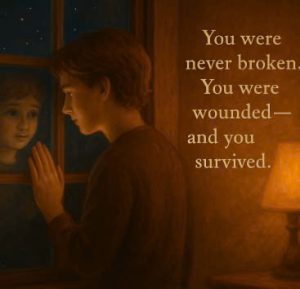
Dear one, you were never broken. You were wounded—but wounds can heal. Scars do not mean you’re damaged. They mean you survived.

You’re not alone anymore.

With warmth like a cup of cocoa in winter,
Grandpa Eli
🧡

You Don’t Have to Forgive to Heal – What Real Emotional Release Looks Like


You’ve heard it all before: “Forgive and forget.” “Just let it go.” “It’s the only way to move on.”

But what if I told you… you don’t have to forgive the person who hurt you in order to heal?

What if true healing isn’t about them at all—but about you reclaiming your power?

Forgiveness can be a beautiful thing. But when rushed, forced, or demanded, it becomes just another wound. So let’s redefine what healing looks like—on your terms.

  1. The Pressure to Forgive Too Soon

Too often, survivors are asked to make peace with monsters before they’ve even stopped bleeding.

Well-meaning friends, faith leaders, or even therapists might say, “You’ll feel better once you forgive.”

But when forgiveness is pushed before the pain has been witnessed, it only silences the truth.

You don’t owe forgiveness to the one who never apologized. You don’t owe absolution to someone who still denies what they did.

  1. What Forgiveness is Not

Let’s be clear:

  • Forgiveness is not saying “it was okay.”
  • Forgiveness is not reconciling.
  • Forgiveness is not forgetting.
  • Forgiveness is not pretending it didn’t change you.

Real healing says: It mattered. It hurt. And I’m allowed to grow beyond it—whether they’re sorry or not.

  1. The Healing That Doesn’t Require Forgiveness

Healing is:

  • Naming what happened.
  • Feeling the feelings you were never allowed to have.
  • Validating your pain without minimizing it.
  • Releasing the belief that it was your fault.

You can rage. You can cry. You can build boundaries so high they never touch you again.

That is healing.

  1. Forgiveness of Self Comes First

If there’s any forgiveness that truly matters, it’s this:

Forgiving yourself.

For the years you stayed silent. For the ways you coped that hurt you. For thinking you deserved it. For the self-blame you carried like a second skin.

You didn’t cause it. You were surviving. You did what you had to do.

Now you get to stop surviving and start healing.

  1. What Letting Go Really Looks Like

Letting go isn’t a moment. It’s a series of micro-decisions:

  • To stop explaining your pain to those who don’t want to understand.
  • To stop chasing closure from people incapable of giving it.
  • To stop believing that you are the broken one.

Letting go means saying: “I release you—not because you earned it, but because I deserve peace.”

You’re not freeing them. You’re freeing yourself.

  1. A Ritual for Release Without Forgiveness

Try this:

  1. Write a letter to the person who hurt you. Say everything.
  2. Don’t hold back. Let your truth rise.
  3. Burn it, tear it, bury it—whatever feels right.
  4. Whisper: “I don’t need to forgive to heal. But I do release this from my body.”

You may cry. That’s healing. You may feel nothing at first. That’s protection.

Repeat when needed. This is your journey.

Closing Words from Grandpa Eli

My dear one, You are not required to carry the weight of their sins just to seem “kind.” You don’t need to forgive to move forward. You need to feel. To grieve. To release.

When you are ready—on your own terms—you’ll know what needs to be forgiven and what simply needs to be released.

And whatever you choose… I’ll be here, cheering for your freedom.

💬 Has someone ever pushed you to forgive before you were ready? Share if you feel safe. Your story may help someone else feel seen.

#RedefineForgiveness #HealingWithoutForgiveness #SelfForgiveness #EmotionalRelease #YouDeservePeace