“The past is a place of reference, not residence.” – Grandpa Eli
If you’re reading this, chances are your childhood wasn’t easy.
Maybe you grew up in a home where love was conditional—or absent altogether. > Maybe you were criticized more than you were comforted. > Maybe you learned early on how to survive… but never how to feel safe.
And now, as an adult—perhaps even a parent—you’re starting to feel just how tightly the past still clings to your present.
You may…
Doubt your worth.
Make choices out of fear rather than faith.
Struggle to believe you’re truly lovable or capable.
You’re not alone. These are the invisible echoes of a wounded childhood. But the good news is: they don’t have to control your future.
Let’s explore how.
1. See the past clearly—but don’t live in it.
You don’t need to deny it or sugarcoat it. You can say: “Yes, that happened. It hurt. It shaped me.” But it doesn’t get to speak for your whole identity. It’s a chapter, not the whole book.
And you don’t have to forget in order to move on. You only have to stop letting it define what’s possible.
2. Look for the hidden strengths inside the wounds.
That pain taught you something—about survival, empathy, awareness. There’s power buried in your past:
The ability to break the cycle.
The courage to choose differently.
The wisdom to raise your child in love, not fear.
You don’t have to repeat the story you came from. You get to create a new one.
3. Choose differently—daily.
The past says, “You’ll never be good enough.” You say: “Watch me grow.” The past says, “This is just who I am.” You say: “Who I was isn’t who I have to be.”
Every small choice—pausing instead of yelling, hugging instead of judging, listening instead of controlling—is a line in the new chapter you’re writing.
Even if it feels awkward. Even if it feels slow. Healing happens in the repetition.
So, What Now?
The past will always be a part of you. It’s etched in memory, in scars, in reflexes. But it doesn’t have to be the author of your future.
🧓 Grandpa Eli’s message is simple: You can pick up the pen. > You can write a new chapter—brighter, stronger, more free.
You are not your wounds. > You are what rises from them.
Some people cry at funerals. Others stand still, arms crossed, heart numb. Some weep for what was lost. Others ache for what was never there.
This is the story of Devon—a man who didn’t shed a single tear when they lowered his mother’s casket into the ground.
Because he wasn’t grieving her death. He was grieving something far more complicated: The childhood he never got.
If you’ve ever buried a parent who left you with more scars than smiles, this story is for you.
This is the story of Devon – a man who didn’t shed a single tear when they lowered his mother’s casket into the ground.
What No One Talks About: Grieving an Abuser
When Devon was ten years old, he brought home a drawing from school. It was a house with a garden. A sun. Two smiling people. He gave it to his mom. She barely glanced at it before snapping,
“You call this art? It looks like trash.”
He stopped drawing after that.
His mother didn’t hit often. But her words sliced deeper than any bruise. And what made it harder was this:
Everyone else thought she was lovely.
Polite in public. Helpful at church. Always “tired from working so hard.”
But at home, Devon was “too sensitive.” “Too dramatic.” “Too much.”
So he learned to shrink himself.
And that version of him—the one who held his breath every time she entered the room—was the one who stood at her funeral, dry-eyed, feeling… nothing.
The Lie Children of Trauma Carry
Children are wired to love their parents, no matter what. And when love isn’t returned in a healthy way, the child doesn’t stop loving. They stop trusting themselves.
Devon believed:
“If I was better, she’d love me.”
“If I didn’t make mistakes, she’d hug me.”
“If I just stayed quiet, maybe this time would be different.”
This lie followed him into adulthood.
It showed up in his relationships—apologizing for asking for affection. It lived in his work ethic—driven by the need to “earn” being seen. And it buried his grief so deeply that even when his mother died, he felt guilt for not missing her more.
Because how do you mourn someone who never really saw you?
After the Funeral, the Grief Finally Came
The funeral was quiet. A few neighbors. Some coworkers. People saying things like:
“She was a strong woman.” “She loved her kids.” “She did her best.”
Devon didn’t argue. But inside, something cracked.
Because love had never felt like love. It felt like fear. It felt like walking on eggshells. It felt like praise that came only when he was invisible.
That night, it rained.
Devon sat on a park bench, watching water pool around his shoes.
He was 29 years old and had spent his entire life waiting for something that never came: His mother’s approval.
And now, with her gone, the realization hit:
“She’s not coming back. And neither is the love I kept hoping for.”
That’s when the tears came.
Not for her. But for him.
Mourning the Childhood That Was Stolen
We often associate grief with death.
But for many survivors of emotional abuse, the deepest grief is for a life never lived:
The hugs that never happened
The birthdays no one remembered
The comfort that never came after nightmares
The words: “I’m proud of you,” that were never spoken
Devon wept for the boy who brought home A’s and only got silence. The boy who stayed in his room while the house buzzed with anger. The boy who never felt safe to cry—until now.
That’s grief too. And it’s valid.
Forgiving Yourself for Surviving
Devon spent years blaming himself.
For not standing up to her. For always seeking her approval. For still feeling conflicted after her death.
But trauma doesn’t make room for logic. It conditions you.
You become who you need to be to survive.
And that version of you—the silent one, the overachiever, the people-pleaser—deserves compassion, not shame.
That night, Devon whispered:
“I forgive you for believing it was your fault. You were just trying to survive.”
And for the first time, he didn’t feel like a lost child. He felt like a man—choosing himself.
When the Parent Is Gone But the Pain Remains
Devon didn’t wake up the next day healed. There were still dreams. Still guilt. Still that voice in his head saying, “Be better.”
But now he had new words to offer back:
“I am enough. I was always enough. I just needed someone to say it.”
And so, he began the long, quiet work of healing:
Writing letters he’d never send
Talking to his younger self in the mirror
Setting boundaries in relationships that echoed his mother’s patterns
Creating a new definition of love—one that included softness, patience, and listening
5 Steps for Healing After Losing a Hurtful Parent
💔 1. Allow Complicated Grief
It’s okay to not feel sad—or to feel sad about the wrong things. Your experience is valid, even if others don’t understand.
🧠 2. Separate the Facts from the Fantasy
Make a list of what actually happened—versus the version you’ve been telling to protect others (or yourself).
💬 3. Say the Words You Needed to Hear
You don’t need their permission. You can speak your truth now.
“You were never too much.” “You were worthy of love.” “You didn’t have to earn it.”
🫂 4. Seek Safe Support
Not everyone can hold space for this kind of grief. Find a therapist, a group, or even one friend who says, “I believe you.”
✍️ 5. Write a New Ending
What kind of parent would you be to yourself? How do you show up now, even when no one else claps?
Conclusion: Let the Rain Come
The rain after the funeral didn’t ruin anything. It softened the ground. It made space for something new to grow.
Devon stood in the rain and said goodbye.
Not to his mother. But to the version of himself who had been waiting at a locked door his whole life.
He turned away. Not in bitterness. But in freedom.
💬 Let’s Talk
Have you ever grieved someone not for who they were—but for who they never were?
Have you had to forgive yourself just for surviving? Or share it with someone who needs to know:
“You were always worth loving. Even if they never did.”
If you’re reading this, it means you’re carrying something heavy. A weight not made of iron or stone, but of guilt… of memories… of blame you should never have held in your little hands.
I want to talk to that child inside you. The one who once wondered, “Was it my fault?” “Did I deserve this?” “If only I had been better… quieter… stronger…”
Let me tell you a secret, whispered gently like the wind in the trees: It was never your fault. Not even for a moment.
This isn’t about forgiving them. This is about forgiving yourself.
You were just a child. You didn’t choose the yelling. You didn’t cause the silence. You weren’t the reason they drank, or lashed out, or disappeared emotionally. The world got it upside down. And for too long, you’ve carried the burden of their brokenness on your innocent shoulders.
I know forgiveness is a complicated word. People often misunderstand it. They say, “You should forgive your abuser.” But I don’t believe you owe them anything. This isn’t about forgiving them.
This is about forgiving yourself.
Forgive yourself for not knowing how to speak up. Forgive yourself for trying so hard to please people who were impossible to please. Forgive yourself for surviving in ways others may not understand—through silence, rebellion, perfectionism, or pretending everything was okay.
Forgive the child who simply wanted to be loved.
That child is still with you. And they are waiting—for your kindness, for your warmth, for your understanding.
So here’s what I want you to do today:
Look in the mirror. Gently place your hand on your chest and say, “I forgive myself. I was just a child. I did nothing wrong.”
Let go of the question “Why did this happen?” There may never be a satisfying answer. What matters more is: What will you do now to live free?
Be the adult your younger self needed. Speak gently. Rest when you’re tired. Set boundaries. Celebrate small joys.
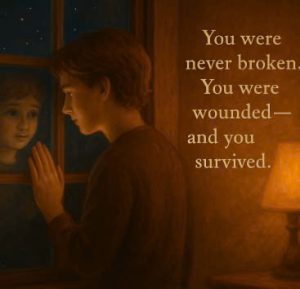
Dear one, you were never broken. You were wounded—but wounds can heal. Scars do not mean you’re damaged. They mean you survived.
You’re not alone anymore.
With warmth like a cup of cocoa in winter, Grandpa Eli 🧡
Keyword focus: self-blame childhood trauma, forgiving yourself for the past
What They Did Wasn’t Your Fault—And It Never Was
Some wounds don’t scream. They whisper.
They whisper that maybe it was you. That you should have been quieter. Smarter. Better behaved. More lovable. They whisper until the echo becomes a belief: It happened because of me.
Let me say this with all the clarity an old soul can muster:
What they did to you was not your fault. And it never was.
The Lie Children Tell Themselves
When something terrible happens to a child, the world becomes unsafe—and children, eager to make sense of chaos, often come to the same heartbreaking conclusion: “It must be me.”
Why? Because it’s safer to believe you were the problem than to believe the people who were supposed to love you didn’t.
This belief becomes a scar deep in the psyche. And long after the bruises fade, the shame remains. It leaks into relationships, career choices, the way we talk to ourselves in the quiet moments.
Guilt and Shame: The Silent Twins
Guilt says, “I did something bad.” Shame says, “I am something bad.”
Many survivors of childhood trauma carry both.
They feel guilty for being “difficult children.” They feel shame for needing, for crying, for surviving. For being the ones who walked away but never quite felt free.
But here’s the truth: children cannot cause abuse. They cannot provoke neglect. They cannot deserve abandonment.
They can only react to what they are given. And no matter how they reacted, it was not a justification for mistreatment.
The Power of Rewriting the Story
You don’t get to rewrite the past, but you do get to rewrite what you believe about it.
You get to say:
“I was a child.”
“I didn’t cause this.”
“They were wrong.”
“I still matter.”
And yes, sometimes that truth is met with resistance. The part of you that still clings to self-blame might push back. That’s okay. You’re unlearning something you were taught in survival mode.
Forgiving the Child You Were
This isn’t about forgiving abusers. This is about forgiving yourself.
Forgive yourself for:
The ways you coped.
The things you didn’t understand.
The silence you kept.
The times you lashed out or shut down.
You did the best you could. And that child you were? They were brave in ways no one ever recognized.
You survived.
Healing Starts With the Truth
And the truth is this: you were innocent. You were worthy of love. And you still are.
The moment you stop blaming yourself is the moment you take your power back.
So today, when that old voice starts whispering again—tell it gently but firmly: