When the Past Becomes a Prison

When the Past Becomes a Prison
—from Grandpa Eli

There is a quiet prison many people live in.

It has no bars, no guards, no chains—yet it holds millions hostage. Its walls are built not from stone, but from memory. Its gates are sealed by a single emotion: blame.

Blame is seductive. It gives structure to suffering. It points a finger at those who failed us and offers the illusion of justice: “This is why I am the way I am.” And often, it is not a lie. Many of us were indeed shaped by the absence of love, the cruelty of words, or the violence of silence. 

But blame, like a fire left unattended, will consume everything in its path—including the future.

For a while, it feels empowering. It gives language to what once had none. It provides clarity in a world that felt unbearably confusing. But slowly, it turns inward. It becomes more than a story of what happened—it becomes a barrier between who we are and who we might become.

The longer we hold onto blame, the more it holds onto us.

We start to live not forward, but backward—tethered to moments that no longer exist, apologies that will never be spoken. The mind replays these scenes as if resolution might rise from repetition.

But the truth is painful in its simplicity: healing begins only when we stop demanding that the past fix itself.

We cannot row toward tomorrow while staring at the dock of yesterday. We cannot build new love on foundations cracked by old resentments. We cannot live freely while carrying the chains of unmet justice.

This is not a call to forget. It is a call to choose.

To choose presence over pain. Responsibility over retribution. Peace over permission.

Letting go of blame is not surrendering the truth of what happened. It is choosing to stop feeding it your joy.

It is an act of radical self-respect.
It is the moment you decide: “I deserve to be free, even if they never say sorry.”

The world will not hand you closure. But you can create peace.

By shifting the story.
By loosening your grip on what cannot change.
By claiming what always belonged to you—your power to write the next chapter.

Because the past may influence who we are.
But only we can decide who we become.
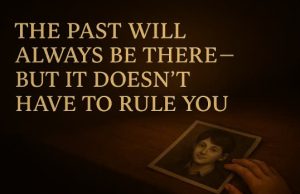
The Past Will Always Be There But It Doesn’t Have to Rule You

Keyword focus: overcoming childhood trauma, does trauma define you

. No matter how far we run, no matter how much we grow, the past finds ways to whisper.
No matter how far we run, no matter how much we grow, the past finds ways to whisper.

The Past Will Always Be There—But It Doesn’t Have to Rule You

There are some stories in life that never fade. Some memories that live just under the skin. No matter how far we run, no matter how much we grow, the past finds ways to whisper.

But here’s what I want to tell you, my dear: it doesn’t have to rule you.

The Shadow That Lingers

You may have worked hard to build a life—maybe a family, a job, a home. On the outside, it might even look like you’ve moved on. But inside, a part of you still flinches. You still second-guess yourself. You still carry echoes of old fear.

Because trauma doesn’t obey time. And the past doesn’t stay in the past just because the calendar changed.

The truth is: your past shaped you. But it does not get to write the ending.

The Wounds That Speak in Silence

For many survivors of a difficult childhood, the past doesn’t scream. It whispers:

  • “You’re not good enough.”
  • “You’re too much.”
  • “You always mess it up.”

These aren’t your true voice—they’re the internalized voices of those who hurt you. But when they go unchallenged, they become the story you believe.

The Turning Point: When You Decide to Reclaim Power

There comes a moment—sometimes quietly, sometimes in crisis—when you realize: I don’t want to be ruled by this anymore.

That moment is everything. It doesn’t mean the pain is gone. It means you’ve chosen to stop letting it lead the way.

From here, healing can truly begin.

You Can Hold the Past Without Letting It Steer the Present

You can remember without reliving. You can honor your younger self without letting fear control your decisions. You can carry your story—and still choose peace.

The key is recognizing that your past is part of you, but not all of you.

How to Stop Letting the Past Rule

  • Name the triggers. What people, words, or situations bring old pain back to life?
  • Befriend your inner child. Talk to them. Reassure them. They’re still listening.
  • Choose new responses. What once was instinct for survival can now be replaced with conscious choice.
  • Surround yourself with safe people. Healing doesn’t happen in isolation.

Each choice is a vote for the life you want, not the one you were handed.

You Are the Author Now

Your past was written without your consent. But your future? That’s in your hands.

And with every small act of love, truth, and courage—you are editing the story.

You are not your wounds. You are the one who lived through them.