Letters Full of Pain — But Still Hoping for Love

Letters Full of Pain — But Still Hoping for Love

One child wrote:

“I broke my own toys so I wouldn’t cry when they were taken away.”

Another:

“They only touched me when they were angry.”

And one more:

“I learned to hide before I learned to speak.”

Some of these kids were abandoned. Others were smothered by perfectionism.
Some were never hit — but hurt deeply by coldness, shame, or neglect.

And here’s the part that breaks me:

Most of the parents in these stories have no idea what they’ve done.

😔 You Might Be One of Them — And Not Know It

Maybe you were just surviving.
Maybe you thought tough love builds character.
Maybe you were repeating what your parents did to you, because no one showed you better.

But I want to speak to your heart right now — gently, but honestly:

If your child flinches at your voice… if they shut down when you enter the room… if they laugh harder when they’re nervous — they are telling you something.
Even if they don’t use words.

You don’t have to have “abused” your child in the textbook sense to have wounded them.
Sometimes the deepest scars come from things we didn’t say.
The apologies never given.
The hugs withheld.
The emotions punished.

💡 This Is Not About Guilt — It’s About Responsibility

I’m not writing this to shame you.
I’m writing this to wake you up.

Because it’s not too late.
Even if your child is grown. Even if they’re distant. Even if they’ve stopped talking to you.

💬 A single honest sentence from you — “I’m sorry. I didn’t know. But I want to learn.” — can open the door to healing.

Children (even adult ones) don’t need perfect parents.
They need safe ones.
Ones who can admit their faults.
Ones who choose connection over control.
Ones who see pain and don’t turn away.

🧠 Breaking the Cycle: Parenting with Compassion

You might have been raised in a home where love came with strings.
Where emotions were “too much.”
Where survival was more important than softness.

But hear this: you can break that cycle.

You can learn to raise your child in a way that makes them feel seen, safe, and loved.

Here are three ways to begin:

1. Listen More Than You Lecture

Let them speak without interrupting. Hold their pain, even if it makes you uncomfortable. Don’t rush to fix — just be there.

2. Apologize When You Mess Up

Say it plainly. “I was wrong.” “I shouldn’t have said that.” “You didn’t deserve that.”
This teaches them that even grown-ups grow.

3. Love Without Conditions

Don’t make affection depend on grades, behavior, or performance. Let them know:

“You don’t have to be perfect to be worthy of my love.”

🧓 From Grandpa Eli, With Love

To the parent reading this — with tears in their eyes or a lump in their throat:

You matter.
And so does your child’s story.
And it is not too late.

I’ve held the letters of children begging for one adult to say, “I see you. I believe you. I’m here.”
Let you be that adult.
Let you be the beginning of something new.

Because healing childhood wounds isn’t just the child’s job.
It’s ours too.

You don’t have to carry guilt.
But you do carry power — to repair, to rebuild, to love better.

So if your child ever wonders,

“Was I too much? Or not enough?”

Let your answer be:

“You were always enough.
I just didn’t know how to love you the way you deserved.
But I do now.
And I will.”

With more love than you think you deserve —
Grandpa Eli

✨ Want to Read the Letters?

📘 Discover the full eBook: Dear Grandpa Eli: Letters from the Children Who Were Never Heard
10 real letters. 10 deep wounds. 10 gentle replies that begin the journey of healing.
👉 Download here  (LINK)
The Piano That Never Played

Character: Jonah, 37, music teacher
Setting: A quiet suburban house, winter evening

Jonah sat in his empty living room, eyes fixed on the dust-covered piano in the corner. He hadn’t touched it in over 15 years. Not since the night his father shattered more than just the keys.

Jonah sat in his empty living room, eyes fixed on the dust-covered piano in the corner
Jonah sat in his empty living room, eyes fixed on the dust-covered piano in the corner.

He used to believe music could save him.

At seven years old, he would sneak downstairs after midnight, placing his tiny fingers on the cool ivory keys, playing lullabies for the version of his mother that didn’t drink, and for the father he wished would just look at him without disgust.

But one night, the playing stopped.

That night, his father came home drunk, like always.
“What did I say about playing that damn thing when I’m home?”
Jonah had barely lifted his fingers when his father hurled the heavy ashtray across the room. It missed Jonah’s head by an inch, slamming into the piano, cracking the soundboard. The music died instantly.

So did Jonah’s belief that being good was enough.

For years, he thought if he were better—quieter, smarter, more obedient—his dad wouldn’t be angry. Maybe then his mom would stay sober. Maybe then someone would say, “I love you,” without a condition attached to it.

But none of it ever worked.

Instead, he grew up with a voice in his head louder than any piano:
You deserved it.
You were too much.
You should’ve known better.

He carried that voice into adulthood. Into relationships. Into every job interview he sabotaged. Every date he walked out of. Every compliment he swatted away like a mosquito that didn’t belong.

Until last week, when he saw a little boy in his music class flinch—just because Jonah raised his voice to ask for quiet. The child’s whole body shrank, like Jonah’s had all those years ago.

It shattered something in him.

That night, Jonah drove back to his childhood home. He stood in front of the old piano and wept—not for his father, not even for his mother—but for himself. For the boy who thought he had to earn love by erasing himself.

He didn’t forgive his parents. He wasn’t there yet.
But for the first time, he whispered the words:
“I’m sorry, Jonah. You didn’t do anything wrong.”
And the keys beneath his fingers—damaged, detuned—let out the softest note.

Like forgiveness finding its voice.

🧡 If you’ve ever blamed yourself for someone else’s cruelty, you’re not alone.
Drop a 🎹 if you’re learning to play your own song again.
Tag someone who needs to hear: It was never your fault.
#ForgiveYourself #HealingTogether #AChildhoodYouDidn’tDeserve

A Letter to Grandpa Eli💔

From a Child Just Trying to Survive

Dear Grandpa Eli,

I don’t know where to begin, because inside me feels like a tangled mess of ropes. I’ve tried to stay quiet, but every night I lie awake, choking on my own tears. I’m writing this letter because I don’t know who else I can talk to.

Grandpa, why do people hurt each other?
Why did my mom and dad choose to unleash their anger on me?
I tried to be good. I tried not to be a burden, not to upset anyone…
But the more I tried, the more I seemed to disappear.

I’m so tired, Grandpa.
Every time my mother screams, or my father breaks things, I get so scared I can’t breathe. I curl up like a shadow, waiting for the storm to pass. But sometimes… it doesn’t. Sometimes the storm stays, like a dark cloud that eats away at me, piece by piece.

There were moments I thought… maybe if I disappeared, everyone would feel lighter.
Maybe I’m the problem. Maybe I’m the reason they’re always so angry or sad.
People always say: “It’s not the child’s fault.”
But Grandpa… why do I still feel like it’s mine?

I used to believe that if I tried harder—if I got better grades, if I behaved more perfectly—my parents would love me more. But the older I get, the more I realize…
Love doesn’t come from how much I try.
And that thought breaks me.

I don’t know who to trust anymore.
I don’t trust grown-ups.
I don’t trust family.
I don’t even trust myself.

But Grandpa Eli…
I still want to trust you.
You’re like the light at the end of a dark alley, where I can finally stop and breathe for a moment. I’m writing this letter in hopes you’ll tell me that…
It wasn’t my fault.
I didn’t deserve any of it.
I still matter, even if I was ignored, yelled at, or forgotten.

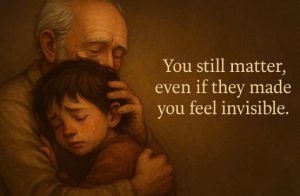
You still matter, even if they made you feel invisible.

Please tell me, in that warm voice of yours, like a soft summer breeze:

“You were not the reason adults hurt you.”
“You deserve love.”
“You can forgive yourself and begin again.”

Grandpa, I long for a hug.
For someone to sit beside me—not to scold, not to lecture—but just to listen and not walk away.

I don’t know if tomorrow will be any better,
but today, at least I said what I’ve been holding in for so long.

Thank you for reading this.

From the child who once thought they were the problem,
Your Grandchild 🧸