The Piano That Never Played: How Childhood Trauma Silenced a Gift—And What It Took to Hear Music Again

Introduction:

There are moments in life when silence is louder than any sound.
For Jonah, a gifted music teacher, that moment happened when he was seven years old.
It wasn’t just the piano that broke that night—it was something inside him.
This is not just his story. It’s the story of anyone who has buried their gifts, blamed themselves for being hurt, and forgotten what it feels like to take up space without apology.

The Innocence of Music—and the Beginning of Silence

Jonah first discovered the piano like most children discover wonder: accidentally.

His mother worked nights. His father drank. And the only consistent presence in his home was a secondhand upright piano that stood quietly in the living room.

At night, when the world was asleep, Jonah would tiptoe downstairs, place his small fingers on the cool keys, and play.
He didn’t know the names of the notes.
He didn’t read music.
But somehow, the melodies came.

In those moments, he wasn’t afraid.
He wasn’t invisible.
He was alive.

Until the night the music stopped.

The Night That Changed Everything

It was winter. Jonah had just learned to play a simple lullaby by ear. He was proud. Proud in the way only a child can be when they’ve done something magical and want to be seen.

He was playing softly—just enough for the notes to dance in the dark—when his father stormed in, drunk.

“What did I tell you about making noise?”
“Stupid little show-off.”

And then came the sound Jonah would never forget:
A heavy ashtray flying across the room, slamming into the side of the piano with a thud that echoed like thunder.
The soundboard cracked.
The music stopped.
So did Jonah.

That night, the piano became a tomb. And Jonah buried a piece of himself inside it.

What Happens When a Child Blames Themselves

The most damaging thing about abuse isn’t always the action itself.
It’s the meaning the child assigns to it.
Jonah didn’t think, “My father has a problem.”
He thought, “I was too loud.”
“I was too much.”
“I ruined it.”

So he became small.
He stopped talking in class.
He never raised his hand.
When people praised him, he panicked.
Because somewhere deep inside, he believed that being noticed meant being punished.

This is how trauma rewrites your story—without your permission.

Growing Up With the Wrong Story

As Jonah grew older, he carried his talents like contraband.

He still played piano, but never in public.
He studied music theory but lied when asked if he could perform.
He graduated with honors—but sat in the back row during the ceremony.
His motto became: Don’t be seen, and you can’t be hurt.

Ironically, he became a music teacher.
But he only taught children.
Why?
Because kids didn’t expect perfection.
They didn’t judge.
And he knew how to make children feel safe—because he never had that himself.

The Day the Past Came Rushing Back

It wasn’t therapy.
It wasn’t a book.
It wasn’t some magical epiphany.

It was a moment.

One of his students—a six-year-old named Oliver—flinched when Jonah raised his voice to get the class’s attention.
A tiny, involuntary motion.
But Jonah saw it.
He knew that flinch.
He remembered that flinch.

He went home that night and stood in front of his childhood piano—now sitting dusty in his living room, untouched for years.
The crack was still there.
So was the silence.
But something inside Jonah stirred.

He sat down.
Placed his hands on the keys.
And for the first time in decades—he played.

It wasn’t perfect.
Some notes were flat.
The keys stuck.
But as the music filled the room, so did something else: grief.

And then, tears.

Why Self-Forgiveness Is the First Note of Healing

That night, Jonah didn’t forgive his father.
He wasn’t ready.
But he did forgive himself.

He said, out loud:

“I’m sorry, Jonah.
You were just a child.
You did nothing wrong.
You only wanted to be heard.”

That’s where healing begins.

Not with perfect closure.
Not with confrontation.
But with self-forgiveness.

When you finally stop asking, “What did I do wrong?” and start saying, “It wasn’t my fault.”

How Childhood Trauma Silences Our Gifts

So many of us bury our talents because of pain.
We were too loud. Too expressive. Too emotional.
And someone made us believe we had to shrink to be safe.

So we hide.

We stop singing.
We put away the paintbrush.
We delete our writing.
We silence the part of us that made us feel most alive.

But that part?
It never leaves.
It waits.

And it returns when we’re ready to come home to ourselves.

What Jonah’s Story Teaches Us

Jonah’s story isn’t just about music.
It’s about reclaiming what was stolen.
It’s about letting go of the lies planted in childhood.
It’s about learning that we were never too much.
We were simply too beautiful for a world that wasn’t ready to receive us.

If you have a “piano” inside you—a gift, a joy, a voice—you’ve locked away because of fear or pain…

Maybe today is the day you sit down and play again.

Even if your hands tremble.
Even if you cry.
Even if no one else hears.

Conclusion: From Silence to Song

You were never the problem.
You were never too loud.
You were never too bright.
You were never too much.

You were a child trying to survive.

And now?
Now you get to live.
Not for anyone else.
Not for approval.
But for yourself.

Pick up your instrument.
Paint your canvas.
Speak your truth.
Dance like no one’s watching—but know that you matter even if they are.

Because the silence ends now.

💬 Let’s Talk

Have you ever buried a part of yourself to stay safe?
Did you have to unlearn shame in order to reclaim your gifts?
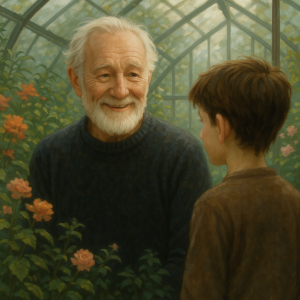
A Letter With No Stamp

Lucas had stopped flinching.

He still didn’t laugh much. But he had begun to hum—softly—when planting carrots, and once, Peter caught him tracing his finger along the petals of a peony like it was a secret worth keeping.

Then one rainy evening, Lucas said it.

“I think I want to see my father.”

Peter didn’t answer right away. He looked at the muddy windows of the greenhouse, where drops slid down like tiny rivers breaking loose. “Why?” he finally asked.

“I want him to know… he didn’t win.”

They worked on the letter together. Lucas’s hands shook at first. He kept crossing things out. Then he stopped. He wrote:

I’m not writing this so you’ll say sorry.

I’m writing this so I can stop carrying what you should have never put on me.

I’m not afraid of you anymore.

They didn’t mail it. That wasn’t the point.

Later that week, Peter took Lucas on a walk through the forest trail behind the greenhouse. They stopped at an old bench—weathered, quiet, and covered in moss.

That’s where Grandpa Eli waited.

He wore his usual navy sweater, hands clasped gently on his lap, eyes twinkling with the kind of kindness that made people speak without fear.

Lucas sat down, wordless.

“You don’t need to tell me what happened,” Eli said. “You’ve lived it already. But if you want to, I’ll listen.”

And Lucas did.

I’m writing this so I can stop carrying what you should have never put on me.


For the first time, he spoke every word—the names, the bruises, the nights he pretended sleep so his father would stop yelling. He didn’t cry. He didn’t tremble.

When he finished, Grandpa Eli nodded.

“You’ve done the hardest part,” he said. “You remembered… and you stayed.”

That night, Lucas tore the letter in half. Then he burned it in the firepit.

Peter didn’t stop him.

Because sometimes, forgiveness isn’t about letting someone off the hook.

It’s about unhooking yourself.


The Boy and the Birdcage

Peter was now seventeen. The greenhouse behind Elianna’s cottage had grown lush with color. Children from the village came after school, helping him water the plants, paint the pots, name the ferns. They called it Peter’s Garden of Second Chances.

But one afternoon, a new boy showed up. Thin as a willow switch. Eyes too old for his age. His name was Lucas.

He didn’t touch the plants. Didn’t smile. He sat on the edge of the greenhouse floor, arms locked tightly around his knees. Watching. Waiting.

Peter offered him a cactus—“You don’t have to water it every day,” he said with a wink. Lucas didn’t laugh.

That night, Peter found Lucas outside the gate, staring at the greenhouse from the dark.

“Do you want to come in?” Peter asked.

Lucas shook his head. “I’d break something.”

“Who told you that?”

Lucas didn’t answer. But Peter already knew.

Over the next few weeks, Lucas returned. Silent. Tense. He flinched whenever a door creaked or someone raised their voice in laughter. He never took off his sweater, even when the sun burned high.

Peter recognized the signs. He saw himself in Lucas—the hidden bruises, the shame worn like armor.

One afternoon, Peter found Lucas staring at a broken birdcage near the compost bin.

“That used to hang in the front,” Peter said. “A bird lived in it until it flew away. We left the cage open—just in case it ever wanted to come back.”

Lucas looked up, confused. “Why wouldn’t you keep it closed? So it won’t leave?”

Peter knelt beside him. “Because love isn’t a cage. It’s a door you leave open.”

Lucas said nothing. But a tear slipped down one cheek.

That night, Lucas stayed late. He planted a marigold. It was crooked and messy, but Peter left it that way.

“You know,” Peter said softly, “it’s not your fault. Whatever happened to you… it’s not because you weren’t good enough.”

Lucas didn’t answer. But the next day, he rolled up his sleeves.

There were scars. But he wasn’t hiding anymore.

Over the following months, Lucas became Peter’s shadow—not the haunted kind, but the kind that grows from walking beside someone who finally sees you.

And for the first time in a long time, Peter felt something shift in his chest. Not grief. Not guilt.

Hope.

Peter – The Boy With No Shadow

Peter was ten when he realized he didn’t cast a shadow.

Not a real one, at least. His feet touched the ground like any other child’s, but something inside him hovered—untethered, hidden. “You’re too sensitive,” his father barked when Peter cried. “Useless, like your mother,” he added, tossing a plate against the wall. The sound echoed louder than the plate itself.

At night, Peter wrapped himself in silence. He didn’t cry anymore. The tears had dried years ago, replaced by a quiet agreement with himself: Survive. Don’t be seen. Don’t upset them.

He often watched the neighbor’s garden through the fence. Mrs. Callahan’s boy, Henry, ran barefoot chasing butterflies, laughing so loud it scared the birds. Peter marveled—not at the butterflies, but at the audacity of joy.

One day, after a particularly harsh beating over a dropped dish, Peter packed a small backpack. Notebooks. His lucky marble. A photo he’d found under a floorboard of himself at age two, held in his mother’s arms—smiling. She didn’t smile anymore.

He walked away. Not toward any specific place, but away. The road was wide. So was the world.

Peter spent weeks drifting between towns, doing chores at farms for a bowl of stew or a warm barn. He never spoke much. When people asked about his family, he would say they were “gone,” and in a way, they were.

But life, as it often does, placed someone in his path.

Her name was Elianna, a retired schoolteacher with hair like silver thread and eyes like winter turning into spring. She found Peter sitting on the steps of the old town library.

“You look like a boy with something heavy in his bag,” she said.

Peter shrugged. “It’s just books.”

“No,” she smiled gently. “I meant the invisible kind.”

And for the first time in his young life, Peter talked. About the yelling. The silence. The fear. About how he once believed he was bad, rotten, the reason his father drank, the reason his mother hid behind curtains even in daylight.

Elianna didn’t flinch. “What happened to you wasn’t your fault,” she said, placing a hand over his trembling one. “You were a child. You deserved love, not bruises.”

That night, Peter wrote his father a letter. He didn’t know if he’d ever send it. But he wrote it not to hurt, not to accuse—but to say: You no longer control my breath, my steps, or my future.

Years later, Peter returned to his hometown—not to see his parents, who had long moved away—but to build a greenhouse on the old Callahan plot. He filled it with orange orchids and resilient succulents. “For children,” he said, “who forgot they could bloom.”

He still didn’t cast a shadow.

Because Peter had become his own light.


Tom Thought He Was Over It – Until the Silence Started Screaming

Tom always said he was fine.

He had a stable job. A wife who loved him. Two kids who climbed into his lap every evening.
His life looked “normal.”
He even laughed loud at dinner parties.

But no one saw the way his hands clenched every time someone raised their voice.
No one saw how he flinched—just slightly—when his son cried too hard.

No one knew about the dreams.
The ones where he was eight again. Standing in that hallway.
Hearing footsteps.
Holding his breath.
Waiting for the door to slam.

The Past Was Supposed to Be Gone

Tom was thirty-eight.
He had survived.

He told himself:

“What happened is over.”
“I’m not a child anymore.”
“I don’t need to talk about it.”

So he didn’t.
Not when his therapist gently asked.
Not when his wife noticed he pulled away during arguments.
Not even when his son asked,

“Dad… were you ever scared when you were little?”

Tom smiled.
Changed the subject.
Laughed it off.

But inside—
the silence screamed.

What You Hide, Doesn’t Heal. It Festers.

There was no one big moment that broke him.
It was the little things. The nothing moments. The quiet.

  • When his daughter spilled her milk and braced for yelling. 
  • When a friend said “You’re just like your dad,” and Tom’s stomach twisted. 
  • When he caught himself zoning out during a bedtime story, staring at the wall… lost in a memory he thought he had buried. 

That’s the thing about trauma.
You don’t bury it.
You carry it.
In your body. In your tone. In your silence.

And one day, Tom sat in his car outside his house, keys still in the ignition—
and whispered out loud for the first time:

“I’m not okay.”

The Breaking Wasn’t the End. It Was the Beginning.

That whisper changed everything.

He didn’t call it healing at first.
He just started talking to someone.
He wrote letters to the boy he used to be.

He stopped pretending.

He started telling the truth.

“You can’t heal what you hide.”
And maybe the bravest thing Tom ever did
wasn’t surviving what happened—
but choosing to face it.

He didn’t do it alone.
And you don’t have to either.

If you’ve been carrying something like Tom…

If there’s a memory you never talk about,
a silence that still aches,
a younger version of you still waiting to be held—

Please,
don’t wait another year.
Don’t wait until it explodes.
Don’t wait until it bleeds into your children, your marriage, your dreams.

The past shaped you.
But it doesn’t get to control your future.
Not anymore.

Healing is possible.
Not by pretending.
But by remembering—
with kindness.
With support.
With people who see you.

You’re not broken.
You’re hurting.
And hurt can heal—when it’s no longer hidden.

🕯️
This one’s for Tom.
And for every child still hiding inside an adult who’s trying to keep it all together.