How to Limit the Power of a Painful Past

The past is a place of reference, not residence.” – Grandpa Eli

If you’re reading this, chances are your childhood wasn’t easy.

Maybe you grew up in a home where love was conditional—or absent altogether.
>
Maybe you were criticized more than you were comforted.
>
Maybe you learned early on how to survive… but never how to feel safe.

And now, as an adult—perhaps even a parent—you’re starting to feel just how tightly the past still clings to your present.

You may…

  • Doubt your worth. 
  • Make choices out of fear rather than faith. 
  • Struggle to believe you’re truly lovable or capable. 

You’re not alone.
These are the invisible echoes of a wounded childhood.
But the good news is: they don’t have to control your future.

Let’s explore how.

1. See the past clearly—but don’t live in it.

You don’t need to deny it or sugarcoat it.
You can say:
“Yes, that happened. It hurt. It shaped me.”
But it doesn’t get to speak for your whole identity.
It’s a chapter, not the whole book.

And you don’t have to forget in order to move on.
You only have to stop letting it define what’s possible.

2. Look for the hidden strengths inside the wounds.

That pain taught you something—about survival, empathy, awareness.
There’s power buried in your past:

  • The ability to break the cycle. 
  • The courage to choose differently. 
  • The wisdom to raise your child in love, not fear. 

You don’t have to repeat the story you came from.
You get to create a new one.

3. Choose differently—daily.

The past says, “You’ll never be good enough.”
You say: “Watch me grow.”
The past says, “This is just who I am.”
You say: “Who I was isn’t who I have to be.”

Every small choice—pausing instead of yelling, hugging instead of judging, listening instead of controlling—is a line in the new chapter you’re writing.

Even if it feels awkward. Even if it feels slow.
Healing happens in the repetition.

So, What Now?

The past will always be a part of you.
It’s etched in memory, in scars, in reflexes.
But it doesn’t have to be the author of your future.

🧓 Grandpa Eli’s message is simple:
You can pick up the pen.
>
You can write a new chapter—brighter, stronger, more free.

You are not your wounds.
>
You are what rises from them.
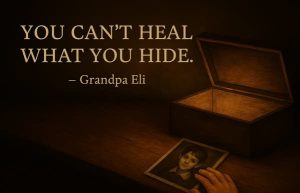
You Can’t Heal What You Hide: Why Facing Your Troubled Childhood Matters

By Grandpa Eli

You were just a child.
And you didn’t get the love you needed.
Maybe there was shouting. Silence. A parent who hurt you—or wasn’t there at all.
Now, as an adult, part of you wants to forget it all.

That’s understandable.
But, my dear, that’s not healing. That’s hiding.

 Why Facing Your Troubled Childhood Matters
Why Facing Your Troubled Childhood Matters

1. 🧠 The mind never really forgets.

You may think you’ve moved on.
You may have a job, a family, and a life that looks “normal” from the outside.
But deep inside, your inner child is still there—waiting, hoping someone will finally listen.

The memories might be locked in a box,
but the feelings?
They leak out in unexpected ways:

  • You panic when someone raises their voice.
  • You over-apologize, even when it’s not your fault.
  • You feel empty, even on “happy” days.
    That’s not weakness. That’s woundedness.

2. ⚠️Unhealed pain becomes silent sabotage

Research shows that adults with traumatic childhoods are:

  • More likely to suffer from anxiety, depression, and addiction.
  • More prone to self-doubt, shame, and trust issues.
  • More likely to repeat the cycle—with their own children.

You’re not broken.
You’re burdened.

And you don’t have to carry that burden alone.

3. 🧩 Pretending it didn’t happen keeps you incomplete.

You can’t erase your past—but you can rewrite your relationship with it.

Your childhood matters.
It shaped your beliefs about love, safety, and self-worth.
Trying to “move on” without understanding it is like trying to rebuild a house without checking the cracked foundation.

You deserve more than survival.
You deserve wholeness.

4. 🌱 Healing is not forgetting—it’s becoming.

When you finally turn to face the past—not with fear, but with compassion—you take back your power.

You begin to see:

  • It wasn’t your fault.
  • You did the best you could to survive.
  • The love you didn’t get then—you can give yourself now.

That’s not weakness.
That’s healing.

🕯️ A gentle invitation

If you’ve been locking the past in a box, maybe it’s time to open it—just a little.

Not to suffer again…
But to remember who you were.
To comfort that child inside.
To tell them:

“You mattered then. You matter now. And I will take care of you.”

You can’t heal what you pretend never hurt.
But you can heal.
You can grow.
You can begin again.