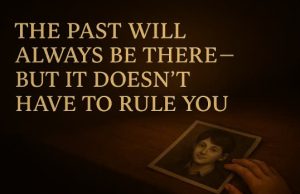
The Past Will Always Be There But It Doesn’t Have to Rule You

Keyword focus: overcoming childhood trauma, does trauma define you
. No matter how far we run, no matter how much we grow, the past finds ways to whisper.
No matter how far we run, no matter how much we grow, the past finds ways to whisper.

The Past Will Always Be There—But It Doesn’t Have to Rule You

There are some stories in life that never fade. Some memories that live just under the skin. No matter how far we run, no matter how much we grow, the past finds ways to whisper.

But here’s what I want to tell you, my dear: it doesn’t have to rule you.

The Shadow That Lingers

You may have worked hard to build a life—maybe a family, a job, a home. On the outside, it might even look like you’ve moved on. But inside, a part of you still flinches. You still second-guess yourself. You still carry echoes of old fear.

Because trauma doesn’t obey time. And the past doesn’t stay in the past just because the calendar changed.

The truth is: your past shaped you. But it does not get to write the ending.

The Wounds That Speak in Silence

For many survivors of a difficult childhood, the past doesn’t scream. It whispers:

  • “You’re not good enough.”
  • “You’re too much.”
  • “You always mess it up.”

These aren’t your true voice—they’re the internalized voices of those who hurt you. But when they go unchallenged, they become the story you believe.

The Turning Point: When You Decide to Reclaim Power

There comes a moment—sometimes quietly, sometimes in crisis—when you realize: I don’t want to be ruled by this anymore.

That moment is everything. It doesn’t mean the pain is gone. It means you’ve chosen to stop letting it lead the way.

From here, healing can truly begin.

You Can Hold the Past Without Letting It Steer the Present

You can remember without reliving. You can honor your younger self without letting fear control your decisions. You can carry your story—and still choose peace.

The key is recognizing that your past is part of you, but not all of you.

How to Stop Letting the Past Rule

  • Name the triggers. What people, words, or situations bring old pain back to life?
  • Befriend your inner child. Talk to them. Reassure them. They’re still listening.
  • Choose new responses. What once was instinct for survival can now be replaced with conscious choice.
  • Surround yourself with safe people. Healing doesn’t happen in isolation.

Each choice is a vote for the life you want, not the one you were handed.

You Are the Author Now

Your past was written without your consent. But your future? That’s in your hands.

And with every small act of love, truth, and courage—you are editing the story.

You are not your wounds. You are the one who lived through them.
You Were Never Meant to Carry This Alone

Keyword focus: healing from childhood trauma, inner child healing

You Were Never Meant to Carry This Alone

There are certain wounds that don’t bleed, but they live inside us. They sit silently in the back of our minds, shaping the way we see ourselves and the world around us. And often, they begin when we are too small to understand, too vulnerable to fight back, too young to even know it’s not normal. This is what it means to carry the burden of childhood trauma.

If no one told you this before, let me tell you now: you were never meant to carry this alone.

There are certain wounds that don’t bleed, but they live inside us.

A Backpack of Stones

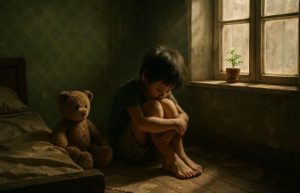
Imagine a small child with a backpack. And every time someone yelled, ignored, insulted, shamed, or abandoned them, a stone was placed in that pack. At first it was just a few. Then more. Then even more. Until one day, the child could barely stand. But they kep

But it was. And it still is.

Because trauma that isn’t healed, doesn’t go away. It grows roots in our nervous system. It whispers in our relationships. It controls how we love, trust, speak, and even how we see ourselves in the mirror.

The Myth of Self-Reliance

Many people who grew up in pain learned to be strong too soon. They became their own protectors. They learned how to read a room in seconds. How to shrink, how to disappear, how to keep the peace.

But strength forged in fear is not peace. And independence built on survival is not freedom.

You may think you’re supposed to figure it out on your own. That you have no right to complain. That it’s too late to change anything now.

But none of that is true.

Healing Begins When We Speak the Unspoken

One of the most powerful steps in healing from childhood trauma is breaking the silence. Speaking the truth of what happened to you. Even if it’s just whispered into a journal. Even if your voice shakes. Even if you’re afraid it makes you weak.

It doesn’t make you weak. It makes you human.

Because the pain that is hidden cannot be healed. The shame that is buried will continue to rot. But the moment you let light in, even a little, the healing begins.

You may need to grieve. You may feel angry. You may feel sad about the childhood you deserved but never got. All of that is valid.

You Were Not Meant to Heal Alone

It’s a beautiful, radical thing to let someone in.

Whether it’s a therapist, a friend, a support group, or even words in a book that understand your pain—you begin to remember that you were never supposed to walk through this in isolation.

Healing is not a solo journey. It is a communal act of remembering, of witnessing, of holding one another when the weight becomes too much.

Your inner child still lives within you. And they don’t need you to be perfect. They just need you to show up, hold their hand, and promise, “We are not alone anymore.”

A Future Not Defined by the Past

You are not broken. You are someone who learned how to survive. You built walls to protect yourself. You carried weight that was never yours. And you made it here.

But survival is not the same as living.

Now, you are allowed to put the backpack down. Slowly. Gently. You are allowed to say, “I deserve softness.” You are allowed to feel joy without guilt. Love without fear. Rest without shame.

You were never meant to carry this alone. And now, you don’t have to.

Let this be the first step. Or the fiftieth. Let this be your reminder: healing from childhood trauma is possible. And your inner child is still waiting for you—not to rescue them, but to sit beside them and say, “We made it. And we’re safe now.”

Peter – The Boy With No Shadow

Peter was ten when he realized he didn’t cast a shadow.

Not a real one, at least. His feet touched the ground like any other child’s, but something inside him hovered—untethered, hidden. “You’re too sensitive,” his father barked when Peter cried. “Useless, like your mother,” he added, tossing a plate against the wall. The sound echoed louder than the plate itself.

At night, Peter wrapped himself in silence. He didn’t cry anymore. The tears had dried years ago, replaced by a quiet agreement with himself: Survive. Don’t be seen. Don’t upset them.

He often watched the neighbor’s garden through the fence. Mrs. Callahan’s boy, Henry, ran barefoot chasing butterflies, laughing so loud it scared the birds. Peter marveled—not at the butterflies, but at the audacity of joy.

One day, after a particularly harsh beating over a dropped dish, Peter packed a small backpack. Notebooks. His lucky marble. A photo he’d found under a floorboard of himself at age two, held in his mother’s arms—smiling. She didn’t smile anymore.

He walked away. Not toward any specific place, but away. The road was wide. So was the world.

Peter spent weeks drifting between towns, doing chores at farms for a bowl of stew or a warm barn. He never spoke much. When people asked about his family, he would say they were “gone,” and in a way, they were.

But life, as it often does, placed someone in his path.

Her name was Elianna, a retired schoolteacher with hair like silver thread and eyes like winter turning into spring. She found Peter sitting on the steps of the old town library.

“You look like a boy with something heavy in his bag,” she said.

Peter shrugged. “It’s just books.”

“No,” she smiled gently. “I meant the invisible kind.”

And for the first time in his young life, Peter talked. About the yelling. The silence. The fear. About how he once believed he was bad, rotten, the reason his father drank, the reason his mother hid behind curtains even in daylight.

Elianna didn’t flinch. “What happened to you wasn’t your fault,” she said, placing a hand over his trembling one. “You were a child. You deserved love, not bruises.”

That night, Peter wrote his father a letter. He didn’t know if he’d ever send it. But he wrote it not to hurt, not to accuse—but to say: You no longer control my breath, my steps, or my future.

Years later, Peter returned to his hometown—not to see his parents, who had long moved away—but to build a greenhouse on the old Callahan plot. He filled it with orange orchids and resilient succulents. “For children,” he said, “who forgot they could bloom.”

He still didn’t cast a shadow.

Because Peter had become his own light.


Tom Thought He Was Over It – Until the Silence Started Screaming

Tom always said he was fine.

He had a stable job. A wife who loved him. Two kids who climbed into his lap every evening.
His life looked “normal.”
He even laughed loud at dinner parties.

But no one saw the way his hands clenched every time someone raised their voice.
No one saw how he flinched—just slightly—when his son cried too hard.

No one knew about the dreams.
The ones where he was eight again. Standing in that hallway.
Hearing footsteps.
Holding his breath.
Waiting for the door to slam.

The Past Was Supposed to Be Gone

Tom was thirty-eight.
He had survived.

He told himself:

“What happened is over.”
“I’m not a child anymore.”
“I don’t need to talk about it.”

So he didn’t.
Not when his therapist gently asked.
Not when his wife noticed he pulled away during arguments.
Not even when his son asked,

“Dad… were you ever scared when you were little?”

Tom smiled.
Changed the subject.
Laughed it off.

But inside—
the silence screamed.

What You Hide, Doesn’t Heal. It Festers.

There was no one big moment that broke him.
It was the little things. The nothing moments. The quiet.

  • When his daughter spilled her milk and braced for yelling. 
  • When a friend said “You’re just like your dad,” and Tom’s stomach twisted. 
  • When he caught himself zoning out during a bedtime story, staring at the wall… lost in a memory he thought he had buried. 

That’s the thing about trauma.
You don’t bury it.
You carry it.
In your body. In your tone. In your silence.

And one day, Tom sat in his car outside his house, keys still in the ignition—
and whispered out loud for the first time:

“I’m not okay.”

The Breaking Wasn’t the End. It Was the Beginning.

That whisper changed everything.

He didn’t call it healing at first.
He just started talking to someone.
He wrote letters to the boy he used to be.

He stopped pretending.

He started telling the truth.

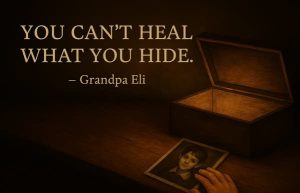
“You can’t heal what you hide.”
And maybe the bravest thing Tom ever did
wasn’t surviving what happened—
but choosing to face it.

He didn’t do it alone.
And you don’t have to either.

If you’ve been carrying something like Tom…

If there’s a memory you never talk about,
a silence that still aches,
a younger version of you still waiting to be held—

Please,
don’t wait another year.
Don’t wait until it explodes.
Don’t wait until it bleeds into your children, your marriage, your dreams.

The past shaped you.
But it doesn’t get to control your future.
Not anymore.

Healing is possible.
Not by pretending.
But by remembering—
with kindness.
With support.
With people who see you.

You’re not broken.
You’re hurting.
And hurt can heal—when it’s no longer hidden.

🕯️
This one’s for Tom.
And for every child still hiding inside an adult who’s trying to keep it all together.

You Can’t Heal What You Hide: Why Facing Your Troubled Childhood Matters

By Grandpa Eli

You were just a child.
And you didn’t get the love you needed.
Maybe there was shouting. Silence. A parent who hurt you—or wasn’t there at all.
Now, as an adult, part of you wants to forget it all.

That’s understandable.
But, my dear, that’s not healing. That’s hiding.

 Why Facing Your Troubled Childhood Matters
Why Facing Your Troubled Childhood Matters

1. 🧠 The mind never really forgets.

You may think you’ve moved on.
You may have a job, a family, and a life that looks “normal” from the outside.
But deep inside, your inner child is still there—waiting, hoping someone will finally listen.

The memories might be locked in a box,
but the feelings?
They leak out in unexpected ways:

  • You panic when someone raises their voice.
  • You over-apologize, even when it’s not your fault.
  • You feel empty, even on “happy” days.
    That’s not weakness. That’s woundedness.

2. ⚠️Unhealed pain becomes silent sabotage

Research shows that adults with traumatic childhoods are:

  • More likely to suffer from anxiety, depression, and addiction.
  • More prone to self-doubt, shame, and trust issues.
  • More likely to repeat the cycle—with their own children.

You’re not broken.
You’re burdened.

And you don’t have to carry that burden alone.

3. 🧩 Pretending it didn’t happen keeps you incomplete.

You can’t erase your past—but you can rewrite your relationship with it.

Your childhood matters.
It shaped your beliefs about love, safety, and self-worth.
Trying to “move on” without understanding it is like trying to rebuild a house without checking the cracked foundation.

You deserve more than survival.
You deserve wholeness.

4. 🌱 Healing is not forgetting—it’s becoming.

When you finally turn to face the past—not with fear, but with compassion—you take back your power.

You begin to see:

  • It wasn’t your fault.
  • You did the best you could to survive.
  • The love you didn’t get then—you can give yourself now.

That’s not weakness.
That’s healing.

🕯️ A gentle invitation

If you’ve been locking the past in a box, maybe it’s time to open it—just a little.

Not to suffer again…
But to remember who you were.
To comfort that child inside.
To tell them:

“You mattered then. You matter now. And I will take care of you.”

You can’t heal what you pretend never hurt.
But you can heal.
You can grow.
You can begin again.

You Don’t Have to Fo Can Stop Carrying It Around Like a Backpack of Stones.

A letter from Grandpa Eli

My dear one,

If I could sit beside you today with a cup of warm tea in hand, I’d tell you this:

You don’t have to forget what happened.

You don’t have to erase the past, and you certainly don’t have to excuse the people who hurt you.
Some things were unfair.
Some words cut deep.
Some silences were louder than any scream. But let me tell you something that might just change your life:

You can stop carrying it around like a backpack of stones.

I know you’ve been holding it all together for a long time.
You carry the memories, the what-ifs, the shame that was never yours to begin with.
You keep those stories in your bones—thinking if you set them down, you’ll forget… or that it means they didn’t matter.

But darling, carrying pain doesn’t honor it.
Healing does.

And healing doesn’t mean pretending it didn’t hurt.
It means saying: Yes, this happened. Yes, it changed me. But it no longer gets to weigh me down.

Every day you keep carrying those stones, you tell your body and heart that you’re still in that past.
But you’re not.
You’re here now.
You’re growing.
You’re brave enough to put one rock down at a time.

That heavy pack on your back?
It was never yours to carry forever.

So maybe today, you lay down just one stone.
Maybe today, you whisper:
“I didn’t deserve that.”
“I am not to blame.”
“I get to move forward.”

You are allowed to remember without reliving.

You are allowed to release without excusing.
You are allowed to forgive—not them, maybe—but yourself…
…for the years you spent surviving.

You are not weak for wanting to feel light again.
You are human.
You are healing.
And you are worthy of peace.

With warmth in every wrinkle,
Grandpa Eli
🧣 The friend who shows up when your heart needs someone to understand.