The Invisible Backpack – How Unhealed Childhood Pain Weighs Down Our Adult Lives

There’s a story I tell the children when their hearts are heavy: that everyone walks through life carrying a backpack. Some hold snacks and books. Others? Stones. And not small ones either—stones shaped like shame, guilt, silence, and fear. The heartbreaking truth is, most of us who were wounded as children are still carrying those stones into adulthood.

The past doesn’t disappear just because we grow taller. Pain unspoken becomes pain unprocessed—and pain unprocessed becomes weight. Today, dear reader, let’s gently unpack that bag together.

  1. The Backpack You Never Chose

You didn’t ask for the yelling. You didn’t ask for the silence. You didn’t ask to be made to feel small, or invisible, or like love had conditions.

But somewhere along the way, your child-self began collecting these invisible stones. Maybe you thought: If I’m quiet, they won’t get angry. Or If I’m perfect, they’ll stay. Each thought became a pebble. Each wound, a rock.

You grew up. But the bag never came off.

  1. How Childhood Pain Echoes into Adulthood

You’re not “too sensitive.” You’re not broken. You’re just tired from carrying what no child should’ve had to bear.

Unhealed trauma often shows up in the smallest, quietest ways:

  • Apologizing too much.
  • Sabotaging love before it can leave you.
  • Shutting down during conflict.
  • Avoiding closeness out of fear it’ll turn into control.

If this is you, you’re not alone. These are not flaws—they’re echoes.

  1. Why We Keep Carrying It

The tragedy is, we think letting go means saying it didn’t matter. That if we set it down, we’re saying it was okay.

But carrying pain doesn’t honor it. Healing does.

Many of us are loyal to the pain because we were never given permission to speak it. We weren’t believed. We were told to “get over it.” And so we carried it silently, like a shameful secret sewn into our skin.

But what if we believed this instead:

You don’t have to forget. You don’t have to excuse it. But you can stop carrying it around like a backpack of stones.

  1. Laying Down the First Stone

Healing isn’t one big moment. It’s one quiet decision at a time:

  • Writing a letter to your inner child.
  • Saying, “I deserved better.”
  • Letting a therapist help you unzip the backpack.
  • Setting down one stone: guilt, blame, silence…

Just one. That’s how we start.

You don’t need to drop the whole bag today. But can you loosen one strap?

  1. What Healing Can Feel Like

It’s not immediate. But it’s real. Suddenly, you’ll notice:

  • Your breath deepens.
  • You don’t shrink around anger.
  • You speak your truth and feel safe.
  • You feel lighter—not because the past disappeared, but because it stopped owning your future.

Healing is not forgetting. It’s remembering without reliving. It’s honoring your pain without feeding it every day. It’s being the adult your younger self needed.

Closing Words from Grandpa Eli

My dear child, You are not weak for being tired. You are not dramatic for remembering. You are not broken for needing help to set it down.

You are brave for carrying it this far. But now… maybe it’s time to rest.

Tell me, what’s the first stone you’d like to put down? 💬 Comment below. Let’s carry it together—for the last time.
 

A Letter With No Stamp

Lucas had stopped flinching.

He still didn’t laugh much. But he had begun to hum—softly—when planting carrots, and once, Peter caught him tracing his finger along the petals of a peony like it was a secret worth keeping.

Then one rainy evening, Lucas said it.

“I think I want to see my father.”

Peter didn’t answer right away. He looked at the muddy windows of the greenhouse, where drops slid down like tiny rivers breaking loose. “Why?” he finally asked.

“I want him to know… he didn’t win.”

They worked on the letter together. Lucas’s hands shook at first. He kept crossing things out. Then he stopped. He wrote:

I’m not writing this so you’ll say sorry.

I’m writing this so I can stop carrying what you should have never put on me.

I’m not afraid of you anymore.

They didn’t mail it. That wasn’t the point.

Later that week, Peter took Lucas on a walk through the forest trail behind the greenhouse. They stopped at an old bench—weathered, quiet, and covered in moss.

That’s where Grandpa Eli waited.

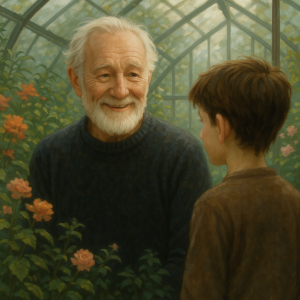
He wore his usual navy sweater, hands clasped gently on his lap, eyes twinkling with the kind of kindness that made people speak without fear.

Lucas sat down, wordless.

“You don’t need to tell me what happened,” Eli said. “You’ve lived it already. But if you want to, I’ll listen.”

And Lucas did.

I’m writing this so I can stop carrying what you should have never put on me.


For the first time, he spoke every word—the names, the bruises, the nights he pretended sleep so his father would stop yelling. He didn’t cry. He didn’t tremble.

When he finished, Grandpa Eli nodded.

“You’ve done the hardest part,” he said. “You remembered… and you stayed.”

That night, Lucas tore the letter in half. Then he burned it in the firepit.

Peter didn’t stop him.

Because sometimes, forgiveness isn’t about letting someone off the hook.

It’s about unhooking yourself.


You Can’t Heal What You Hide: Why Facing Your Troubled Childhood Matters

By Grandpa Eli

You were just a child.
And you didn’t get the love you needed.
Maybe there was shouting. Silence. A parent who hurt you—or wasn’t there at all.
Now, as an adult, part of you wants to forget it all.

That’s understandable.
But, my dear, that’s not healing. That’s hiding.

 Why Facing Your Troubled Childhood Matters
Why Facing Your Troubled Childhood Matters

1. 🧠 The mind never really forgets.

You may think you’ve moved on.
You may have a job, a family, and a life that looks “normal” from the outside.
But deep inside, your inner child is still there—waiting, hoping someone will finally listen.

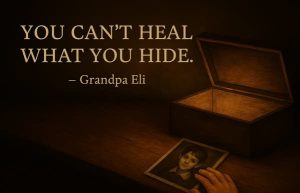
The memories might be locked in a box,
but the feelings?
They leak out in unexpected ways:

  • You panic when someone raises their voice.
  • You over-apologize, even when it’s not your fault.
  • You feel empty, even on “happy” days.
    That’s not weakness. That’s woundedness.

2. ⚠️Unhealed pain becomes silent sabotage

Research shows that adults with traumatic childhoods are:

  • More likely to suffer from anxiety, depression, and addiction.
  • More prone to self-doubt, shame, and trust issues.
  • More likely to repeat the cycle—with their own children.

You’re not broken.
You’re burdened.

And you don’t have to carry that burden alone.

3. 🧩 Pretending it didn’t happen keeps you incomplete.

You can’t erase your past—but you can rewrite your relationship with it.

Your childhood matters.
It shaped your beliefs about love, safety, and self-worth.
Trying to “move on” without understanding it is like trying to rebuild a house without checking the cracked foundation.

You deserve more than survival.
You deserve wholeness.

4. 🌱 Healing is not forgetting—it’s becoming.

When you finally turn to face the past—not with fear, but with compassion—you take back your power.

You begin to see:

  • It wasn’t your fault.
  • You did the best you could to survive.
  • The love you didn’t get then—you can give yourself now.

That’s not weakness.
That’s healing.

🕯️ A gentle invitation

If you’ve been locking the past in a box, maybe it’s time to open it—just a little.

Not to suffer again…
But to remember who you were.
To comfort that child inside.
To tell them:

“You mattered then. You matter now. And I will take care of you.”

You can’t heal what you pretend never hurt.
But you can heal.
You can grow.
You can begin again.