
Lucas had stopped flinching.
He still didn’t laugh much. But he had begun to hum—softly—when planting carrots, and once, Peter caught him tracing his finger along the petals of a peony like it was a secret worth keeping.
Then one rainy evening, Lucas said it.
“I think I want to see my father.”
Peter didn’t answer right away. He looked at the muddy windows of the greenhouse, where drops slid down like tiny rivers breaking loose. “Why?” he finally asked.
“I want him to know… he didn’t win.”
They worked on the letter together. Lucas’s hands shook at first. He kept crossing things out. Then he stopped. He wrote:
I’m not writing this so you’ll say sorry.
I’m writing this so I can stop carrying what you should have never put on me.
I’m not afraid of you anymore.
They didn’t mail it. That wasn’t the point.
Later that week, Peter took Lucas on a walk through the forest trail behind the greenhouse. They stopped at an old bench—weathered, quiet, and covered in moss.
That’s where Grandpa Eli waited.
He wore his usual navy sweater, hands clasped gently on his lap, eyes twinkling with the kind of kindness that made people speak without fear.
Lucas sat down, wordless.
“You don’t need to tell me what happened,” Eli said. “You’ve lived it already. But if you want to, I’ll listen.”
And Lucas did.
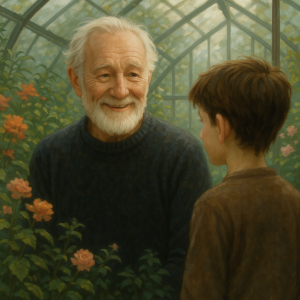
For the first time, he spoke every word—the names, the bruises, the nights he pretended sleep so his father would stop yelling. He didn’t cry. He didn’t tremble.
When he finished, Grandpa Eli nodded.
“You’ve done the hardest part,” he said. “You remembered… and you stayed.”
That night, Lucas tore the letter in half. Then he burned it in the firepit.
Peter didn’t stop him.
Because sometimes, forgiveness isn’t about letting someone off the hook.
It’s about unhooking yourself.