Forgiving the Past (Not the People Who Hurt You)

Keyword focus: forgiving the past, healing without forgiving abuser

Forgiving the Past (Not the People Who Hurt You)

Forgiveness is a complicated word, especially when it comes to childhood pain.

People say things like, “You’ll never be free until you forgive them.” But what if the people who hurt you never said sorry? What if they kept hurting you—or still are?

Here’s what I want you to know:

You don’t have to forgive the people who broke you. But you can forgive the past that tried to define you.
You don’t have to forgive the people who broke you. But you can forgive the past that tried to define you.

What Forgiveness Isn’t

Forgiveness isn’t forgetting. It isn’t pretending. It isn’t excusing. It isn’t letting anyone off the hook.

You do not need to say, “It’s okay.” Because it wasn’t.

Forgiveness is not a gift to the abuser. It’s a gift to yourself. And it starts when you shift the direction of your anger—from what happened then, to what you need now.

Releasing the Grip of Rage

Rage is sacred. It protects us. It tells us, “This is wrong.” But rage is also heavy. It’s exhausting. And if left unattended, it can harden into bitterness that poisons joy.

When you forgive the past—not the people, but the time—you are saying:

  • “I will not let these moments define the rest of my life.”
  • “I deserve peace, even if they never change.”

Forgiving the past means reclaiming your time, your voice, your worth.

Forgiveness As Freedom

You don’t need to tell them. You don’t need to see them. You don’t need to speak a word aloud.

You can whisper it into a letter you never send. You can cry it out in a room where no one watches. You can burn the old stories in a journal and write new ones.

What matters is this: that you stop letting them live rent-free in your head and heart.

You are allowed to say:

  • “You no longer have power here.”
  • “I choose me.”

The Example of Radical Forgiveness

There’s a story of a woman who lived through war. She watched her family die. When the dust settled, she didn’t seek revenge.

Someone asked her, “Don’t you want justice?”

She said, “I remember what they did. But I won’t let that night ruin the rest of my life.”

She didn’t forgive the killers. She forgave the night. She forgave history. So she could have a future.

Forgive the Night

You are not expected to forgive the hands that harmed you. But you can forgive the years that felt like shadows. You can forgive the birthdays no one celebrated. The report cards no one looked at. The words you needed but never heard.

Forgiveness of the past means you no longer punish yourself for things you couldn’t control.

It means you no longer rehearse the pain on a loop. It means peace is no longer postponed until someone else earns it.

Today, You Choose Peace

You’ve suffered enough. You’ve carried the weight long enough.

Forgiveness of the past is not forgetting what happened. It’s remembering without bleeding. It’s saying: “That was part of my story, but not the whole of it.”

It’s letting the light touch the places that hurt.

You are not weak for wanting peace. You are brave for choosing it.
 

The Past Will Always Be There But It Doesn’t Have to Rule You

Keyword focus: overcoming childhood trauma, does trauma define you

. No matter how far we run, no matter how much we grow, the past finds ways to whisper.
No matter how far we run, no matter how much we grow, the past finds ways to whisper.

The Past Will Always Be There—But It Doesn’t Have to Rule You

There are some stories in life that never fade. Some memories that live just under the skin. No matter how far we run, no matter how much we grow, the past finds ways to whisper.

But here’s what I want to tell you, my dear: it doesn’t have to rule you.

The Shadow That Lingers

You may have worked hard to build a life—maybe a family, a job, a home. On the outside, it might even look like you’ve moved on. But inside, a part of you still flinches. You still second-guess yourself. You still carry echoes of old fear.

Because trauma doesn’t obey time. And the past doesn’t stay in the past just because the calendar changed.

The truth is: your past shaped you. But it does not get to write the ending.

The Wounds That Speak in Silence

For many survivors of a difficult childhood, the past doesn’t scream. It whispers:

  • “You’re not good enough.”
  • “You’re too much.”
  • “You always mess it up.”

These aren’t your true voice—they’re the internalized voices of those who hurt you. But when they go unchallenged, they become the story you believe.

The Turning Point: When You Decide to Reclaim Power

There comes a moment—sometimes quietly, sometimes in crisis—when you realize: I don’t want to be ruled by this anymore.

That moment is everything. It doesn’t mean the pain is gone. It means you’ve chosen to stop letting it lead the way.

From here, healing can truly begin.

You Can Hold the Past Without Letting It Steer the Present

You can remember without reliving. You can honor your younger self without letting fear control your decisions. You can carry your story—and still choose peace.

The key is recognizing that your past is part of you, but not all of you.

How to Stop Letting the Past Rule

  • Name the triggers. What people, words, or situations bring old pain back to life?
  • Befriend your inner child. Talk to them. Reassure them. They’re still listening.
  • Choose new responses. What once was instinct for survival can now be replaced with conscious choice.
  • Surround yourself with safe people. Healing doesn’t happen in isolation.

Each choice is a vote for the life you want, not the one you were handed.

You Are the Author Now

Your past was written without your consent. But your future? That’s in your hands.

And with every small act of love, truth, and courage—you are editing the story.

You are not your wounds. You are the one who lived through them.

A Letter With No Stamp

Lucas had stopped flinching.

He still didn’t laugh much. But he had begun to hum—softly—when planting carrots, and once, Peter caught him tracing his finger along the petals of a peony like it was a secret worth keeping.

Then one rainy evening, Lucas said it.

“I think I want to see my father.”

Peter didn’t answer right away. He looked at the muddy windows of the greenhouse, where drops slid down like tiny rivers breaking loose. “Why?” he finally asked.

“I want him to know… he didn’t win.”

They worked on the letter together. Lucas’s hands shook at first. He kept crossing things out. Then he stopped. He wrote:

I’m not writing this so you’ll say sorry.

I’m writing this so I can stop carrying what you should have never put on me.

I’m not afraid of you anymore.

They didn’t mail it. That wasn’t the point.

Later that week, Peter took Lucas on a walk through the forest trail behind the greenhouse. They stopped at an old bench—weathered, quiet, and covered in moss.

That’s where Grandpa Eli waited.

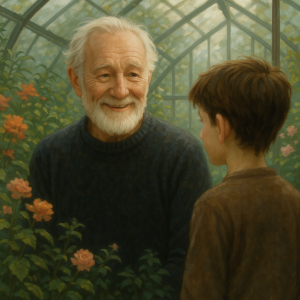
He wore his usual navy sweater, hands clasped gently on his lap, eyes twinkling with the kind of kindness that made people speak without fear.

Lucas sat down, wordless.

“You don’t need to tell me what happened,” Eli said. “You’ve lived it already. But if you want to, I’ll listen.”

And Lucas did.

I’m writing this so I can stop carrying what you should have never put on me.


For the first time, he spoke every word—the names, the bruises, the nights he pretended sleep so his father would stop yelling. He didn’t cry. He didn’t tremble.

When he finished, Grandpa Eli nodded.

“You’ve done the hardest part,” he said. “You remembered… and you stayed.”

That night, Lucas tore the letter in half. Then he burned it in the firepit.

Peter didn’t stop him.

Because sometimes, forgiveness isn’t about letting someone off the hook.

It’s about unhooking yourself.