Does Your Childhood Still Control Your Life?

🌿 Does Your Childhood Still Control Your Life?

By Grandpa Eli

Hello there, dear one.

If you’ve ever caught yourself wondering, “Why do I keep struggling with the same fears, the same broken relationships, the same sadness I can’t name?”—you’re not alone. Many of us, especially those who walked through the stormy fields of childhood, carry quiet burdens into adulthood.

And sometimes… those burdens still whisper louder than anything else.

💔 The Hidden Cost of a Difficult Childhood

You see, not all wounds bleed on the outside.

Some children grow up in homes where love came with conditions.
Where silence replaced affection.
Where safety wasn’t promised—and kindness felt like a game of chance.

Even now, as grown men and women, those children still live inside us.
Still flinching. Still fearing. Still wondering:

“Was it my fault?”
“Am I too broken to be loved?”
“Why do I still hear their voice in my head?”

🧠 The Truth: Childhood Shapes the Brain—and the Soul

Research and experience both show this clearly:

  • Children raised in chaos often become adults who fear peace.

  • Kids who were criticized endlessly grow up doubting every decision.

  • Survivors of neglect may find it nearly impossible to trust—even when love finally arrives.

And worst of all?

Many people don’t even realize their childhood is still in charge.

They chalk it up to “bad luck” in relationships… or “just how I am.” But when we dig deeper, the past isn’t just influencing their present—it’s running the show.

🔁 The Cycle of Hurt: Why It Repeats

You might think:
“If someone knew how painful it was to be abused, they’d never do it to their own children.”

But often, the opposite happens.

Because children model what they see.
And if what they saw was coldness, control, or cruelty… that becomes their blueprint for “parenting.”

It doesn’t mean they’re bad. It means they’re unhealed.

And unhealed people often hurt others without meaning to.

🌱 So… Can You Ever Be Free?

Yes. A thousand times yes.

But here’s the truth:
Healing doesn’t begin with forgetting.
It doesn’t come from pretending it “wasn’t that bad.”

It starts with courage.

The courage to say:

“I want better. For myself. For the people I love. For the child I used to be.”

🪜 The 3 Steps to Freedom

Here’s what I’ve seen, in all my years listening to hurting hearts:

1. Understand

Name what happened. Don’t sugarcoat it.
If you were neglected, abused, controlled, or emotionally starved—say it out loud.
You can’t heal what you refuse to see.

2. Repair

This doesn’t mean “fix the past.”
It means tending to your inner wounds today:

  • Learning healthy coping strategies

  • Finding safe people

  • Telling the truth about what hurt

  • Forgiving yourself for surviving the only way you knew how

3. Grow

Growth means the past no longer holds the steering wheel.
You take back the keys.
You stop blaming yourself.
You become the adult you needed back then.

And let me tell you something, dear one… That adult?
They’re already inside you. Waiting.

💬 A Final Word, From Grandpa Eli

If no one has told you this in a while…

You are not broken.
You are not too late.
You are not the bad things that happened to you.

You’re still here. And that means healing is still possible.
Your childhood may have shaped you.
But it does not define you.

The pen is in your hand now. And you get to write the next chapter.

💌 If this stirred something in your heart…

Follow my blog or Facebook page for more gentle wisdom, stories, and healing tools for those walking out of painful pasts and into peaceful futures.

You are never alone.

With all my heart,
— Grandpa Eli
Letters Full of Pain — But Still Hoping for Love

Letters Full of Pain — But Still Hoping for Love

One child wrote:

“I broke my own toys so I wouldn’t cry when they were taken away.”

Another:

“They only touched me when they were angry.”

And one more:

“I learned to hide before I learned to speak.”

Some of these kids were abandoned. Others were smothered by perfectionism.
Some were never hit — but hurt deeply by coldness, shame, or neglect.

And here’s the part that breaks me:

Most of the parents in these stories have no idea what they’ve done.

😔 You Might Be One of Them — And Not Know It

Maybe you were just surviving.
Maybe you thought tough love builds character.
Maybe you were repeating what your parents did to you, because no one showed you better.

But I want to speak to your heart right now — gently, but honestly:

If your child flinches at your voice… if they shut down when you enter the room… if they laugh harder when they’re nervous — they are telling you something.
Even if they don’t use words.

You don’t have to have “abused” your child in the textbook sense to have wounded them.
Sometimes the deepest scars come from things we didn’t say.
The apologies never given.
The hugs withheld.
The emotions punished.

💡 This Is Not About Guilt — It’s About Responsibility

I’m not writing this to shame you.
I’m writing this to wake you up.

Because it’s not too late.
Even if your child is grown. Even if they’re distant. Even if they’ve stopped talking to you.

💬 A single honest sentence from you — “I’m sorry. I didn’t know. But I want to learn.” — can open the door to healing.

Children (even adult ones) don’t need perfect parents.
They need safe ones.
Ones who can admit their faults.
Ones who choose connection over control.
Ones who see pain and don’t turn away.

🧠 Breaking the Cycle: Parenting with Compassion

You might have been raised in a home where love came with strings.
Where emotions were “too much.”
Where survival was more important than softness.

But hear this: you can break that cycle.

You can learn to raise your child in a way that makes them feel seen, safe, and loved.

Here are three ways to begin:

1. Listen More Than You Lecture

Let them speak without interrupting. Hold their pain, even if it makes you uncomfortable. Don’t rush to fix — just be there.

2. Apologize When You Mess Up

Say it plainly. “I was wrong.” “I shouldn’t have said that.” “You didn’t deserve that.”
This teaches them that even grown-ups grow.

3. Love Without Conditions

Don’t make affection depend on grades, behavior, or performance. Let them know:

“You don’t have to be perfect to be worthy of my love.”

🧓 From Grandpa Eli, With Love

To the parent reading this — with tears in their eyes or a lump in their throat:

You matter.
And so does your child’s story.
And it is not too late.

I’ve held the letters of children begging for one adult to say, “I see you. I believe you. I’m here.”
Let you be that adult.
Let you be the beginning of something new.

Because healing childhood wounds isn’t just the child’s job.
It’s ours too.

You don’t have to carry guilt.
But you do carry power — to repair, to rebuild, to love better.

So if your child ever wonders,

“Was I too much? Or not enough?”

Let your answer be:

“You were always enough.
I just didn’t know how to love you the way you deserved.
But I do now.
And I will.”

With more love than you think you deserve —
Grandpa Eli

✨ Want to Read the Letters?

📘 Discover the full eBook: Dear Grandpa Eli: Letters from the Children Who Were Never Heard
10 real letters. 10 deep wounds. 10 gentle replies that begin the journey of healing.
👉 Download here  (LINK)

This Ends With Me – Becoming the Cycle Breaker Your Family Never Had

Keywords: generational trauma, breaking the cycle, parenting after trauma, conscious parenting, emotional resilience

Somewhere, someone has to say it: “This ends with me.”

The yelling. The silent treatment. The fear in small footsteps. The shame tangled into bedtime.

It traveled through generations, passed down like a cruel inheritance. But here you are—tired, tender, trembling—and choosing differently.

You, my dear, are the cycle breaker. And though it may be the hardest role in the family… it is also the most sacred.

  1. What the Cycle Looks Like

Maybe you grew up walking on eggshells. Maybe you were never hugged. Maybe you only felt noticed when you were achieving—or when you failed.

And now, as a parent, partner, or even just a grown-up looking back… you see the patterns. The same wounds trying to make a home in you. The same voices now echoing in your own.

But you noticed. And that awareness? That’s where the break begins.

  1. Why It’s So Hard to Break Free

The pain we lived in childhood becomes our blueprint. Even when we hated it. Even when we swore we’d never repeat it.

Stress hits… and suddenly, we hear our parents in our voice. We withdraw, we raise our voices, we freeze. And afterward, the guilt eats us alive.

But here’s what I want you to hear:

You are not failing. You are interrupting. And interruptions are messy.

  1. Choosing to Parent Differently

Cycle breaking doesn’t mean perfect parenting. It means conscious parenting.

It means:

  • Apologizing when you mess up.
  • Letting your child say “no” and still be safe.
  • Saying “I love you” even when you’re angry.
  • Allowing space for big feelings—not punishing them.

It’s giving your child what you never had. And giving yourself what you always needed.

  1. Healing While You Lead

Many cycle breakers are still bleeding. Still triggered. Still afraid of becoming “just like them.”

So let me remind you: You don’t have to be fully healed to start healing the future. You just have to be willing.

Take breaks. Cry in the laundry room if you have to. But keep choosing:

  • Therapy.
  • Journaling.
  • Saying, “This isn’t how it has to be.”

Every tiny choice to respond instead of react is rebellion. Every hug you give is a revolution.

  1. Reparenting Yourself Along the Way

As you parent your children, or simply grow into your truest self, you may find parts of you still stuck in the past.

A scared child still bracing for criticism. An angry teen still trying to be seen. A broken soul still aching for approval.

Love them. Speak to them gently. Say:

  • “You didn’t deserve that.”
  • “I see you now.”
  • “We’re doing it differently.”

Because cycle breaking doesn’t just heal forward—it heals backward too.

  1. What Legacy Really Means

Legacy isn’t the wealth you leave. It’s the warmth.

It’s your child saying, “I feel safe.” It’s your partner feeling seen instead of shamed. It’s you… waking up one day, realizing the voices in your head have grown quieter.

You are not weak for wanting better. You are strong for choosing better with shaking hands.

Closing Words from Grandpa Eli

My dear one, You are the first light after a long line of storms. You are the soft voice where there used to be screams. You are the one who chose not to pass the pain forward.

You are the cycle breaker. And because of you, everything can change.

💬 If you’re walking this road—leave a 🌱 in the comments. Let the others know: we’re not doing this alone. #CycleBreaker #BreakTheChain #ConsciousParenting #GenerationalHealing #ThisEndsWithMe

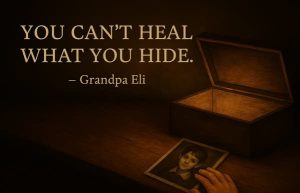
You Can’t Heal What You Hide: Why Facing Your Troubled Childhood Matters

By Grandpa Eli

You were just a child.
And you didn’t get the love you needed.
Maybe there was shouting. Silence. A parent who hurt you—or wasn’t there at all.
Now, as an adult, part of you wants to forget it all.

That’s understandable.
But, my dear, that’s not healing. That’s hiding.

 Why Facing Your Troubled Childhood Matters
Why Facing Your Troubled Childhood Matters

1. 🧠 The mind never really forgets.

You may think you’ve moved on.
You may have a job, a family, and a life that looks “normal” from the outside.
But deep inside, your inner child is still there—waiting, hoping someone will finally listen.

The memories might be locked in a box,
but the feelings?
They leak out in unexpected ways:

  • You panic when someone raises their voice.
  • You over-apologize, even when it’s not your fault.
  • You feel empty, even on “happy” days.
    That’s not weakness. That’s woundedness.

2. ⚠️Unhealed pain becomes silent sabotage

Research shows that adults with traumatic childhoods are:

  • More likely to suffer from anxiety, depression, and addiction.
  • More prone to self-doubt, shame, and trust issues.
  • More likely to repeat the cycle—with their own children.

You’re not broken.
You’re burdened.

And you don’t have to carry that burden alone.

3. 🧩 Pretending it didn’t happen keeps you incomplete.

You can’t erase your past—but you can rewrite your relationship with it.

Your childhood matters.
It shaped your beliefs about love, safety, and self-worth.
Trying to “move on” without understanding it is like trying to rebuild a house without checking the cracked foundation.

You deserve more than survival.
You deserve wholeness.

4. 🌱 Healing is not forgetting—it’s becoming.

When you finally turn to face the past—not with fear, but with compassion—you take back your power.

You begin to see:

  • It wasn’t your fault.
  • You did the best you could to survive.
  • The love you didn’t get then—you can give yourself now.

That’s not weakness.
That’s healing.

🕯️ A gentle invitation

If you’ve been locking the past in a box, maybe it’s time to open it—just a little.

Not to suffer again…
But to remember who you were.
To comfort that child inside.
To tell them:

“You mattered then. You matter now. And I will take care of you.”

You can’t heal what you pretend never hurt.
But you can heal.
You can grow.
You can begin again.