Why Growing Up Without Emotional Support Was Never Your Fault

Healing Emotional Neglect: How to Recover When Love Was Missing | Grandpa Eli’s Wisdom

You didn’t get hugs. You got silence. You didn’t get encouragement. You got expectations. You didn’t feel safe. You just felt… invisible.

Dear one, if that was your childhood, I need you to hear this with your whole heart: What happened to you was not your fault. You didn’t deserve that pain.

The House Was Full, But You Felt Alone

Some children grow up in homes where no one yells, no one hits — but no one sees them either.

Your parents may have provided food, clothes, even good schools. But you needed more than that. You needed to be held when you cried. You needed someone to say, “I see you. I’m proud of you. You matter.”

Instead, you got silence. Busyness. Cold answers. Maybe they said things like:

  • “You’re too sensitive.”
  • “Stop crying, you’re fine.”
  • “Other kids have it worse.”

So you learned to keep it all inside. To shrink yourself. To stop asking for love, and start earning approval.

And now, as an adult, you may find yourself:

  • Feeling like a burden when you express your needs.
  • Overachieving to feel worthy.
  • Chasing emotionally unavailable people.
  • Battling anxiety or loneliness in rooms full of people.

That’s not because you’re broken. It’s because you were emotionally starved.

Emotional Neglect Leaves Invisible Scars

Unlike physical abuse, emotional neglect leaves no bruises. But the wounds are just as deep.

You might question your worth. Struggle to trust. Or feel like you’re always “too much” or “not enough.”

You might say:

  • “I had a roof over my head. I shouldn’t complain.”
  • “They didn’t mean to hurt me.”
  • “They did their best.”

Yes — and. You still deserved more. You still needed tenderness. You still needed a parent who looked into your eyes and said, “You are enough. Just as you are.”

Healing Begins With Understanding

When children don’t get emotional safety, they don’t stop loving their parents — they stop loving themselves.

So if you’re still doubting your needs, minimizing your pain, or blaming yourself… please stop.

Let Grandpa Eli tell you the truth:

  • You were not too needy. You were just a child with needs.
  • You were not too sensitive. You were deeply feeling.
  • You were not dramatic. You were hurting.

And none of that was your fault.

What Can You Do Now?

Healing emotional neglect isn’t about blaming. It’s about naming. Naming what was missing. Naming what it did to you. And then giving yourself — maybe for the first time — the love you were denied.

Here’s how to start:

  1. Validate your experience – It matters. You matter.
  2. Seek support – Therapists, books, safe friends who understand.
  3. Reparent yourself – Speak kindly to the little one inside you.
  4. Set boundaries – You’re allowed to protect your peace.
  5. Let yourself feel – The sadness. The grief. Even the anger. It’s all valid.

Final Words from Grandpa Eli

Dear heart, emotional neglect doesn’t always come from cruelty — sometimes it comes from parents who were emotionally neglected themselves. But that doesn’t make your pain any less real.

You didn’t imagine it. You didn’t cause it. And you don’t have to carry the shame anymore.

You are not broken. You are becoming. And I’m so proud of you for reading this far. That means you’re already healing.

With all my heart, ~ Grandpa Eli

How the Past Still Affects You Today

Dear heart. Let’s sit down for a moment, just you and me. If your childhood was filled with pain, neglect, or fear — even if no one ever called it “abuse” — it can still leave deep marks on the grown-up you’ve become. I want to help you see those marks not as signs of weakness, but as a map — a guide — that can show you the way forward.

🌧 How the Past Still Affects You Today

  1. Your relationships may feel confusing or painful.
    You might struggle to trust people. Maybe you pull away when someone gets too close. Or you find yourself pleasing others just to feel safe. That’s not weakness. That’s your inner child trying to protect you the only way they know how. 
  2. You may feel responsible for everything — even the things that hurt you.
    When love was conditional as a child (“Be quiet or else…” / “Why can’t you be like your brother?”), you may have learned to blame yourself. That can carry into adulthood as shame, guilt, or a sense of never being “good enough.” 
  3. You may react too strongly — or not at all.
    Little things can feel like big explosions. Or big things can make you shut down completely. Why? Because your brain was wired in a storm, and it’s still trying to survive it. 
  4. You might feel stuck, unmotivated, or like something’s “wrong” with you.
    That’s not laziness or failure. That’s grief. That’s exhaustion from carrying a backpack full of invisible pain. You’ve been surviving so long, you forgot what thriving feels like. 
  5. You might be scared of becoming like your parents.
    Many adults who were mistreated as kids live in fear of repeating the cycle — or they do repeat it without meaning to. Hurt people often hurt people… until someone brave chooses to heal. 

🛠 How to Begin Healing

I’ve walked beside many wounded children in grown-up bodies, and here’s the gentle truth I’ve learned:

Healing is possible. But it’s not magic.
It’s a path — and that path usually begins in three stages:

1. Understanding

Name what happened. Not to blame — but to see clearly.

“I was neglected.”
“I was afraid all the time.”
“No one hugged me when I cried.”

When we name the pain, we stop letting it hide.
And when it stops hiding, we can stop blaming ourselves for it.

2. Repair

This is where we gently untangle the mess the past made inside us.
It might look like therapy. Or journaling. Or safe friendships.
It might look like reading books or joining support groups.
It definitely looks like learning how to treat yourself with the care you never got.

3. Growth

This is the sweet stage — where you start living for you, not for fear.
You begin setting boundaries.
You begin laughing more.
You begin parenting your children — and your inner child — in ways that heal.

🌱 Remember, Dear One…

You didn’t choose the pain.
But you get to choose what happens next.

And if no one has ever said this to you, let Grandpa Eli be the first:

I’m proud of you.
Not because you’ve got it all figured out — but because you’re still here.
You survived what others wouldn’t understand. And now, you’re searching for light.
That makes you mighty.

The Smell of Burnt Toast: When Childhood Trauma Comes Back in a Moment—and How to Heal from It

It wasn’t a memory. It wasn’t even a thought.
It was a smell—burnt toast—and suddenly, Malik was no longer 41.

He was ten again. Back in that apartment where yelling lived in the walls, and fear clung to every corner.
He was hiding by the sink, humming lullabies to the faucet so he wouldn’t hear the sounds of rage in the next room.

One scent.
That’s all it took.

If you’ve ever been ambushed by a sound, a smell, a room, a tone of voice—and felt yourself swallowed whole by something you couldn’t explain—this story is yours too.

If you've ever been ambushed by a sound, a smell, a room, a tone of voice—and felt yourself swallowed whole by something you couldn’t explain—this story is yours too.
If you’ve ever been ambushed by a sound, a smell, a room, a tone of voice—and felt yourself swallowed whole by something you couldn’t explain—this story is yours too.

What a Smell Can Unlock

Malik wasn’t thinking about his childhood.
He was just trying to start his day.

A regular morning. A small-town diner.
Black coffee. Eggs. Toast—slightly browned.

But someone in the kitchen burned the bread.

And suddenly, he was back in his mother’s kitchen.
The lights dim. The air heavy. The smell of burnt toast clinging to the air like a warning.

Burnt toast meant Mom didn’t sleep.
Mom not sleeping meant Dad came home.
And Dad coming home meant bruises were coming.

The moment that smell reached his nose, his heart raced.
His palms sweated.
His jaw clenched.
He felt dizzy.

That’s the thing about trauma—it doesn’t ask permission.

The Hidden Power of Childhood Triggers

Trauma isn’t just a memory.
It’s a reaction your body stores.

The technical term is a “sensory trigger.”
Smells. Sounds. Touch. Even lighting.

For Malik, burnt toast wasn’t just a kitchen mistake.
It was an emotional alarm his brain had wired decades ago:
Something is wrong. Get small. Get safe. Don’t speak. Don’t move.

He didn’t even notice he had stopped eating.
Didn’t realize he was gripping the fork so tight his knuckles turned white.

He just sat there, 41 years old… and terrified.

Childhood Abuse Doesn’t Always Look Like Broken Bones

Malik’s father wasn’t violent every day.
Sometimes he was even… nice.

That made it worse.

Because unpredictability is where trauma grows deepest.

You never knew if the front door meant dinner or disaster.
You never knew if silence meant peace or punishment.

So Malik did what so many kids do:
He became invisible.
He got straight A’s.
He washed the dishes without being asked.
He apologized before speaking.

He became a ghost in his own house.

The Silent Promises We Make in Pain

Malik left home the day he turned 18.
He packed everything he owned into a trunk and drove until the city became trees.

He made himself a promise:

“I’ll never be like him.”

And he wasn’t.

He didn’t yell.
He didn’t drink.
He didn’t raise his voice at his kids.
He didn’t hit.

But he also didn’t let anyone love him.

He flinched at affection.
He sabotaged relationships before they got too close.
He never let anyone stay the night.
He never said “I love you” unless it was a joke.

Because the boy who learned that love could hurt had become a man who feared it might hurt again.

The Day the Spell Broke

What changed wasn’t therapy or some grand spiritual awakening.

It was a little boy in the diner.
Five years old. Lost in a maze of legs and coffee cups.

He ran into Malik’s table and said, “Sorry! Sorry!” before his dad swooped in and picked him up.

“Hey, you’re okay,” the father said.
“You’re safe. I got you.”

That’s it.

But it was everything.

Malik felt his throat tighten. His eyes sting. His breath catch.

Because no one had ever said those words to him.
Not once.
Not in the closet.
Not at the kitchen sink.
Not after the bruises.
Not before the nightmares.

He had never been told:
“You’re okay.”
“You’re safe.”
“I got you.”

Grief for the Childhood You Deserved

Later that night, Malik drove home.
Parked outside his apartment.
And just sat there.

The smell of burnt toast had faded, but the memory remained.
Only now, it wasn’t just fear—it was grief.

He cried in the dark.

Not just for what happened.
But for what never did.

The birthday parties.
The bedtime stories.
The words: “I love you. I’m proud of you. You’re enough.”

He wept for the boy who still lived inside him, waiting—just once—to be held and told,

“None of this was your fault.”

Why Triggers Are Invitations—Not Just Wounds

For years, Malik hated his triggers.
He thought they made him weak.
Embarrassing. Broken.

But now, he began to see them differently.

Burnt toast wasn’t a breakdown.
It was a message.

A flare shot up from his nervous system, saying:

“There’s something here you’ve buried.
You’re safe enough now to look at it.
You’re strong enough to feel it.”

That night, he did something brave.

He called his brother.
They hadn’t spoken in years.
He didn’t know what to say.
So he started with:

“Do you remember how the house smelled when Dad came home?”

There was silence.

Then:

“Yeah.
I do.”

And just like that—he wasn’t alone anymore.

How to Begin Healing When You’re Triggered

You don’t need to “get over” it.
You don’t need to “stay strong.”
You don’t need to perform wellness.

You just need to begin.

🔥 1. Pause When It Hits

Don’t push it away.
Don’t shame yourself.
You’re not broken.
You’re remembering.

🧠 2. Name It

“This is fear. This is grief. This is not now.”
Labeling the feeling helps your brain step out of survival mode.

💬 3. Talk to Someone

Call a friend. Write in a journal. Join a support group.
Even one conversation can make the difference.

🫂 4. Talk to Your Inner Child

You can be the adult that child needed.
Try saying:

“You’re safe. You’re not bad. You didn’t deserve it.”
“I’m here now. I’ve got you.”

Conclusion: You Are Not the Smell of Burnt Toast

Trauma doesn’t make sense.
It doesn’t care about time or logic or what looks “normal.”
It lives in the body.
And it asks, again and again:

“Am I safe yet?”

The answer, slowly, one memory at a time, can become:

“Yes.
You’re safe now.
I’ve got you.”

So the next time the smell hits—the sound, the voice, the street—pause.

And remember:
It’s not weakness.
It’s not failure.
It’s the doorway to healing.

Walk through it gently.
And maybe, just maybe…
make yourself some toast.
And eat it with peace.

💬 Let’s Talk

Have you ever been pulled back into the past by a smell, a sound, or a space?

What did your body remember before your brain caught up? Share this with someone who needs to hear:

“You’re not broken. You’re healing.”

A Letter from Grandpa Eli

To the Child Inside You: Forgive Yourself

My dear,

If you’re reading this, it means you’re carrying something heavy. A weight not made of iron or stone, but of guilt… of memories… of blame you should never have held in your little hands.

I want to talk to that child inside you. The one who once wondered,
“Was it my fault?”
“Did I deserve this?”
“If only I had been better… quieter… stronger…”

Let me tell you a secret, whispered gently like the wind in the trees:
It was never your fault. Not even for a moment.

 This isn’t about forgiving them.This is about forgiving yourself.
This isn’t about forgiving them.
This is about forgiving yourself.

You were just a child. You didn’t choose the yelling. You didn’t cause the silence. You weren’t the reason they drank, or lashed out, or disappeared emotionally. The world got it upside down. And for too long, you’ve carried the burden of their brokenness on your innocent shoulders.

I know forgiveness is a complicated word. People often misunderstand it. They say, “You should forgive your abuser.” But I don’t believe you owe them anything.
This isn’t about forgiving them.

This is about forgiving yourself.

Forgive yourself for not knowing how to speak up.
Forgive yourself for trying so hard to please people who were impossible to please.
Forgive yourself for surviving in ways others may not understand—through silence, rebellion, perfectionism, or pretending everything was okay.

Forgive the child who simply wanted to be loved.

That child is still with you. And they are waiting—for your kindness, for your warmth, for your understanding.

So here’s what I want you to do today:

  1. Look in the mirror. Gently place your hand on your chest and say,
    “I forgive myself. I was just a child. I did nothing wrong.”
  2. Let go of the question “Why did this happen?” There may never be a satisfying answer. What matters more is: What will you do now to live free?
  3. Be the adult your younger self needed. Speak gently. Rest when you’re tired. Set boundaries. Celebrate small joys.

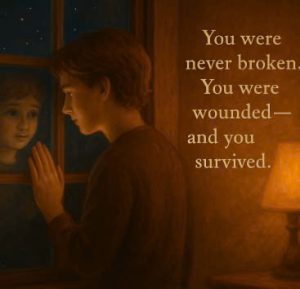
Dear one, you were never broken. You were wounded—but wounds can heal. Scars do not mean you’re damaged. They mean you survived.

You’re not alone anymore.

With warmth like a cup of cocoa in winter,
Grandpa Eli
🧡