The Closet We Never Outgrow: How Childhood Fear Teaches Us to Stay Silent—And What It Takes to Speak Again

For some people, closets are for coats.
For others, they’re for secrets.
And for many who’ve lived through childhood trauma, they were a place to hide from storms that had names like Dad or Mom.

This is the story of Maria—an HR assistant, a “model employee,” a grown woman—who found herself frozen in the supply closet of her office one afternoon.
Not because of a fire. Not because of a panic attack.
But because the air smelled like old wood and paper.

And that smell transported her 25 years back—into the tiny hallway closet where she once hid from violence, believing that silence meant survival.

This isn’t just her story.
It’s for anyone who learned too young that being invisible felt safer than being loved.

When the Closet Becomes a Refuge

Maria was six the first time she was told to hide.
Her mother whispered, “Go, baby, go,” as the front door slammed and her stepfather’s drunken footsteps stomped down the hall.

Maria ran.

She knew the way.
Down the hallway. Past the bathroom. Into the coat closet—wedged between her mother’s church dress and an old vacuum.

She waited there in the dark, holding her breath while screams and crashes shook the floorboards.
Sometimes for minutes.
Sometimes for hours.

In that space of mothballs and silence, Maria made a home.
She imagined her own version of safety: a mother who didn’t cry, a man who didn’t rage, a world that didn’t shatter every Saturday night.

But closets weren’t magical. They were just wooden tombs that taught her how to disappear.

How Childhood Teaches Us Silence Is Safer

As Maria grew older, she never talked about the closet.

She didn’t tell friends.
She didn’t mention it in college essays.
She didn’t cry when her therapist asked about her childhood.

She just smiled.
Told people she “grew up fast.”
That she was “independent.”

And she was.

She graduated early. Held down two jobs.
Worked her way into HR leadership before 30.
She was praised for being “calm under pressure,” “unshakable,” “professional.”

No one saw that beneath the professionalism was a girl still hiding.

Because Maria learned young that speaking up had consequences.
That asking for too much made people leave.
That expressing pain made you the problem.

So she stayed quiet.
Even when coworkers interrupted her in meetings.
Even when her partner mocked her weight in public.
Even when she felt the need to scream.

The Supply Closet Breakdown

It wasn’t a dramatic moment.
Just another Tuesday.
She was gathering office supplies before a training when she stepped into the closet and closed the door behind her.

And then it hit her.
The scent. The stillness. The shape of the doorknob.
It wasn’t a closet anymore—it was a portal.

She couldn’t breathe.

Her body remembered what her brain had buried:
The screams.
The pounding.
The silence that followed.

Maria dropped the clipboard and sank to the floor, shaking.

But this time, she wasn’t six.
And she wasn’t alone.

When Another Child Helps You Meet Your Own

Just the day before, a new intern had walked into her office.
Nervous. Apologetic.
He’d made a mistake on a document. His voice trembled.
When Maria raised her voice—gently—he flinched.

It stopped her cold.

Because she knew that flinch.
She was that flinch.

So she sat him down.
Handed him a glass of water.
And said something she’d never said out loud—not even to herself:

“It’s okay.
You’re safe now.
Nobody’s going to hurt you here.”

Those words came back to her now, sitting on the floor of the supply closet.
And they weren’t for the intern anymore.
They were for her.

Reclaiming the Voice You Buried to Survive

Maria didn’t need to shout.
She didn’t need a confrontation or a grand apology.
She just needed to feel what she had once been forced to silence.

She whispered:

“I’m not hiding anymore.
I was never bad.
I was just scared.”

It wasn’t a lightning bolt.
But it was a beginning.

That afternoon, she told her manager she wanted to lead next quarter’s diversity training.
That night, she told her partner they needed to talk—about respect, about boundaries, about whether love should feel like walking on eggshells.

And the next morning?
She walked into the supply closet, grabbed what she needed, and walked out.

Just like that.

No panic.
No past chasing her.
Just a woman with a purpose—no longer hiding between the coats.

What the Closet Represents in So Many of Our Lives

Psychologically, the “closet” isn’t always physical.
It can be:

  • The fake smile at the family table
  • The years of people-pleasing
  • The way we apologize before we even speak
  • The unspoken rule that “nice” girls and boys don’t make noise

We carry our closets with us.

We shrink ourselves in relationships.
We silence our needs in workplaces.
We ignore red flags because we were taught love is earned, not given.

But the truth is this:

You don’t have to hide anymore.

How to Begin Speaking Again

You may not be ready to shout.
You may not even be ready to whisper.

But here are small ways to begin unlocking the door:

🧩 1. Notice the Flinch

Where in life are you shrinking?
Who do you fear upsetting—and why?

🪞 2. Speak Kindly to the Child Inside

Try saying:

“I’m sorry you had to hide.”
“You didn’t deserve the fear.”
“You’re allowed to speak now.”

✍️ 3. Write the Letter You Never Sent

To your younger self. To your abuser. To the world.
Even if you never send it—write it. Name what was never named.

🗣️ 4. Say One Thing Today

Tell a friend how you really feel.
Set a boundary.
Even if your voice shakes.

Conclusion: From Supply Closet to Safe Space

Maria’s journey didn’t end in that closet.
It began there.

Because healing doesn’t always start in a therapist’s office.
Sometimes, it starts with the courage to enter the room you once feared—and leave it with your head high.

So if you’re still hiding, still quiet, still apologizing for having needs—this is for you:

You were never the problem.
You were never too much.
You were just a child in a world that couldn’t love you the way you deserved.

But now?
Now you get to be the one who opens the door.

And walks out.

💬 Let’s Talk

Have you ever carried your “closet” into adulthood?
Are you still learning how to speak, set boundaries, and take up space?

Drop a 🧥 in the comments if you’re learning to live outside the silence.
Or share this with someone who needs to hear:

“You don’t have to hide anymore. You never did.”
A Letter from Grandpa Eli

To the Child Inside You: Forgive Yourself

My dear,

If you’re reading this, it means you’re carrying something heavy. A weight not made of iron or stone, but of guilt… of memories… of blame you should never have held in your little hands.

I want to talk to that child inside you. The one who once wondered,
“Was it my fault?”
“Did I deserve this?”
“If only I had been better… quieter… stronger…”

Let me tell you a secret, whispered gently like the wind in the trees:
It was never your fault. Not even for a moment.

 This isn’t about forgiving them.This is about forgiving yourself.
This isn’t about forgiving them.
This is about forgiving yourself.

You were just a child. You didn’t choose the yelling. You didn’t cause the silence. You weren’t the reason they drank, or lashed out, or disappeared emotionally. The world got it upside down. And for too long, you’ve carried the burden of their brokenness on your innocent shoulders.

I know forgiveness is a complicated word. People often misunderstand it. They say, “You should forgive your abuser.” But I don’t believe you owe them anything.
This isn’t about forgiving them.

This is about forgiving yourself.

Forgive yourself for not knowing how to speak up.
Forgive yourself for trying so hard to please people who were impossible to please.
Forgive yourself for surviving in ways others may not understand—through silence, rebellion, perfectionism, or pretending everything was okay.

Forgive the child who simply wanted to be loved.

That child is still with you. And they are waiting—for your kindness, for your warmth, for your understanding.

So here’s what I want you to do today:

  1. Look in the mirror. Gently place your hand on your chest and say,
    “I forgive myself. I was just a child. I did nothing wrong.”
  2. Let go of the question “Why did this happen?” There may never be a satisfying answer. What matters more is: What will you do now to live free?
  3. Be the adult your younger self needed. Speak gently. Rest when you’re tired. Set boundaries. Celebrate small joys.

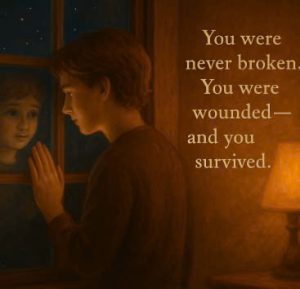
Dear one, you were never broken. You were wounded—but wounds can heal. Scars do not mean you’re damaged. They mean you survived.

You’re not alone anymore.

With warmth like a cup of cocoa in winter,
Grandpa Eli
🧡

You Were Never Meant to Carry This Alone

Keyword focus: healing from childhood trauma, inner child healing

You Were Never Meant to Carry This Alone

There are certain wounds that don’t bleed, but they live inside us. They sit silently in the back of our minds, shaping the way we see ourselves and the world around us. And often, they begin when we are too small to understand, too vulnerable to fight back, too young to even know it’s not normal. This is what it means to carry the burden of childhood trauma.

If no one told you this before, let me tell you now: you were never meant to carry this alone.

There are certain wounds that don’t bleed, but they live inside us.

A Backpack of Stones

Imagine a small child with a backpack. And every time someone yelled, ignored, insulted, shamed, or abandoned them, a stone was placed in that pack. At first it was just a few. Then more. Then even more. Until one day, the child could barely stand. But they kep

But it was. And it still is.

Because trauma that isn’t healed, doesn’t go away. It grows roots in our nervous system. It whispers in our relationships. It controls how we love, trust, speak, and even how we see ourselves in the mirror.

The Myth of Self-Reliance

Many people who grew up in pain learned to be strong too soon. They became their own protectors. They learned how to read a room in seconds. How to shrink, how to disappear, how to keep the peace.

But strength forged in fear is not peace. And independence built on survival is not freedom.

You may think you’re supposed to figure it out on your own. That you have no right to complain. That it’s too late to change anything now.

But none of that is true.

Healing Begins When We Speak the Unspoken

One of the most powerful steps in healing from childhood trauma is breaking the silence. Speaking the truth of what happened to you. Even if it’s just whispered into a journal. Even if your voice shakes. Even if you’re afraid it makes you weak.

It doesn’t make you weak. It makes you human.

Because the pain that is hidden cannot be healed. The shame that is buried will continue to rot. But the moment you let light in, even a little, the healing begins.

You may need to grieve. You may feel angry. You may feel sad about the childhood you deserved but never got. All of that is valid.

You Were Not Meant to Heal Alone

It’s a beautiful, radical thing to let someone in.

Whether it’s a therapist, a friend, a support group, or even words in a book that understand your pain—you begin to remember that you were never supposed to walk through this in isolation.

Healing is not a solo journey. It is a communal act of remembering, of witnessing, of holding one another when the weight becomes too much.

Your inner child still lives within you. And they don’t need you to be perfect. They just need you to show up, hold their hand, and promise, “We are not alone anymore.”

A Future Not Defined by the Past

You are not broken. You are someone who learned how to survive. You built walls to protect yourself. You carried weight that was never yours. And you made it here.

But survival is not the same as living.

Now, you are allowed to put the backpack down. Slowly. Gently. You are allowed to say, “I deserve softness.” You are allowed to feel joy without guilt. Love without fear. Rest without shame.

You were never meant to carry this alone. And now, you don’t have to.

Let this be the first step. Or the fiftieth. Let this be your reminder: healing from childhood trauma is possible. And your inner child is still waiting for you—not to rescue them, but to sit beside them and say, “We made it. And we’re safe now.”

You Don’t Have to Forgive to Heal – What Real Emotional Release Looks Like


You’ve heard it all before: “Forgive and forget.” “Just let it go.” “It’s the only way to move on.”

But what if I told you… you don’t have to forgive the person who hurt you in order to heal?

What if true healing isn’t about them at all—but about you reclaiming your power?

Forgiveness can be a beautiful thing. But when rushed, forced, or demanded, it becomes just another wound. So let’s redefine what healing looks like—on your terms.

  1. The Pressure to Forgive Too Soon

Too often, survivors are asked to make peace with monsters before they’ve even stopped bleeding.

Well-meaning friends, faith leaders, or even therapists might say, “You’ll feel better once you forgive.”

But when forgiveness is pushed before the pain has been witnessed, it only silences the truth.

You don’t owe forgiveness to the one who never apologized. You don’t owe absolution to someone who still denies what they did.

  1. What Forgiveness is Not

Let’s be clear:

  • Forgiveness is not saying “it was okay.”
  • Forgiveness is not reconciling.
  • Forgiveness is not forgetting.
  • Forgiveness is not pretending it didn’t change you.

Real healing says: It mattered. It hurt. And I’m allowed to grow beyond it—whether they’re sorry or not.

  1. The Healing That Doesn’t Require Forgiveness

Healing is:

  • Naming what happened.
  • Feeling the feelings you were never allowed to have.
  • Validating your pain without minimizing it.
  • Releasing the belief that it was your fault.

You can rage. You can cry. You can build boundaries so high they never touch you again.

That is healing.

  1. Forgiveness of Self Comes First

If there’s any forgiveness that truly matters, it’s this:

Forgiving yourself.

For the years you stayed silent. For the ways you coped that hurt you. For thinking you deserved it. For the self-blame you carried like a second skin.

You didn’t cause it. You were surviving. You did what you had to do.

Now you get to stop surviving and start healing.

  1. What Letting Go Really Looks Like

Letting go isn’t a moment. It’s a series of micro-decisions:

  • To stop explaining your pain to those who don’t want to understand.
  • To stop chasing closure from people incapable of giving it.
  • To stop believing that you are the broken one.

Letting go means saying: “I release you—not because you earned it, but because I deserve peace.”

You’re not freeing them. You’re freeing yourself.

  1. A Ritual for Release Without Forgiveness

Try this:

  1. Write a letter to the person who hurt you. Say everything.
  2. Don’t hold back. Let your truth rise.
  3. Burn it, tear it, bury it—whatever feels right.
  4. Whisper: “I don’t need to forgive to heal. But I do release this from my body.”

You may cry. That’s healing. You may feel nothing at first. That’s protection.

Repeat when needed. This is your journey.

Closing Words from Grandpa Eli

My dear one, You are not required to carry the weight of their sins just to seem “kind.” You don’t need to forgive to move forward. You need to feel. To grieve. To release.

When you are ready—on your own terms—you’ll know what needs to be forgiven and what simply needs to be released.

And whatever you choose… I’ll be here, cheering for your freedom.

💬 Has someone ever pushed you to forgive before you were ready? Share if you feel safe. Your story may help someone else feel seen.

#RedefineForgiveness #HealingWithoutForgiveness #SelfForgiveness #EmotionalRelease #YouDeservePeace

You Don’t Have to Fo Can Stop Carrying It Around Like a Backpack of Stones.

A letter from Grandpa Eli

My dear one,

If I could sit beside you today with a cup of warm tea in hand, I’d tell you this:

You don’t have to forget what happened.

You don’t have to erase the past, and you certainly don’t have to excuse the people who hurt you.
Some things were unfair.
Some words cut deep.
Some silences were louder than any scream. But let me tell you something that might just change your life:

You can stop carrying it around like a backpack of stones.

I know you’ve been holding it all together for a long time.
You carry the memories, the what-ifs, the shame that was never yours to begin with.
You keep those stories in your bones—thinking if you set them down, you’ll forget… or that it means they didn’t matter.

But darling, carrying pain doesn’t honor it.
Healing does.

And healing doesn’t mean pretending it didn’t hurt.
It means saying: Yes, this happened. Yes, it changed me. But it no longer gets to weigh me down.

Every day you keep carrying those stones, you tell your body and heart that you’re still in that past.
But you’re not.
You’re here now.
You’re growing.
You’re brave enough to put one rock down at a time.

That heavy pack on your back?
It was never yours to carry forever.

So maybe today, you lay down just one stone.
Maybe today, you whisper:
“I didn’t deserve that.”
“I am not to blame.”
“I get to move forward.”

You are allowed to remember without reliving.

You are allowed to release without excusing.
You are allowed to forgive—not them, maybe—but yourself…
…for the years you spent surviving.

You are not weak for wanting to feel light again.
You are human.
You are healing.
And you are worthy of peace.

With warmth in every wrinkle,
Grandpa Eli
🧣 The friend who shows up when your heart needs someone to understand.