I Tucked Her In at Night: A Story of Childhood Role Reversal

“I Tucked Her In at Night”

From: A child who had to parent their own parent

Dear Grandpa Eli,

I don’t really remember being little.

I mean, I know I was — there are pictures of me in footie pajamas, holding a stuffed bear with one eye. But even then, I remember watching over Mom. Making sure she didn’t cry too long. Or sleep too long. Or drink too much.

Other kids got tucked in at night.
But I was the one doing the tucking.

I’d help her to bed after she passed out on the couch. I’d take off her shoes, pull a blanket over her shoulders. Once, I even sang her a lullaby. I was five.

People say kids are resilient. But I think sometimes we’re just… good at hiding.
Good at pretending we’re not scared.
Good at smiling for teachers and saying, “I’m fine,” when no one packed our lunch again.

Every morning before school, I checked to see if she was breathing. That was my routine. That — and pouring cereal with water because the milk was gone.

When other kids asked what my mom did for work, I made things up. “She’s a nurse,” I said once. She wasn’t. She didn’t leave the house for days. Except to buy wine.

When she was sober, she could be magic.
She’d braid my hair and call me “her little sunshine.”
But when the bottle came out, the sunshine disappeared.

Sometimes she’d cry and say, “You’re the only thing keeping me going.”
I didn’t know if that was supposed to be a compliment.
It felt like a cage.

One time, I told the school counselor that I felt tired all the time. She said maybe I needed to sleep more. I wanted to say:
“I sleep just fine. It’s waking up to this that’s exhausting.”

But I didn’t.
Because if someone found out, I was afraid they’d take me away.
And as broken as Mom was… she was still mine.

Now I’m twelve. I still flinch when someone knocks on the door.
I still freeze when someone yells.
I still feel guilty when I rest — like I should be checking on someone, fixing something, apologizing for something I didn’t even do.

Grandpa Eli,
Is it okay if I say I’m tired?
Even if I don’t look like it on the outside?

Is it okay to be a kid…
Even if I never learned how?

Sometimes I look in the mirror and try to see me — just me — not the caretaker. Not the peacekeeper. Not the one keeping everyone from falling apart.

Do you think she ever saw me?

Do you?


Reply from Grandpa Eli

Oh my precious one,

I see you.

I see the five-year-old with tiny hands pulling blankets over a grown woman. I see the tired eyes behind the “I’m fine.” I see the strength it took to become a parent before you even lost your baby teeth.

And yes — I see you. Not the caretaker. Not the peacemaker.
You. The child who deserved to be held, not to be holding everything together.

Sweetheart, what happened to you was not okay.

You should never have had to carry so much. You should have been the one being sung to, not the one whispering lullabies to a woman drowning in her pain. You should have been eating warm dinners, not cereal with water. You should have had one job: to be a child.

But instead, you were handed a silent contract — to become her hope, her helper, her emotional anchor. And no one asked if your tiny heart could carry all that weight.

You asked if it’s okay to be tired.
Let me be the one to give you the answer your soul has waited years to hear:

Yes. It is okay to be tired.
It is okay to rest.
It is okay to cry.
It is okay to not be okay.

You don’t have to earn rest. You don’t have to apologize for your exhaustion. You don’t have to stay in “alert mode” just because love once depended on it.

You are allowed to lay down the weight.

And you know what else?

You don’t have to save anyone to be worthy of being saved.

I want you to hear this: You were never meant to be her solution.
That was never your job. Not then. Not now.

You’re twelve, and yet you speak like someone who’s lived a hundred years. But buried beneath that armor is still a child. A child who wants to laugh freely. To play. To mess up without fear. To eat cereal with milk and not count every drop.

That child still lives inside you — and they’re waiting.

Let them out, bit by bit. Let them be loud. Let them rest. Let them be seen.
Because I see them. And I love them. Just as they are.

You are not invisible to me.
You are unforgettable.

And I am so, so proud of you.

With the gentlest arms and the warmest lap,
— Grandpa Eli
How the Past Still Affects You Today

Dear heart. Let’s sit down for a moment, just you and me. If your childhood was filled with pain, neglect, or fear — even if no one ever called it “abuse” — it can still leave deep marks on the grown-up you’ve become. I want to help you see those marks not as signs of weakness, but as a map — a guide — that can show you the way forward.

🌧 How the Past Still Affects You Today

  1. Your relationships may feel confusing or painful.
    You might struggle to trust people. Maybe you pull away when someone gets too close. Or you find yourself pleasing others just to feel safe. That’s not weakness. That’s your inner child trying to protect you the only way they know how. 
  2. You may feel responsible for everything — even the things that hurt you.
    When love was conditional as a child (“Be quiet or else…” / “Why can’t you be like your brother?”), you may have learned to blame yourself. That can carry into adulthood as shame, guilt, or a sense of never being “good enough.” 
  3. You may react too strongly — or not at all.
    Little things can feel like big explosions. Or big things can make you shut down completely. Why? Because your brain was wired in a storm, and it’s still trying to survive it. 
  4. You might feel stuck, unmotivated, or like something’s “wrong” with you.
    That’s not laziness or failure. That’s grief. That’s exhaustion from carrying a backpack full of invisible pain. You’ve been surviving so long, you forgot what thriving feels like. 
  5. You might be scared of becoming like your parents.
    Many adults who were mistreated as kids live in fear of repeating the cycle — or they do repeat it without meaning to. Hurt people often hurt people… until someone brave chooses to heal. 

🛠 How to Begin Healing

I’ve walked beside many wounded children in grown-up bodies, and here’s the gentle truth I’ve learned:

Healing is possible. But it’s not magic.
It’s a path — and that path usually begins in three stages:

1. Understanding

Name what happened. Not to blame — but to see clearly.

“I was neglected.”
“I was afraid all the time.”
“No one hugged me when I cried.”

When we name the pain, we stop letting it hide.
And when it stops hiding, we can stop blaming ourselves for it.

2. Repair

This is where we gently untangle the mess the past made inside us.
It might look like therapy. Or journaling. Or safe friendships.
It might look like reading books or joining support groups.
It definitely looks like learning how to treat yourself with the care you never got.

3. Growth

This is the sweet stage — where you start living for you, not for fear.
You begin setting boundaries.
You begin laughing more.
You begin parenting your children — and your inner child — in ways that heal.

🌱 Remember, Dear One…

You didn’t choose the pain.
But you get to choose what happens next.

And if no one has ever said this to you, let Grandpa Eli be the first:

I’m proud of you.
Not because you’ve got it all figured out — but because you’re still here.
You survived what others wouldn’t understand. And now, you’re searching for light.
That makes you mighty.

How to Limit the Power of a Painful Past

The past is a place of reference, not residence.” – Grandpa Eli

If you’re reading this, chances are your childhood wasn’t easy.

Maybe you grew up in a home where love was conditional—or absent altogether.
>
Maybe you were criticized more than you were comforted.
>
Maybe you learned early on how to survive… but never how to feel safe.

And now, as an adult—perhaps even a parent—you’re starting to feel just how tightly the past still clings to your present.

You may…

  • Doubt your worth. 
  • Make choices out of fear rather than faith. 
  • Struggle to believe you’re truly lovable or capable. 

You’re not alone.
These are the invisible echoes of a wounded childhood.
But the good news is: they don’t have to control your future.

Let’s explore how.

1. See the past clearly—but don’t live in it.

You don’t need to deny it or sugarcoat it.
You can say:
“Yes, that happened. It hurt. It shaped me.”
But it doesn’t get to speak for your whole identity.
It’s a chapter, not the whole book.

And you don’t have to forget in order to move on.
You only have to stop letting it define what’s possible.

2. Look for the hidden strengths inside the wounds.

That pain taught you something—about survival, empathy, awareness.
There’s power buried in your past:

  • The ability to break the cycle. 
  • The courage to choose differently. 
  • The wisdom to raise your child in love, not fear. 

You don’t have to repeat the story you came from.
You get to create a new one.

3. Choose differently—daily.

The past says, “You’ll never be good enough.”
You say: “Watch me grow.”
The past says, “This is just who I am.”
You say: “Who I was isn’t who I have to be.”

Every small choice—pausing instead of yelling, hugging instead of judging, listening instead of controlling—is a line in the new chapter you’re writing.

Even if it feels awkward. Even if it feels slow.
Healing happens in the repetition.

So, What Now?

The past will always be a part of you.
It’s etched in memory, in scars, in reflexes.
But it doesn’t have to be the author of your future.

🧓 Grandpa Eli’s message is simple:
You can pick up the pen.
>
You can write a new chapter—brighter, stronger, more free.

You are not your wounds.
>
You are what rises from them.

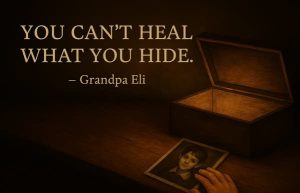
You Can’t Heal What You Hide: Why Facing Your Troubled Childhood Matters

By Grandpa Eli

You were just a child.
And you didn’t get the love you needed.
Maybe there was shouting. Silence. A parent who hurt you—or wasn’t there at all.
Now, as an adult, part of you wants to forget it all.

That’s understandable.
But, my dear, that’s not healing. That’s hiding.

 Why Facing Your Troubled Childhood Matters
Why Facing Your Troubled Childhood Matters

1. 🧠 The mind never really forgets.

You may think you’ve moved on.
You may have a job, a family, and a life that looks “normal” from the outside.
But deep inside, your inner child is still there—waiting, hoping someone will finally listen.

The memories might be locked in a box,
but the feelings?
They leak out in unexpected ways:

  • You panic when someone raises their voice.
  • You over-apologize, even when it’s not your fault.
  • You feel empty, even on “happy” days.
    That’s not weakness. That’s woundedness.

2. ⚠️Unhealed pain becomes silent sabotage

Research shows that adults with traumatic childhoods are:

  • More likely to suffer from anxiety, depression, and addiction.
  • More prone to self-doubt, shame, and trust issues.
  • More likely to repeat the cycle—with their own children.

You’re not broken.
You’re burdened.

And you don’t have to carry that burden alone.

3. 🧩 Pretending it didn’t happen keeps you incomplete.

You can’t erase your past—but you can rewrite your relationship with it.

Your childhood matters.
It shaped your beliefs about love, safety, and self-worth.
Trying to “move on” without understanding it is like trying to rebuild a house without checking the cracked foundation.

You deserve more than survival.
You deserve wholeness.

4. 🌱 Healing is not forgetting—it’s becoming.

When you finally turn to face the past—not with fear, but with compassion—you take back your power.

You begin to see:

  • It wasn’t your fault.
  • You did the best you could to survive.
  • The love you didn’t get then—you can give yourself now.

That’s not weakness.
That’s healing.

🕯️ A gentle invitation

If you’ve been locking the past in a box, maybe it’s time to open it—just a little.

Not to suffer again…
But to remember who you were.
To comfort that child inside.
To tell them:

“You mattered then. You matter now. And I will take care of you.”

You can’t heal what you pretend never hurt.
But you can heal.
You can grow.
You can begin again.