A Letter to Grandpa Eli💔

From a Child Just Trying to Survive

Dear Grandpa Eli,

I don’t know where to begin, because inside me feels like a tangled mess of ropes. I’ve tried to stay quiet, but every night I lie awake, choking on my own tears. I’m writing this letter because I don’t know who else I can talk to.

Grandpa, why do people hurt each other?
Why did my mom and dad choose to unleash their anger on me?
I tried to be good. I tried not to be a burden, not to upset anyone…
But the more I tried, the more I seemed to disappear.

I’m so tired, Grandpa.
Every time my mother screams, or my father breaks things, I get so scared I can’t breathe. I curl up like a shadow, waiting for the storm to pass. But sometimes… it doesn’t. Sometimes the storm stays, like a dark cloud that eats away at me, piece by piece.

There were moments I thought… maybe if I disappeared, everyone would feel lighter.
Maybe I’m the problem. Maybe I’m the reason they’re always so angry or sad.
People always say: “It’s not the child’s fault.”
But Grandpa… why do I still feel like it’s mine?

I used to believe that if I tried harder—if I got better grades, if I behaved more perfectly—my parents would love me more. But the older I get, the more I realize…
Love doesn’t come from how much I try.
And that thought breaks me.

I don’t know who to trust anymore.
I don’t trust grown-ups.
I don’t trust family.
I don’t even trust myself.

But Grandpa Eli…
I still want to trust you.
You’re like the light at the end of a dark alley, where I can finally stop and breathe for a moment. I’m writing this letter in hopes you’ll tell me that…
It wasn’t my fault.
I didn’t deserve any of it.
I still matter, even if I was ignored, yelled at, or forgotten.
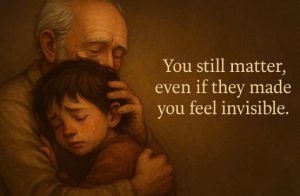
You still matter, even if they made you feel invisible.

Please tell me, in that warm voice of yours, like a soft summer breeze:

“You were not the reason adults hurt you.”
“You deserve love.”
“You can forgive yourself and begin again.”

Grandpa, I long for a hug.
For someone to sit beside me—not to scold, not to lecture—but just to listen and not walk away.

I don’t know if tomorrow will be any better,
but today, at least I said what I’ve been holding in for so long.

Thank you for reading this.

From the child who once thought they were the problem,
Your Grandchild 🧸

What They Did Wasn’t Your Fault – And It Never Was

Keyword focus: self-blame childhood trauma, forgiving yourself for the past

What They Did Wasn’t Your Fault—And It Never Was

Some wounds don’t scream. They whisper.

They whisper that maybe it was you. That you should have been quieter. Smarter. Better behaved. More lovable. They whisper until the echo becomes a belief: It happened because of me.

Let me say this with all the clarity an old soul can muster:

What they did to you was not your fault. And it never was.

The Lie Children Tell Themselves

When something terrible happens to a child, the world becomes unsafe—and children, eager to make sense of chaos, often come to the same heartbreaking conclusion: “It must be me.”

Why? Because it’s safer to believe you were the problem than to believe the people who were supposed to love you didn’t.

This belief becomes a scar deep in the psyche. And long after the bruises fade, the shame remains. It leaks into relationships, career choices, the way we talk to ourselves in the quiet moments.

Guilt and Shame: The Silent Twins

Guilt says, “I did something bad.” Shame says, “I am something bad.”

Many survivors of childhood trauma carry both.

They feel guilty for being “difficult children.” They feel shame for needing, for crying, for surviving. For being the ones who walked away but never quite felt free.

But here’s the truth: children cannot cause abuse. They cannot provoke neglect. They cannot deserve abandonment.

They can only react to what they are given. And no matter how they reacted, it was not a justification for mistreatment.

The Power of Rewriting the Story

You don’t get to rewrite the past, but you do get to rewrite what you believe about it.

You get to say:

  • “I was a child.”
  • “I didn’t cause this.”
  • “They were wrong.”
  • “I still matter.”

And yes, sometimes that truth is met with resistance. The part of you that still clings to self-blame might push back. That’s okay. You’re unlearning something you were taught in survival mode.

Forgiving the Child You Were

This isn’t about forgiving abusers. This is about forgiving yourself.

Forgive yourself for:

  • The ways you coped.
  • The things you didn’t understand.
  • The silence you kept.
  • The times you lashed out or shut down.

You did the best you could. And that child you were? They were brave in ways no one ever recognized.

You survived.

Healing Starts With the Truth

And the truth is this: you were innocent. You were worthy of love. And you still are.

The moment you stop blaming yourself is the moment you take your power back.

So today, when that old voice starts whispering again—tell it gently but firmly:

“I know better now. That was never my fault.”