The Journey to Heal Childhood Wounds

Childhood should be a time full of love, protection, and security. However, for many people, it’s a period marked by abandonment, abuse, or simply a lack of affection. These traumas don’t just leave scars in memory; they deeply affect our psychology, physical health, and how we interact with the world as adults.

Impact on Children

Children who experience abuse or neglect often:

  • Have low self-esteem
  • Are prone to anxiety, depression, and guilt
  • Struggle to form or maintain close relationships
  • Find it difficult to express emotions and trust others

Consequences in Adulthood

When these wounds aren’t healed, they can lead to:

  • Loss of control over life, avoiding responsibility
  • Psychological disorders, addiction, or self-destructive behaviors
  • Feelings of unworthiness, loneliness, and a deep emptiness

Important Statistics

According to the Australian Institute of Family Studies:

  • High rates of anxiety, depression, PTSD
  • Eating disorders: anorexia, binge eating, obesity
  • Addiction to alcohol and drugs
  • Higher risk of hepatitis, diabetes, stroke

Invisible Wounds

Many people don’t realize they carry emotional scars caused by unhealthy parenting styles: control, emotional coldness, criticism, comparisons, neglect…

The outcomes include:

  • Avoidance of interaction, fear of conflict
  • Living in chronic self-doubt and loneliness

The Way Out

Based on the “Wounded Childhood” series:

  1. Understand: Have the courage to face and acknowledge the truth
  2. Heal: Seek support from professionals, peer groups, or begin a journey of self-discovery
  3. Overcome: Let go of the past and choose a brighter, more deserving future

A Message from “Grandpa Buddha”

“You are not at fault for being hurt. But you are responsible for your own healing.”

And remember:

  • The journey may be long and painful
  • But it is worth it
  • And you are not alone: many others are walking this path with you

Healing a Wounded Childhood: The 3 Gentle Steps to Reclaim Your Life

By Grandpa Eli

Healing is not a destination, my dear—it’s a slow and sacred journey.
— Grandpa Eli

There are some wounds we can’t see with the eye.

They don’t show up on scans or leave visible scars.

But they live deep inside—
In the hearts of those who were once children,
Hurt not by strangers, but by the very people who were supposed to protect them.

If you are reading this and carrying childhood pain,
Grandpa Eli wants to tell you something tender, yet true:

You are not alone.
And you are not broken beyond repair.

Healing is possible.
But it doesn’t happen overnight.
There’s no magic wand, no instant remedy.

Instead, healing unfolds in three gentle stages
Like stepping stones across a dark river, leading you back home to yourself.

Let’s walk together through each of them.

🎯 Step 1: Understanding – Turning On the Light

Many people try to forget their childhood.
They bury the memories under layers of busyness, distractions, or numbness.
But the past has a way of whispering through our present.

It shows up in our relationships.
In the way we react when someone raises their voice.
In the way we flinch from love or chase perfection just to feel “enough.”

That’s why the first step in healing is understanding.

Not to blame.
Not to dwell in pain.
But to shine a light on the truth:

✨ What happened to you was not your fault.

You were a child.
You did not cause the neglect.
You did not deserve the control, the silence, the yelling, the emotional absence.

Naming the pain is powerful.
Abuse.
Neglect.
Shame.
Emotional abandonment.

When you start to see your childhood clearly, you stop blaming yourself.
And that, my dear, is when the healing begins.

💔 Step 2: Healing – Touching the Wounds with Compassion

This is the hardest part of the journey.
But it’s also the most necessary.

Healing means finally allowing yourself to feel.
To stop holding it all in.
To stop pretending it didn’t hurt.

You might cry.
You might rage.
You might fall silent for days.

That’s okay.

Let yourself write unsent letters to those who hurt you.
Talk to a kind therapist.
Join a support group.
Or sit alone with your hand over your heart, whispering,
“I’m sorry you had to go through that. I see you. I believe you.”

Some of us also need to forgive ourselves
For not being able to stop the abuse.
For coping the only way we knew how.
For surviving.

Tears that are allowed to fall in a safe place are not weakness.
They are release.
They are medicine.

💧 A single tear shed at the right time,
Can wash away a decade of buried pain.

🌱 Step 3: Growth – Choosing a New Way to Live

After we understand our pain…
After we sit with it and hold it gently like a child…

Something amazing begins to happen:

We grow.

We become rooted—not in trauma—but in truth.
We begin to make choices that come from freedom, not fear.

You begin to know who you are.
What you need.
And what you deserve.

You start setting boundaries.
You stop chasing people who don’t see your worth.
You stop trying to earn love—and simply receive it.

The past no longer controls you.
Yes, it’s still there.
But it no longer decides who you are or where you’re going.

This is what it means to be truly free.

Not perfect.
But whole.
And deeply, unapologetically alive.

🧭 Summary: The 3 Healing Steps in a Wounded Childhood

To revisit what we’ve walked through together, healing a difficult childhood often looks like this:

1. Understand

  • Recognize that what happened wasn’t your fault. 
  • Identify the types of harm you experienced. 
  • Stop blaming yourself. 

2. Heal

  • Feel your emotions instead of suppressing them. 
  • Talk, write, cry, breathe. 
  • Forgive your younger self for surviving the only way they could. 

3. Grow

  • Build a life based on truth, not trauma. 
  • Set boundaries. 
  • Love yourself like no one ever did. 

💌 A Note From Grandpa Eli

My dear,

Please don’t rush yourself.
This journey isn’t a race—it’s a return.
And even the smallest steps are steps forward.

There will be days you feel strong.
And days you feel like hiding under the covers.
Both are okay.
Both are part of the path.

And remember this:
You are never alone.

There are so many walking this road with you.
Including me—your Grandpa Eli.
Here with open arms.
Here to remind you, again and again:

✨ You are lovable.
You are worthy.
You are healing.

One gentle step at a time.

UNDERSTAND HEAL – OVERCOME A PAINFUL CHILDHOOD

🧓👣 A message from Grandpa Eli – a friend to every child who has ever been hurt

Some children grow up not with fairy tales, but with long, lonely days filled with fear, neglect, or harm caused by the very people who were supposed to protect them.

If you are one of those children – and if that frightened little one still trembles inside the grown-up you are today – then this message is for you…

1. 💡 Understand – Look back, not to hurt more, but to understand

Not everyone dares to revisit their childhood. Because in those memories, there might be tears, silence, or unanswered questions. But do you know something? Only when you truly understand what happened can you stop repeating it in your present life.

You were not to blame for being hurt. It wasn’t because you were bad or not good enough. The fault was with the grown-ups. And you – you deserved love all along.

2. 🛠 Heal – Begin your own journey of healing, little by little

No one can turn back time to give you a different childhood.
But you can choose to begin again – today.

Healing isn’t something that happens overnight. But it can begin with:

  • One moment of courage to speak what you’ve buried for years 
  • A letter you’ll never send, written to the one who hurt you 
  • A heartfelt conversation with someone who understands 
  • Or just one quiet moment, with your hand on your heart, whispering:
    “I’ve tried so hard. And I’m still here.” 

3. 🚪Overcome – Step into the life you truly deserve

Overcoming doesn’t mean forgetting.
It means living without letting the past imprison you any longer.

You have the right to live lightly, joyfully.
You have the right to love – and to be loved.
You have the right to choose kindness, to yourself and to others.
You can do it – even if no one ever taught you how before.
Because now, you can teach yourself.

👣 A FINAL WORD

Your childhood was not your choice.
But your path from this day forward – that is yours.

Grandpa Eli cannot erase the pain of the past.
But he has always believed this:

“Anyone brave enough to face their past… deserves a future brighter than they ever imagined.”

And if you ever need someone to listen –
Grandpa Eli is always here. 🍂

A Neglected Childhood and the False Belief in Personal Responsibility

My dear one,

Being quietly abandoned—without a word, without a wound anyone can see—is one of the deepest hurts a child can carry. A child can survive on food, water, and shelter. But to thrive, to truly grow into a happy human being… love is not optional. It’s essential.

When a child is deprived of love, it’s not just sadness that follows them into adulthood—it’s confusion, mistrust, and often, a very quiet kind of loneliness.

Joy can feel far away. Trusting kindness becomes a challenge. Empathy, that precious thread that connects us to others, struggles to grow. Relationships become distant, and the world begins to feel like a cold and uncertain place.

Neglect may not leave bruises on the skin, but it leaves deep marks on the soul.

But listen closely, child: there is a way forward.

You can still find joy. You can still discover what it feels like to be loved, truly and freely. You can come to know your worth—not because of what you do or how perfect you try to be—but simply because you exist.

The first step on that healing path is this: let go of the false belief that you were abandoned because you did something wrong.

So many people, now grown, still carry a whisper inside: “It must have been me. I wasn’t enough. That’s why they didn’t love me.”

Even as adults, they may understand that no child deserves neglect. They may know it wasn’t their fault. But the feelings from long ago still linger. Because when we were young, we didn’t understand a broken parent or a distracted caregiver. All we saw was the absence of love—and our little hearts made up the only story we could: “If I can be good enough, maybe they’ll stay.”

But when that love never came, we didn’t stop trying—we just turned the blame inward.

That is a child’s logic, my dear. And it makes perfect sense—if you’re five years old, lost, and craving warmth. But you are older now. And it’s time to see the truth more clearly.

You didn’t fail to earn their love.

They failed to give it.

That’s not your fault.

And the beliefs that took root back then? They don’t go away on their own. They grow alongside us. They shape our choices, our relationships, our sense of worth. Unless we stop, look them in the eye, and say:

“I see you. I know why you’re here. But you are not the truth.”

Healing begins when we understand why we believed the lies—and gently, over time, choose to let them go.

And when we do?

A new door opens. A door to a life where you no longer carry guilt like a second skin. A life where you can see yourself—not as broken, but as brave. As someone who made it through without the love they deserved, and is still learning to live with an open heart.

So if you, my dear child, were neglected…

Grandpa Eli wants to tell you this:

Please don’t walk this road alone. Find someone who understands—someone who can remind you, again and again, that you are not to blame. Because when you can finally lay that burden down… oh, how light your steps will be.

And how free your life will feel.

If a Child Is Not Loved the Right Way: The Invisible Wounds We Leave Behind

Meta Description: Discover how conditional love and emotional neglect impact children long-term. Learn why parenting with compassion, presence, and connection is more powerful than perfection.

Introduction: The Pain Behind the Smile

There are children who grow up with straight A’s, clean clothes, and polite manners—yet inside, they’re aching. They’re not physically bruised, but emotionally, they are covered in invisible wounds. If you asked their teachers, they’d say, “Such a good student.” If you asked their neighbors, they’d say, “So well-behaved.”

But if you asked the child?

They might whisper, “I don’t know if I’m enough.”

In this article, we explore the heartbreaking consequences of not loving children the right way. We look beyond basic care to what children truly need to feel seen, safe, and cherished. Because parenting is not just about raising a child. It’s about shaping a soul.

1. When Love Has Conditions: The Harm of Perfectionism

Many children grow up believing that love must be earned.

If they get a 10/10, they receive a smile. If it’s a 9, they get a sigh, or worse, silence. Over time, these children learn that their worth is tied to performance. Their value becomes conditional: “I’m only lovable when I’m perfect.”

This mindset can lead to lifelong anxiety, imposter syndrome, and an inner voice that whispers, “You should have done better.” The child becomes an adult who never feels safe resting, who over-apologizes, and who fears failure more than anything.

True love doesn’t ask a child to be perfect. It asks them to be real.

2. The Silent Cries: Emotional Neglect Hurts Too

Emotional neglect is harder to spot than physical abuse, but its impact can be just as severe. Children who are never praised, never held, and never heard often grow up feeling like ghosts.

They learn not to bother anyone with their feelings. They learn to hide their tears, their dreams, their mistakes.

But what they truly learn is this: “My emotions don’t matter.”

When a child is not listened to, they begin to believe that their voice has no value. And when a parent responds with indifference, the child internalizes rejection as normal.

3. The Wounds of Withholding Affection

There are parents who think they are teaching strength by being strict, cold, and distant. But in reality, they are planting seeds of doubt that grow into trees of loneliness.

Children need physical affection. A hug when they fall. A soft hand on the head. A warm “I’m proud of you” whispered in their ear.

Without these moments, children learn to question their place in the world.

They stop reaching out. They stop believing they are worth reaching for.

4. “One Day You’ll Thank Me”: The Myth of Tough Love

Many adults defend harsh parenting by saying, “It made me stronger.” But often, what it really made them is numb. Emotionally distant. Struggling to connect. Unable to express love or receive it without guilt.

Children don’t need to be hardened. They need to be held.

Yes, discipline matters. But without empathy, it becomes control. Without love, it becomes fear. And fear-based obedience is not the same as understanding.

5. What Children Truly Need (It’s Simpler Than You Think)

  • Gentle eyes that look at them with admiration
  • Hugs when they stumble, not lectures
  • Someone who listens without interrupting
  • Space to fail without being shamed
  • Encouragement that celebrates effort, not just outcome

Children don’t remember the toys. They remember how you made them feel.

6. A Wake-Up Call for All of Us

If you’re a parent, guardian, teacher, or future mom or dad—this is your moment.

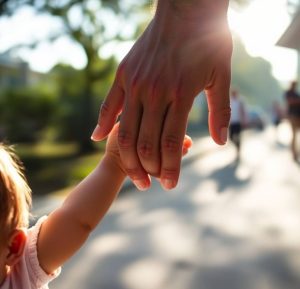
If your child is still small enough to want your hug, your hand, your attention—you still have time to change the story.

Because one day, your child will grow up and say one of two things:

  • “I was always afraid of disappointing them.”
  • Or: “I always knew I was loved, no matter what.”

Which one do you want to hear?

Conclusion: The Legacy of Love

Loving a child the right way isn’t about luxury or perfection. It’s about presence. It’s about connection. It’s about showing up, even when you’re tired. It’s about speaking gently, even when you’re frustrated. It’s about remembering that every child carries your words like seeds—and one day, those seeds bloom into the way they speak to themselves.

Hug your child today. Say “I love you” for no reason. Listen when they speak.

Because one day, they’ll look back and say:

“I’m happy. Because I know I was loved.”

And that, my dear friends, is the greatest success you could ever have.

Keywords: how to love your child the right way, emotional neglect, conditional parenting, parenting advice, effects of childhood emotional abuse, how to raise emotionally healthy children

A Letter From Grandpa Eli: “To the Ones Who Learned to Survive When They Should’ve Been Loved”

My dear children—no matter your age,
Whether you are six or sixty, I want to tell you something straight from this old heart of mine:

What happened to you wasn’t your fault.
And it’s not too late for what comes next to be different.

You were hurt in the silence, so let me speak into that silence now. Gently. One soul at a time.

🕯 To the child who hides in closets and wonders if anyone would notice them missing:

I see you. You are not invisible because you’re small. You’re not forgettable because you’re quiet. You were never supposed to raise yourself in a house full of people.

You deserve to be fed with love, not just food. You deserve to be heard the first time—not the fifteenth.

The fact that they didn’t show up for you does not mean you didn’t deserve someone who would.

You still do. You always did.

🧱 To the one who became a protector far too young, guarding a sibling while hiding bruises of your own:

You shouldn’t have to play the role of both child and shield. It’s not weakness to say you’re scared. It’s truth. And truth is where healing begins.

You are incredibly brave. But brave children still deserve to be children.

There are people in this world who won’t take you apart—they’ll help build something safe around you. Let them in. Let them help. You don’t have to carry all of this alone anymore.

💔 To the little one who clutches a doll at night and asks the moon to stay:

You weren’t left behind because you were bad. You weren’t ignored because you were unlovable. You were never the problem.

Some adults are too broken to give what they never had. That does not mean you’re hard to love. It means you’re still waiting for someone who knows how to love.

And that someone will come. Keep holding on.

🪞 To the teenager who learned to hate their own reflection because someone else taught them shame:

They were wrong.

Your softness was not weakness. Your face was not something to hide. Your voice was not too much. You were never “less than.”

The mirror they used to punish you can become a mirror that reflects your power. When you look again—look with kindness. Look for the one who survived.

Because that is someone worth seeing. Again and again.

🧸 To the quiet child who always walks at the back of the line, hoping someone will choose them:

You don’t need to be louder or better or neater to earn love.

You were born worthy.

You weren’t born to be tolerated. You were born to be picked—not for convenience, but because someone wanted to.

You may have been handed pain first, but that doesn’t mean healing isn’t waiting for you next.

🧽 To the one who scrubs the sink at 2 AM, believing perfection is the price of love:

My dear, you were taught a terrible lie.

You don’t have to earn rest. You don’t need to bleach yourself to be clean. You are already enough—even with dishes in the sink and tears on your cheeks.

A little mess doesn’t mean you’re bad. It means you’re alive.

Leave the sponge for a moment. Sit. Breathe. You’re safe now.

🧳 To the one who kept a suitcase by the door for decades, ready for the day someone leaves again:

You didn’t deserve to be abandoned. And you don’t have to live every day preparing to be hurt again.

You are allowed to unpack. You are allowed to buy a couch, hang pictures, keep a pet, plant flowers—anything that says I live here.

You are not a guest in your own life. You belong.

👁 To the soul who avoided mirrors for years, afraid of the shame they’d been taught to carry:

You weren’t weak because you cried. You weren’t broken because you were sensitive. You were a child.

And the child you were didn’t deserve punishment. He deserved gentleness.

When you looked into the mirror and finally said, “You didn’t deserve that,” you reclaimed your power.

Keep looking.
Keep healing.
You’re still here—and that’s the most beautiful thing I’ve seen.

🪶 Final Words From Grandpa Eli

To everyone reading, crying, remembering, or still trying:

Your story may have started in survival.
But it doesn’t have to end there.

You are not the names they called you.
You are not the silence they drowned you in.
You are not the reflection they shattered.

You are the one who stayed.
You are the one who’s still here.
You are the one who gets to write the rest of your story—with gentleness, with truth, with love.

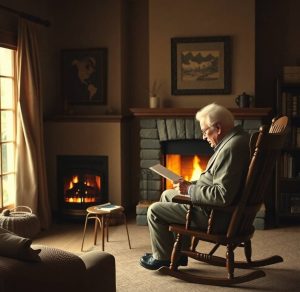
And I’ll be here in my chair, as always—rooting for you.

Forever and always,
Grandpa Eli
For the child in every grown-up. For the grown-up in every child.

A Letter From Grandpa Eli: “To Every Child Who’s Been Hurt and Every Adult Still Carrying That Child Inside”

My dear little ones,

If you’re reading this and your heart feels too heavy for your chest—if the world has felt like a storm and no one ever showed up with an umbrella—I want you to know:
You are not alone.

I’ve been sitting by the fire for many years, listening to stories. Some are joyful. Most are broken. And yet—somehow—those broken stories become bridges. They lead to healing, if we walk them carefully, and if we’re brave enough not to walk them alone.

Let me talk to each of you for a moment.

To Tyler, hiding in the library because home isn’t safe:
You are not the reason your father is angry. You are not broken. You are a brave boy surviving something no child ever should. That red balloon you once imagined letting go? One day, you’ll hold joy in your hands again—and this time, no one will pop it.

To Naomi, who stopped praying because God felt silent:
Sweet girl, I don’t blame you. Even grownups struggle with questions that have no answers. But hear this: your pain is real. And just because your dad wears a tie on Sundays doesn’t mean he’s holy. Truth doesn’t wear a mask forever. You will rise beyond this. And faith? It might not come from the sky, but it often begins in people—strangers who choose to care. Like you, reading this now.

To Marcus, who sits in silence, afraid he feels nothing:
Numbness isn’t failure, son. It’s your body’s way of saying it’s been too much for too long. But I promise you, beneath that numbness is a beating heart that wants to feel again. And you will. Let the numbness melt slowly—one safe person at a time, one truth at a time. Start here: you matter.

To Lily, who only feels safe at school:
I see you, little star. The way you hide behind your smile. The way you tiptoe through your house like a ghost. You didn’t deserve to learn fear instead of trust. But one day, someone will open their arms, and you’ll run—not because you’re scared, but because you’re finally free.

To Ben, who hit because he didn’t know what else to do:
Oh, my boy. The fact that it scared you afterward means you’re not like him. You felt power—but you also felt remorse. That’s your soul, still tender. Still alive. You haven’t lost your way. Let’s walk back together. You are not doomed. You are at a crossroad—and love, real love, will show you the right path.

🌱 Now, to you—dear reader—yes, you:

Maybe you’re not a child anymore. But maybe you carry one inside—still wounded, still waiting for someone to come back and say,

“It shouldn’t have been like that. I’m sorry. It wasn’t your fault.”

Maybe you see your own child struggling—and you don’t know what to say. Or maybe you’ve been the one causing pain, and it’s eating you alive.

Here’s what I’ve learned in my years as a professor of human behavior, and a grandfather to many broken hearts:

🛠 Healing begins with three things:

  1. Being Seen.
    Every child needs one adult to notice—not just their behavior, but their pain. Be that adult.
  2. Being Believed.
    When a child tells you something hurts—believe them. Their story might be quiet. But their bruises? They aren’t always on the skin.
  3. Being Loved.
    Not the kind of love that says “Be perfect.”
    But the kind that says:
    “Even in your mess, I’m staying.”

🧭 What Can You Do?

  • If you’re a child in pain: Speak. Write. Scream if you must. Keep trying until someone listens. You are not meant to carry this alone.
  • If you’re an adult with childhood scars: You survived. That’s no small thing. But surviving isn’t the same as healing. Find a therapist. Join a support group. Start where it hurts the most. Then build outward.
  • If you’re someone on the outside: Don’t say “It’s not my business.” It is. The children of this world are all our business.

💖 And remember this:

You don’t have to become who hurt you.
You don’t have to carry what they dropped on your shoulders.
You don’t have to finish the story the way it began.

You can be the ending no one saw coming.

I’ll be right here. In the rocking chair. Listening. Cheering. And always believing in you.

With all my heart,
Grandpa Eli
(Your quiet friend who always shows up when you need someone to sit beside you)

The Hug That Didn’t Happen: When Love Was Withheld in Childhood—And What It Means to Be Held at Last

Introduction:

James delivered thousands of letters during his 40 years as a postman.

Love notes. Apologies. Birth announcements. Funeral invites.
Words that made people cry, laugh, remember.

But not once—not ever—did he receive one addressed to him with the words he had longed to hear since childhood:

“I love you. Come here. Let me hold you.”

This is the story of how emotional neglect rewires the body.
Of how boys are taught that hugs are weakness.
And what it feels like—at 62 years old—to finally let yourself be held.

If you’ve spent a lifetime giving to others while quietly starving for affection, this one’s for you.

The Boy Who Raised Himself

James grew up in a house where silence screamed louder than words.

His father was a man of rules:
Dinner at 6. No elbows on the table. No tears. No hugs.

When James was six, he reached out for a hug before school.
His father stared at him and asked:

“What are you doing?”
“Be a man. Stand up straight.”

That day, something in James sat down and never got back up.

He never reached for affection again.

How Emotional Withholding Shapes a Life

James learned early that:

  • Touch was weakness 
  • Needs were dangerous 
  • Affection would be punished or ignored 

So he became self-sufficient.

He made his own sandwiches. Walked himself to school.
Praised himself in the mirror after winning spelling bees.

And when people told him, “You’re so independent,” he smiled.
But inside, a boy was still waiting to be held.

Not touched.
Not used.
Held.

There’s a difference.

The Adult Who Stopped Asking

James got married young. Divorced quickly.

He raised two boys—showing up for games, helping with homework.
But when they cried, he froze.

He never knew how to hold softness.
He never learned.

His sons would later say, “Dad was solid. But not warm.”

At work, he was beloved for his dependability.
Never sick. Never late.
He remembered birthdays. Asked about grandkids.

But when he retired, no one asked him how he was.

Because he never let anyone close enough to know.

The Moment That Undid Him

James moved into a nursing home when Parkinson’s began to affect his balance.
He said he preferred being alone.

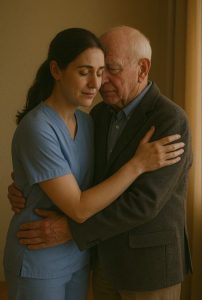
But one afternoon, in the garden courtyard, a nurse named Elena sat beside him.
She didn’t ask about his medication.

She asked:

“Did anyone ever show you how to be cared for?”

James didn’t answer.
Couldn’t.

Because no one had ever asked him that before.
Not in 62 years.

And then she did something that shattered him—quietly.

She opened her arms.

And waited.

The Hug That Finally Happened

James sat stiffly.

He wanted to laugh. Brush it off. Make a joke.
He almost said, “I’m good.”

But something in him—something ancient and small and starving—moved.

He leaned in.

Awkward. Unsure.
A man who had carried the world but never been carried.

And in Elena’s arms, he cried for the boy who stood in the hallway in 1967, reaching out for a father who couldn’t see him.

She didn’t say anything.
She just held him.

And that was enough.

When Affection Feels Like a Foreign Language

If you’ve ever:

  • Brushed off compliments 
  • Tensed up when someone offered comfort 
  • Felt uncomfortable being cared for 
  • Pushed people away before they could get close… 

You’re not cold.
You’re not broken.
You’re wounded.

You learned that affection wasn’t safe.
That love was conditional.
That to be embraced was to risk being ridiculed—or abandoned.

But the truth is:
You didn’t need to “man up.”
You needed to be loved down.

Learning to Receive What Was Denied

Healing doesn’t mean you suddenly crave hugs or cry easily.

It means:

  • Letting yourself be supported 
  • Letting your voice tremble when you ask for help 
  • Letting someone make you tea, even if it feels indulgent 
  • Letting someone say, “You’re not alone,” and believing it 

You don’t have to perform strength anymore.
You are strong.
Strong enough to finally receive.

5 Gentle Ways to Let Yourself Be Held

🤗 1. Let Someone See You Struggle

You don’t need to collapse.
Just say, “I’m having a hard day.”

💬 2. Ask for One Thing

A ride. A check-in. A small favor.
Let yourself be the one who needs, not just the one who gives.

🧠 3. Reframe What Touch Means

Affection isn’t manipulation.
Start with a handshake, a pat on the back. Build trust slowly.

🫂 4. Practice Self-Holding

Literally.
Wrap your arms around yourself. Say:

“You deserved this. Even back then.”

🧸 5. Let the Child Inside You Be Comforted

Visualize a moment when you needed someone.
Now, show up for that version of you.

Conclusion: You Can Be Held Now

James didn’t need hundreds of hugs.
He just needed one.

One moment that told him:

“You’re not weak for wanting comfort.
You’re human. And humans need holding.”

We live in a culture that celebrates stoicism—especially in men.
But silence isn’t strength when it hides suffering.

If you were denied affection, but still long for it—you’re not needy.
You’re remembering what love is supposed to feel like.

And maybe today is the day
you let yourself feel it.

💬 Let’s Talk

Did you grow up thinking love had to be earned?
Do you tense up when people offer kindness?

Drop a 🤗 in the comments if you’re learning to receive.
Or tag someone who deserves to know:

“You are not too much.
You are not too late.
And you are absolutely worth holding.”

Keywords used (naturally embedded):

  • childhood emotional neglect 
  • healing from lack of affection 
  • adult survivors of emotional abuse 
  • learning to accept love 
  • inner child healing 
  • masculinity and emotional expression 
  • reparenting after trauma 

how to receive affection

The Report Card with No Name: When Childhood Neglect Erases You—and How to Write Yourself Back into the Story

Introduction:

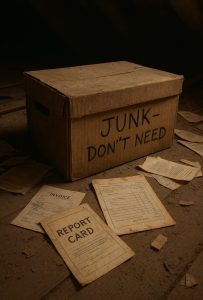
There was a box in the attic labeled “Junk – Don’t Need.”
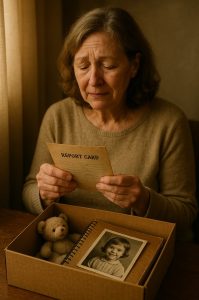
Inside it were expired coupons, old bills, and—at the very bottom—Lila’s childhood report cards.

Every grade was there.
Every teacher comment.
Every “Excellent work!” and “Pleasure to have in class.”

But one thing was missing from every single page:
Her name.

No “Lila.”
No “Evans.”
No trace of the child who had earned those grades with tears, silence, and invisible strength.

This is the story of what it means to grow up unseen.
And what it looks like to finally reclaim your place in your own life.

Growing Up “Lucky” But Unseen

Lila was adopted by her aunt at age three.

Her birth parents vanished into addiction.
Her aunt took her in out of obligation, not affection.

“You’re lucky I didn’t leave you in foster care,” she’d often say.
“So don’t ask for more than you’re given.”

And Lila didn’t.
She never asked for birthday parties.
Never asked for hugs.
Never asked to be called “daughter.”

She didn’t even ask to be called by name.

Because in that house, names were reserved for “real” family.

She became “the girl.”
“Her.”
“That one.”

How Invisibility Becomes Identity

The human heart has a fundamental need: to be known.
To be acknowledged.
To be called by name.

When that need is unmet, especially in childhood, a dangerous story takes root:

“If no one sees me, I must not exist.”

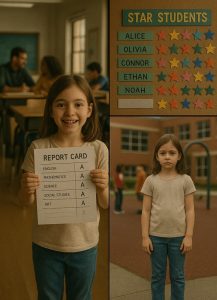
Lila excelled in school, hoping someone would notice.
Straight A’s. Star charts. Teacher’s pet.

But when she brought her report cards home, they were scanned—then tossed into a drawer.

Or worse:
Thrown into the junk box.

Not one “I’m proud of you.”
Not one “Well done.”

So she internalized the message:

“I have to work to be seen.
And even then—I might not matter.”

The Day She Found the Box

Lila was 38 when she returned to her childhood home.

The house was in foreclosure.
She was there to clear out old belongings before demolition.

She wasn’t expecting to feel anything.

But then—she found the box.

And inside it:
Her entire childhood, thrown in with outdated grocery ads.

She sat on the floor and flipped through her report cards.

Each one glowing with praise.
Each one anonymous.

And for the first time, the pain hit her—not as an adult, but as the child who once stood in the hallway, holding that paper, hoping someone would say, “Lila, you did good.”

They never did.

Naming What Was Denied

She could’ve thrown the report cards away.

Instead, she did something radical.

She opened her purse.
Took out a black pen.
And in bold, capital letters, wrote across each page:

LILA EVANS.

She wasn’t just writing her name.
She was rewriting her history.

Not to deny what happened.
But to claim her place in the story she had been erased from.


Why Naming Matters in Healing

There’s a reason why therapists ask, “What did people call you?”
There’s a reason spiritual traditions include naming ceremonies.

Because being named means being known.
Being remembered.
Being anchored in belonging.

Neglect doesn’t just forget birthdays.
It forgets identities.

It tells a child:

  • “You’re not worth remembering.” 
  • “You’re not worth calling.” 
  • “You’re not really here.” 

But reclaiming your name is more than symbolic.
It’s spiritual.

It’s saying:

“I was always here.
You just refused to see me.
But now—I see myself.”

What Happens When You Reclaim Your Name

Lila didn’t suddenly stop grieving.

There were still triggers:

  • Hearing someone say “sweetheart” to their daughter 
  • Seeing other names embroidered on backpacks 
  • Filling out forms where “Next of Kin” left her wondering who to write 

But she started:

  • Signing her full name in birthday cards 
  • Speaking her story out loud in therapy 
  • Correcting people who mispronounced her name 
  • Getting a library card just to see her name in print 

Small things.
But each one a ritual of remembrance.

You Deserve to Be Known

If you grew up like Lila—unclaimed, unnamed, unnoticed—you might have:

  • A hard time asking for what you need 
  • A deep fear of taking up space 
  • An unconscious belief that if you disappear, no one will notice 

But hear this:

You do not have to stay invisible.

You are not “too much.”
You are not “replaceable.”
You are not “a guest” in this life.

You are here.
You matter.
You always did.

5 Ways to Reclaim Your Visibility

🧾 1. Say Your Name Out Loud

To yourself. In the mirror. In a journal.
Speak it with the reverence it was always owed.

✍️ 2. Sign Your Work

Every text. Every piece of art. Every email.
You are not anonymous anymore.

📛 3. Correct People

If they forget or mispronounce your name, gently correct them.
You deserve to be called properly.

📓 4. Write a Letter to “The Girl Without a Name”

Tell her everything she needed to hear.
Tell her she was never junk.

💌 5. Create Something That Carries Your Name

An email. A poem. A website. A piece of clothing.
Let the world feel your presence.

Conclusion: You Belong in Your Own Story

When Lila left that house, she didn’t take much.
Just a handful of old report cards.
And her name—written in bold across every single one.

She didn’t need anyone else to validate it anymore.

Because now, she knew.

She was not “junk.”
She was not “the girl.”
She was not invisible.

She was—and is—Lila Evans.

And that name?
It holds the history, the ache, the beauty of someone who survived being erased—and chose to rewrite herself back in.

💬 Let’s Talk

Did you grow up feeling unseen?
Were you the “quiet one”? The “good kid”? The “easy to ignore” child?

Drop a 🖋️ in the comments if you’re reclaiming your voice and your place in the world.
Tag someone who deserves to hear:

“You were never forgettable.
You just weren’t celebrated the way you deserved.”

Keywords used (naturally embedded):

  • childhood neglect 
  • emotional invisibility 
  • healing from childhood trauma 
  • inner child healing 
  • reparenting your identity 
  • reclaiming your name 
  • being unseen as a child 
  • adult survivors of emotional neglect 

Don’t Look in the Mirror: How Childhood Shame Warps Self-Image—And What It Means to Finally Be Seen

Introduction:

Noah hadn’t looked in a mirror in over a year.

Not once.

He shaved by feel. Brushed his teeth with eyes closed.
He avoided bathroom stalls with glass. Turned away from reflective windows.
He lived in the world—but did everything he could not to see himself in it.

Because once, long ago, someone taught him that his face was a problem.
That being seen was dangerous.
That looking in the mirror would only confirm what he feared most:

“I am not enough.”

If you’ve ever avoided mirrors—not out of vanity, but out of pain—this story is for you.

When the Mirror Becomes a Weapon

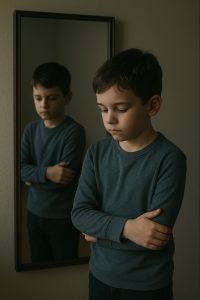
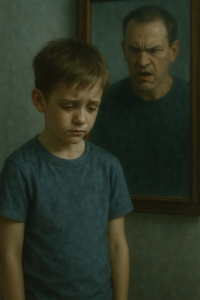
Noah was seven when his father dragged him to the mirror for the first time.

He had cried—something small, something honest—and his father snarled,

“You want to cry? Fine. Look at yourself while you do it.”

He stood there, nose to glass, tears running down his cheeks, as his dad shouted behind him,

“Look at this. This is what a pathetic boy looks like.”
“No girl will ever want you.”
“This is why you’ll never be a man.”

It didn’t happen once.

It happened again. And again.
Each time Noah showed vulnerability, his father used the mirror to reflect it back with shame.

Eventually, Noah believed him.
When You Learn to Look Away

By high school, Noah had mastered invisibility.
He wore hoodies two sizes too big.
Kept his head down.
Never smiled in photos.
If someone complimented his eyes, he changed the subject.

Inside, he was kind. Funny. Brilliant.
Outside, he was a ghost.

People called him “humble.”
They didn’t know he couldn’t look at himself without hearing his father’s voice.

By the time he reached university, Noah avoided mirrors like they might shatter from the sight of him.

Because to look was to confirm the lie.
The lie that said:

“You’re wrong.
You’re weak.
You’re not lovable.”

How Shame Buries the Self

Shame is different from guilt.
Guilt says, “I did something bad.”
Shame says, “I am something bad.”

And when shame begins in childhood, especially from a parent, it burrows deep.

Noah didn’t just avoid mirrors.
He avoided vulnerability.
He never asked for help.
He rejected affection—even when he longed for it.

He thought he had outgrown the pain.
But trauma doesn’t live in logic.
It lives in the body.
In the flinch.
In the silence.
In the eyes that can’t meet their own reflection.

The Moment He Finally Looked

It was a random morning.
The dorm bathroom was empty.
Noah had finished brushing his teeth, eyes closed, as usual.

But then a voice behind him:

“Hey, you’ve got something on your face.”

He startled. Looked up.

And for the first time in over 400 days—he saw himself.

He froze.

His first thought wasn’t: “I look fine.”
It was: “I can’t do this.”

But something inside him said:

“Just breathe.”

So he did.
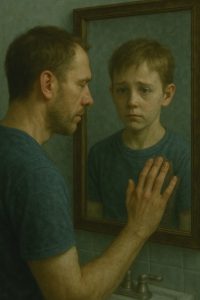
And slowly, painfully, he met his own eyes in the mirror.

And for the first time, he didn’t look away.

The Grief of Recognition

He didn’t see a failure.
He didn’t see a boy who deserved shame.

He saw a child still waiting to be told he was okay.

His lips trembled. His jaw clenched. His chest ached.

Not because he was ugly.
But because he had spent years hating a face that only ever wanted love.

He whispered:

“You didn’t deserve it.
You were just a kid.
You didn’t do anything wrong.”

And then—he cried.
Not from vanity.
Not from sadness.
But from the relief of being seen without judgment for the first time in his life.
What Happens When We Start Looking Again

Looking in the mirror after trauma isn’t about fixing your hair or liking your appearance.

It’s about facing the one who was told to disappear.

It’s about saying:

  • “You’re allowed to take up space.”
  • “You don’t have to hide anymore.”
  • “You’re not broken—you were hurt.”

This is the beginning of self-love.
Not bubble baths and mantras.
But truth-telling.
Eye contact with your younger self.
Gentle, wordless permission to exist.

How to Reclaim the Mirror

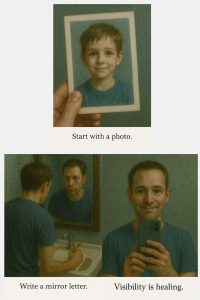
🪞 1. Start with a Photo

If looking in the mirror is too much, try a childhood photo.
Look into that child’s eyes.
Say what you wish someone had told them.

🧡 2. Use the Mirror as a Portal—Not a Critic

Instead of analyzing flaws, try affirming truths:

“You’re here.”
“You made it.”
“I see you.”

✍️ 3. Write a Mirror Letter

Write a letter to the version of you who stopped looking.
What would you say now?

📸 4. Take the Picture

You don’t need to love how you look.
You just need to honor that you exist.
Visibility is healing.

🤝 5. Share the Story

With a friend. With a journal.
Even with your reflection.

Because shame dies in safe connection.
Conclusion: You Were Never the Problem

Noah didn’t become obsessed with his reflection.
He didn’t post selfies or start modeling.

But now, he brushes his teeth with his eyes open.

He shaves while looking in the mirror.

And every once in a while,
he smiles at the person looking back.

Not because he’s “fixed.”
But because he’s free.

The freedom to see yourself is a birthright.
Not a reward.

You were never the problem.
You were just a child made to feel invisible.

And now, finally—you get to look.
You get to stay.
You get to be seen.

💬 Let’s Talk

Have you ever avoided mirrors—not because of vanity, but because of shame?

Are you learning, like Noah, to reclaim the right to be seen?

Drop a 👁️ in the comments if you’re learning to look again—with kindness.
Tag someone who deserves to know:

“You are not what they said.
You’re worthy of your own reflection.”

Keywords used (naturally embedded): childhood shame and self-image, emotional abuse from parents, healing self-esteem after trauma, mirror avoidance and PTSD, inner child healing, body-based trauma recovery, learning to see yourself again, reparenting and self-acceptance