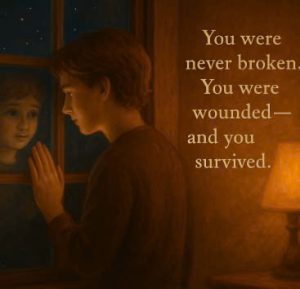
Don’t Look in the Mirror: How Childhood Shame Warps Self-Image—And What It Means to Finally Be Seen

Introduction:

Noah hadn’t looked in a mirror in over a year.

Not once.

He shaved by feel. Brushed his teeth with eyes closed.
He avoided bathroom stalls with glass. Turned away from reflective windows.
He lived in the world—but did everything he could not to see himself in it.

Because once, long ago, someone taught him that his face was a problem.
That being seen was dangerous.
That looking in the mirror would only confirm what he feared most:

“I am not enough.”

If you’ve ever avoided mirrors—not out of vanity, but out of pain—this story is for you.

When the Mirror Becomes a Weapon

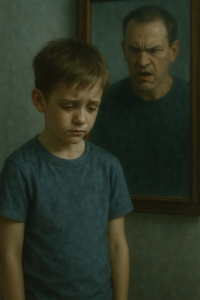
Noah was seven when his father dragged him to the mirror for the first time.

He had cried—something small, something honest—and his father snarled,

“You want to cry? Fine. Look at yourself while you do it.”

He stood there, nose to glass, tears running down his cheeks, as his dad shouted behind him,

“Look at this. This is what a pathetic boy looks like.”
“No girl will ever want you.”
“This is why you’ll never be a man.”

It didn’t happen once.

It happened again. And again.
Each time Noah showed vulnerability, his father used the mirror to reflect it back with shame.

Eventually, Noah believed him.
When You Learn to Look Away

By high school, Noah had mastered invisibility.
He wore hoodies two sizes too big.
Kept his head down.
Never smiled in photos.
If someone complimented his eyes, he changed the subject.

Inside, he was kind. Funny. Brilliant.
Outside, he was a ghost.

People called him “humble.”
They didn’t know he couldn’t look at himself without hearing his father’s voice.

By the time he reached university, Noah avoided mirrors like they might shatter from the sight of him.

Because to look was to confirm the lie.
The lie that said:

“You’re wrong.
You’re weak.
You’re not lovable.”

How Shame Buries the Self

Shame is different from guilt.
Guilt says, “I did something bad.”
Shame says, “I am something bad.”

And when shame begins in childhood, especially from a parent, it burrows deep.

Noah didn’t just avoid mirrors.
He avoided vulnerability.
He never asked for help.
He rejected affection—even when he longed for it.

He thought he had outgrown the pain.
But trauma doesn’t live in logic.
It lives in the body.
In the flinch.
In the silence.
In the eyes that can’t meet their own reflection.

The Moment He Finally Looked

It was a random morning.
The dorm bathroom was empty.
Noah had finished brushing his teeth, eyes closed, as usual.

But then a voice behind him:

“Hey, you’ve got something on your face.”

He startled. Looked up.

And for the first time in over 400 days—he saw himself.

He froze.

His first thought wasn’t: “I look fine.”
It was: “I can’t do this.”

But something inside him said:

“Just breathe.”

So he did.
And slowly, painfully, he met his own eyes in the mirror.

And for the first time, he didn’t look away.

The Grief of Recognition

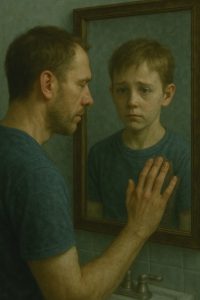
He didn’t see a failure.
He didn’t see a boy who deserved shame.

He saw a child still waiting to be told he was okay.

His lips trembled. His jaw clenched. His chest ached.

Not because he was ugly.
But because he had spent years hating a face that only ever wanted love.

He whispered:

“You didn’t deserve it.
You were just a kid.
You didn’t do anything wrong.”

And then—he cried.
Not from vanity.
Not from sadness.
But from the relief of being seen without judgment for the first time in his life.
What Happens When We Start Looking Again

Looking in the mirror after trauma isn’t about fixing your hair or liking your appearance.

It’s about facing the one who was told to disappear.

It’s about saying:

  • “You’re allowed to take up space.”
  • “You don’t have to hide anymore.”
  • “You’re not broken—you were hurt.”

This is the beginning of self-love.
Not bubble baths and mantras.
But truth-telling.
Eye contact with your younger self.
Gentle, wordless permission to exist.

How to Reclaim the Mirror

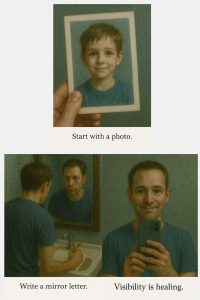
🪞 1. Start with a Photo

If looking in the mirror is too much, try a childhood photo.
Look into that child’s eyes.
Say what you wish someone had told them.

🧡 2. Use the Mirror as a Portal—Not a Critic

Instead of analyzing flaws, try affirming truths:

“You’re here.”
“You made it.”
“I see you.”

✍️ 3. Write a Mirror Letter

Write a letter to the version of you who stopped looking.
What would you say now?

📸 4. Take the Picture

You don’t need to love how you look.
You just need to honor that you exist.
Visibility is healing.

🤝 5. Share the Story

With a friend. With a journal.
Even with your reflection.

Because shame dies in safe connection.
Conclusion: You Were Never the Problem

Noah didn’t become obsessed with his reflection.
He didn’t post selfies or start modeling.

But now, he brushes his teeth with his eyes open.

He shaves while looking in the mirror.

And every once in a while,
he smiles at the person looking back.

Not because he’s “fixed.”
But because he’s free.

The freedom to see yourself is a birthright.
Not a reward.

You were never the problem.
You were just a child made to feel invisible.

And now, finally—you get to look.
You get to stay.
You get to be seen.

💬 Let’s Talk

Have you ever avoided mirrors—not because of vanity, but because of shame?

Are you learning, like Noah, to reclaim the right to be seen?

Drop a 👁️ in the comments if you’re learning to look again—with kindness.
Tag someone who deserves to know:

“You are not what they said.
You’re worthy of your own reflection.”

Keywords used (naturally embedded): childhood shame and self-image, emotional abuse from parents, healing self-esteem after trauma, mirror avoidance and PTSD, inner child healing, body-based trauma recovery, learning to see yourself again, reparenting and self-acceptance

The Rain Came After the Funeral: Grieving the Parent Who Hurt You—And Forgiving the Child You Were

Grief isn’t always clean.

Some people cry at funerals. Others stand still, arms crossed, heart numb. Some weep for what was lost. Others ache for what was never there.

This is the story of Devon—a man who didn’t shed a single tear when they lowered his mother’s casket into the ground.

Because he wasn’t grieving her death.
He was grieving something far more complicated:
The childhood he never got.

If you’ve ever buried a parent who left you with more scars than smiles, this story is for you.

This is the story of Devon—a man who didn’t shed a single tear when they lowered his mother’s casket into the ground.
This is the story of Devon – a man who didn’t shed a single tear when they lowered his mother’s casket into the ground.

What No One Talks About: Grieving an Abuser

When Devon was ten years old, he brought home a drawing from school.
It was a house with a garden. A sun. Two smiling people.
He gave it to his mom. She barely glanced at it before snapping,

“You call this art? It looks like trash.”

He stopped drawing after that.

His mother didn’t hit often.
But her words sliced deeper than any bruise.
And what made it harder was this:

Everyone else thought she was lovely.

Polite in public.
Helpful at church.
Always “tired from working so hard.”

But at home, Devon was “too sensitive.”
“Too dramatic.”
“Too much.”

So he learned to shrink himself.

And that version of him—the one who held his breath every time she entered the room—was the one who stood at her funeral, dry-eyed, feeling… nothing.

The Lie Children of Trauma Carry

Children are wired to love their parents, no matter what.
And when love isn’t returned in a healthy way, the child doesn’t stop loving.
They stop trusting themselves.

Devon believed:

  • “If I was better, she’d love me.”
  • “If I didn’t make mistakes, she’d hug me.”
  • “If I just stayed quiet, maybe this time would be different.”

This lie followed him into adulthood.

It showed up in his relationships—apologizing for asking for affection.
It lived in his work ethic—driven by the need to “earn” being seen.
And it buried his grief so deeply that even when his mother died, he felt guilt for not missing her more.

Because how do you mourn someone who never really saw you?

After the Funeral, the Grief Finally Came

The funeral was quiet.
A few neighbors. Some coworkers.
People saying things like:

“She was a strong woman.”
“She loved her kids.”
“She did her best.”

Devon didn’t argue.
But inside, something cracked.

Because love had never felt like love.
It felt like fear.
It felt like walking on eggshells.
It felt like praise that came only when he was invisible.

That night, it rained.

Devon sat on a park bench, watching water pool around his shoes.

He was 29 years old and had spent his entire life waiting for something that never came:
His mother’s approval.

And now, with her gone, the realization hit:

“She’s not coming back.
And neither is the love I kept hoping for.”

That’s when the tears came.

Not for her.
But for him.

Mourning the Childhood That Was Stolen

We often associate grief with death.

But for many survivors of emotional abuse, the deepest grief is for a life never lived:

  • The hugs that never happened
  • The birthdays no one remembered
  • The comfort that never came after nightmares
  • The words: “I’m proud of you,” that were never spoken

Devon wept for the boy who brought home A’s and only got silence.
The boy who stayed in his room while the house buzzed with anger.
The boy who never felt safe to cry—until now.

That’s grief too.
And it’s valid.

Forgiving Yourself for Surviving

Devon spent years blaming himself.

For not standing up to her.
For always seeking her approval.
For still feeling conflicted after her death.

But trauma doesn’t make room for logic.
It conditions you.

You become who you need to be to survive.

And that version of you—the silent one, the overachiever, the people-pleaser—deserves compassion, not shame.

That night, Devon whispered:

“I forgive you for believing it was your fault.
You were just trying to survive.”

And for the first time, he didn’t feel like a lost child.
He felt like a man—choosing himself.

When the Parent Is Gone But the Pain Remains

Devon didn’t wake up the next day healed.
There were still dreams. Still guilt. Still that voice in his head saying, “Be better.”

But now he had new words to offer back:

“I am enough.
I was always enough.
I just needed someone to say it.”

And so, he began the long, quiet work of healing:

  • Writing letters he’d never send
  • Talking to his younger self in the mirror
  • Setting boundaries in relationships that echoed his mother’s patterns
  • Creating a new definition of love—one that included softness, patience, and listening

5 Steps for Healing After Losing a Hurtful Parent

💔 1. Allow Complicated Grief

It’s okay to not feel sad—or to feel sad about the wrong things.
Your experience is valid, even if others don’t understand.

🧠 2. Separate the Facts from the Fantasy

Make a list of what actually happened—versus the version you’ve been telling to protect others (or yourself).

💬 3. Say the Words You Needed to Hear

You don’t need their permission.
You can speak your truth now.

“You were never too much.”
“You were worthy of love.”
“You didn’t have to earn it.”

🫂 4. Seek Safe Support

Not everyone can hold space for this kind of grief.
Find a therapist, a group, or even one friend who says, “I believe you.”

✍️ 5. Write a New Ending

What kind of parent would you be to yourself?
How do you show up now, even when no one else claps?

Conclusion: Let the Rain Come

The rain after the funeral didn’t ruin anything.
It softened the ground.
It made space for something new to grow.

Devon stood in the rain and said goodbye.

Not to his mother.
But to the version of himself who had been waiting at a locked door his whole life.

He turned away.
Not in bitterness.
But in freedom.

💬 Let’s Talk

Have you ever grieved someone not for who they were—but for who they never were?

Have you had to forgive yourself just for surviving? Or share it with someone who needs to know:

“You were always worth loving.
Even if they never did.”

The Smell of Burnt Toast: When Childhood Trauma Comes Back in a Moment—and How to Heal from It

It wasn’t a memory. It wasn’t even a thought.
It was a smell—burnt toast—and suddenly, Malik was no longer 41.

He was ten again. Back in that apartment where yelling lived in the walls, and fear clung to every corner.
He was hiding by the sink, humming lullabies to the faucet so he wouldn’t hear the sounds of rage in the next room.

One scent.
That’s all it took.

If you’ve ever been ambushed by a sound, a smell, a room, a tone of voice—and felt yourself swallowed whole by something you couldn’t explain—this story is yours too.

If you've ever been ambushed by a sound, a smell, a room, a tone of voice—and felt yourself swallowed whole by something you couldn’t explain—this story is yours too.
If you’ve ever been ambushed by a sound, a smell, a room, a tone of voice—and felt yourself swallowed whole by something you couldn’t explain—this story is yours too.

What a Smell Can Unlock

Malik wasn’t thinking about his childhood.
He was just trying to start his day.

A regular morning. A small-town diner.
Black coffee. Eggs. Toast—slightly browned.

But someone in the kitchen burned the bread.

And suddenly, he was back in his mother’s kitchen.
The lights dim. The air heavy. The smell of burnt toast clinging to the air like a warning.

Burnt toast meant Mom didn’t sleep.
Mom not sleeping meant Dad came home.
And Dad coming home meant bruises were coming.

The moment that smell reached his nose, his heart raced.
His palms sweated.
His jaw clenched.
He felt dizzy.

That’s the thing about trauma—it doesn’t ask permission.

The Hidden Power of Childhood Triggers

Trauma isn’t just a memory.
It’s a reaction your body stores.

The technical term is a “sensory trigger.”
Smells. Sounds. Touch. Even lighting.

For Malik, burnt toast wasn’t just a kitchen mistake.
It was an emotional alarm his brain had wired decades ago:
Something is wrong. Get small. Get safe. Don’t speak. Don’t move.

He didn’t even notice he had stopped eating.
Didn’t realize he was gripping the fork so tight his knuckles turned white.

He just sat there, 41 years old… and terrified.

Childhood Abuse Doesn’t Always Look Like Broken Bones

Malik’s father wasn’t violent every day.
Sometimes he was even… nice.

That made it worse.

Because unpredictability is where trauma grows deepest.

You never knew if the front door meant dinner or disaster.
You never knew if silence meant peace or punishment.

So Malik did what so many kids do:
He became invisible.
He got straight A’s.
He washed the dishes without being asked.
He apologized before speaking.

He became a ghost in his own house.

The Silent Promises We Make in Pain

Malik left home the day he turned 18.
He packed everything he owned into a trunk and drove until the city became trees.

He made himself a promise:

“I’ll never be like him.”

And he wasn’t.

He didn’t yell.
He didn’t drink.
He didn’t raise his voice at his kids.
He didn’t hit.

But he also didn’t let anyone love him.

He flinched at affection.
He sabotaged relationships before they got too close.
He never let anyone stay the night.
He never said “I love you” unless it was a joke.

Because the boy who learned that love could hurt had become a man who feared it might hurt again.

The Day the Spell Broke

What changed wasn’t therapy or some grand spiritual awakening.

It was a little boy in the diner.
Five years old. Lost in a maze of legs and coffee cups.

He ran into Malik’s table and said, “Sorry! Sorry!” before his dad swooped in and picked him up.

“Hey, you’re okay,” the father said.
“You’re safe. I got you.”

That’s it.

But it was everything.

Malik felt his throat tighten. His eyes sting. His breath catch.

Because no one had ever said those words to him.
Not once.
Not in the closet.
Not at the kitchen sink.
Not after the bruises.
Not before the nightmares.

He had never been told:
“You’re okay.”
“You’re safe.”
“I got you.”

Grief for the Childhood You Deserved

Later that night, Malik drove home.
Parked outside his apartment.
And just sat there.

The smell of burnt toast had faded, but the memory remained.
Only now, it wasn’t just fear—it was grief.

He cried in the dark.

Not just for what happened.
But for what never did.

The birthday parties.
The bedtime stories.
The words: “I love you. I’m proud of you. You’re enough.”

He wept for the boy who still lived inside him, waiting—just once—to be held and told,

“None of this was your fault.”

Why Triggers Are Invitations—Not Just Wounds

For years, Malik hated his triggers.
He thought they made him weak.
Embarrassing. Broken.

But now, he began to see them differently.

Burnt toast wasn’t a breakdown.
It was a message.

A flare shot up from his nervous system, saying:

“There’s something here you’ve buried.
You’re safe enough now to look at it.
You’re strong enough to feel it.”

That night, he did something brave.

He called his brother.
They hadn’t spoken in years.
He didn’t know what to say.
So he started with:

“Do you remember how the house smelled when Dad came home?”

There was silence.

Then:

“Yeah.
I do.”

And just like that—he wasn’t alone anymore.

How to Begin Healing When You’re Triggered

You don’t need to “get over” it.
You don’t need to “stay strong.”
You don’t need to perform wellness.

You just need to begin.

🔥 1. Pause When It Hits

Don’t push it away.
Don’t shame yourself.
You’re not broken.
You’re remembering.

🧠 2. Name It

“This is fear. This is grief. This is not now.”
Labeling the feeling helps your brain step out of survival mode.

💬 3. Talk to Someone

Call a friend. Write in a journal. Join a support group.
Even one conversation can make the difference.

🫂 4. Talk to Your Inner Child

You can be the adult that child needed.
Try saying:

“You’re safe. You’re not bad. You didn’t deserve it.”
“I’m here now. I’ve got you.”

Conclusion: You Are Not the Smell of Burnt Toast

Trauma doesn’t make sense.
It doesn’t care about time or logic or what looks “normal.”
It lives in the body.
And it asks, again and again:

“Am I safe yet?”

The answer, slowly, one memory at a time, can become:

“Yes.
You’re safe now.
I’ve got you.”

So the next time the smell hits—the sound, the voice, the street—pause.

And remember:
It’s not weakness.
It’s not failure.
It’s the doorway to healing.

Walk through it gently.
And maybe, just maybe…
make yourself some toast.
And eat it with peace.

💬 Let’s Talk

Have you ever been pulled back into the past by a smell, a sound, or a space?

What did your body remember before your brain caught up? Share this with someone who needs to hear:

“You’re not broken. You’re healing.”

The Birthday Balloon: How Childhood Neglect Steals Celebration—And What It Means to Finally Celebrate Yourself

Some children blow out birthday candles surrounded by laughter.
Others stand at the window with a balloon in their hand, wishing someone—anyone—would remember them.

This is the story of Eliora, a mother who gave her son magical birthdays but never celebrated her own.
Not because she didn’t care about birthdays—but because hers had been a wound, not a joy.

And maybe, like Eliora, you’ve spent years throwing perfect parties for others while secretly believing you were never worth celebrating.

If that’s you—this story is for your inner child.

The Forgotten Birthday

Eliora was seven the first time she realized birthdays didn’t mean the same thing for every child.

Her friends at school had balloons, cupcakes, and songs.
She had silence.
A cracked plate of rice.
And her father’s voice barking from the living room, “Turn that crap off.”

She had saved up for weeks—skipping lunch, returning soda cans—just to buy herself a single red balloon from the corner store.

It was the only gift she got.

That night, after her mother slapped her for knocking over a glass of water, Eliora took the balloon to the front porch.
She let it go.
Watched it drift into the dark sky.
And whispered, “Maybe next year.”

But next year never came.

How Children Turn Pain Into Belief

The worst thing about childhood neglect isn’t just the moment you’re forgotten.
It’s the story you start to believe because of it.

Eliora didn’t just think her birthday was skipped.
She thought:

  • “I’m not special.”
  • “I take up too much space.”
  • “I should be grateful for what I get.”

And those beliefs didn’t stop when she turned 18.
They followed her into adulthood.

They showed up in every relationship where she settled for less.
They echoed every time someone forgot her birthday and she said, “Oh, it’s no big deal.”
They lingered every time she went out of her way to make someone else feel seen—while refusing to ask for anything in return.

Because deep down, she believed she wasn’t worth the balloon.

The Cycle of Overgiving

Eliora became the mom who went all out for her son’s birthdays.

Cupcakes shaped like astronauts.
Handmade banners.
Elaborate scavenger hunts.
Every year, she would stay up late, painting signs and blowing up balloons until her fingers hurt.

People praised her.
“You’re such a good mom.”
“He’s so lucky.”
“You’re amazing!”

And she smiled.
Because giving made her feel useful. Needed. Seen.

But every time someone asked, “What do you want for your birthday?”
She’d wave them off.
“Oh no, I don’t celebrate.”

Because when you’ve grown up invisible, being celebrated feels suspicious.
Like you have to earn it.
Like you’re about to be punished for taking up space.

The Balloon That Broke the Spell

This year, Eliora’s son turned seven.

She stayed up late, as always—baking, decorating, wrapping.
Around 2:00 AM, she was inflating the last balloon when it popped.
Loud. Sudden.

And in that sound, she went back in time.

Back to the slap.
Back to the silence.
Back to the red balloon floating alone in the sky.

She dropped the balloon pump and fell to her knees in the kitchen.
Shaking.
Crying.

Not because the balloon popped.

But because the child inside her finally felt safe enough to weep.

Reparenting Yourself in the Quiet Hours

That night, Eliora sat on the cold kitchen floor, remembering the girl who waited at the window with a balloon she bought for herself.

And something shifted.

She walked to the fridge, took out one of her son’s cupcakes, lit a candle, and whispered:

“Happy birthday, baby Eliora.
I’m sorry you were alone.
I’m sorry they forgot.
But I see you now.
And I will never forget you again.”

She blew out the candle—not to wish for something—but to release the lie that she didn’t matter.

Why It’s So Hard to Celebrate Ourselves

If you’ve ever:

  • Downplayed your birthday
  • Avoided attention
  • Felt uncomfortable receiving praise
  • Over-gifted to others but froze when it came to yourself

Then you might be carrying a story like Eliora’s.

The belief that you are not the kind of person people show up for.

That belief is a lie.

But it’s a lie that sticks until you actively replace it with truth.

5 Ways to Reclaim the Celebration You Deserve

🎁 1. Name What You Never Got

Write down everything you wish someone had said or done for you on your birthday as a child.

Then give it to yourself. Today. In any form you can.

🎂 2. Throw a Birthday Party for Your Inner Child

Even if it’s just you and a cupcake—mark the day. Celebrate that little one who made it through.

🎈 3. Let Others Celebrate You

When someone offers kindness, accept it.
Say yes.
You don’t have to earn it.

📸 4. Take the Photo

You’re not “too old” or “too awkward.”
You’re visible. You exist.
You belong in the frame.

🧡 5. Forgive Yourself for Believing You Were Unworthy

The child who felt forgotten didn’t do anything wrong.
She survived.
And that’s worth celebrating.

Conclusion: The Red Balloon Still Floats

You may not have had the birthday you deserved.
You may still cry when others cheer.
But the story doesn’t end with silence.

Like Eliora, you can look that forgotten child in the eyes and say:

“You matter.
I remember you.
And I will never let you be erased again.”

So buy the cake.
Light the candle.
Hold your own hand.
And let the red balloon rise—this time, not as a symbol of loneliness, but of freedom.

💬 Let’s Talk

Did you grow up feeling like your birthday didn’t matter?

Have you spent your adult life pouring into others while quietly hiding your own needs?

Drop a 🎂 in the comments if you’re ready to start celebrating yourself, one year at a time.
Or share this with someone who never had a birthday song sung to them, but still deserves a standing ovation.

The Closet We Never Outgrow: How Childhood Fear Teaches Us to Stay Silent—And What It Takes to Speak Again

For some people, closets are for coats.
For others, they’re for secrets.
And for many who’ve lived through childhood trauma, they were a place to hide from storms that had names like Dad or Mom.

This is the story of Maria—an HR assistant, a “model employee,” a grown woman—who found herself frozen in the supply closet of her office one afternoon.
Not because of a fire. Not because of a panic attack.
But because the air smelled like old wood and paper.

And that smell transported her 25 years back—into the tiny hallway closet where she once hid from violence, believing that silence meant survival.

This isn’t just her story.
It’s for anyone who learned too young that being invisible felt safer than being loved.

When the Closet Becomes a Refuge

Maria was six the first time she was told to hide.
Her mother whispered, “Go, baby, go,” as the front door slammed and her stepfather’s drunken footsteps stomped down the hall.

Maria ran.

She knew the way.
Down the hallway. Past the bathroom. Into the coat closet—wedged between her mother’s church dress and an old vacuum.

She waited there in the dark, holding her breath while screams and crashes shook the floorboards.
Sometimes for minutes.
Sometimes for hours.

In that space of mothballs and silence, Maria made a home.
She imagined her own version of safety: a mother who didn’t cry, a man who didn’t rage, a world that didn’t shatter every Saturday night.

But closets weren’t magical. They were just wooden tombs that taught her how to disappear.

How Childhood Teaches Us Silence Is Safer

As Maria grew older, she never talked about the closet.

She didn’t tell friends.
She didn’t mention it in college essays.
She didn’t cry when her therapist asked about her childhood.

She just smiled.
Told people she “grew up fast.”
That she was “independent.”

And she was.

She graduated early. Held down two jobs.
Worked her way into HR leadership before 30.
She was praised for being “calm under pressure,” “unshakable,” “professional.”

No one saw that beneath the professionalism was a girl still hiding.

Because Maria learned young that speaking up had consequences.
That asking for too much made people leave.
That expressing pain made you the problem.

So she stayed quiet.
Even when coworkers interrupted her in meetings.
Even when her partner mocked her weight in public.
Even when she felt the need to scream.

The Supply Closet Breakdown

It wasn’t a dramatic moment.
Just another Tuesday.
She was gathering office supplies before a training when she stepped into the closet and closed the door behind her.

And then it hit her.
The scent. The stillness. The shape of the doorknob.
It wasn’t a closet anymore—it was a portal.

She couldn’t breathe.

Her body remembered what her brain had buried:
The screams.
The pounding.
The silence that followed.

Maria dropped the clipboard and sank to the floor, shaking.

But this time, she wasn’t six.
And she wasn’t alone.

When Another Child Helps You Meet Your Own

Just the day before, a new intern had walked into her office.
Nervous. Apologetic.
He’d made a mistake on a document. His voice trembled.
When Maria raised her voice—gently—he flinched.

It stopped her cold.

Because she knew that flinch.
She was that flinch.

So she sat him down.
Handed him a glass of water.
And said something she’d never said out loud—not even to herself:

“It’s okay.
You’re safe now.
Nobody’s going to hurt you here.”

Those words came back to her now, sitting on the floor of the supply closet.
And they weren’t for the intern anymore.
They were for her.

Reclaiming the Voice You Buried to Survive

Maria didn’t need to shout.
She didn’t need a confrontation or a grand apology.
She just needed to feel what she had once been forced to silence.

She whispered:

“I’m not hiding anymore.
I was never bad.
I was just scared.”

It wasn’t a lightning bolt.
But it was a beginning.

That afternoon, she told her manager she wanted to lead next quarter’s diversity training.
That night, she told her partner they needed to talk—about respect, about boundaries, about whether love should feel like walking on eggshells.

And the next morning?
She walked into the supply closet, grabbed what she needed, and walked out.

Just like that.

No panic.
No past chasing her.
Just a woman with a purpose—no longer hiding between the coats.

What the Closet Represents in So Many of Our Lives

Psychologically, the “closet” isn’t always physical.
It can be:

  • The fake smile at the family table
  • The years of people-pleasing
  • The way we apologize before we even speak
  • The unspoken rule that “nice” girls and boys don’t make noise

We carry our closets with us.

We shrink ourselves in relationships.
We silence our needs in workplaces.
We ignore red flags because we were taught love is earned, not given.

But the truth is this:

You don’t have to hide anymore.

How to Begin Speaking Again

You may not be ready to shout.
You may not even be ready to whisper.

But here are small ways to begin unlocking the door:

🧩 1. Notice the Flinch

Where in life are you shrinking?
Who do you fear upsetting—and why?

🪞 2. Speak Kindly to the Child Inside

Try saying:

“I’m sorry you had to hide.”
“You didn’t deserve the fear.”
“You’re allowed to speak now.”

✍️ 3. Write the Letter You Never Sent

To your younger self. To your abuser. To the world.
Even if you never send it—write it. Name what was never named.

🗣️ 4. Say One Thing Today

Tell a friend how you really feel.
Set a boundary.
Even if your voice shakes.

Conclusion: From Supply Closet to Safe Space

Maria’s journey didn’t end in that closet.
It began there.

Because healing doesn’t always start in a therapist’s office.
Sometimes, it starts with the courage to enter the room you once feared—and leave it with your head high.

So if you’re still hiding, still quiet, still apologizing for having needs—this is for you:

You were never the problem.
You were never too much.
You were just a child in a world that couldn’t love you the way you deserved.

But now?
Now you get to be the one who opens the door.

And walks out.

💬 Let’s Talk

Have you ever carried your “closet” into adulthood?
Are you still learning how to speak, set boundaries, and take up space?

Drop a 🧥 in the comments if you’re learning to live outside the silence.
Or share this with someone who needs to hear:

“You don’t have to hide anymore. You never did.”

The Piano That Never Played: How Childhood Trauma Silenced a Gift—And What It Took to Hear Music Again

Introduction:

There are moments in life when silence is louder than any sound.
For Jonah, a gifted music teacher, that moment happened when he was seven years old.
It wasn’t just the piano that broke that night—it was something inside him.
This is not just his story. It’s the story of anyone who has buried their gifts, blamed themselves for being hurt, and forgotten what it feels like to take up space without apology.

The Innocence of Music—and the Beginning of Silence

Jonah first discovered the piano like most children discover wonder: accidentally.

His mother worked nights. His father drank. And the only consistent presence in his home was a secondhand upright piano that stood quietly in the living room.

At night, when the world was asleep, Jonah would tiptoe downstairs, place his small fingers on the cool keys, and play.
He didn’t know the names of the notes.
He didn’t read music.
But somehow, the melodies came.

In those moments, he wasn’t afraid.
He wasn’t invisible.
He was alive.

Until the night the music stopped.

The Night That Changed Everything

It was winter. Jonah had just learned to play a simple lullaby by ear. He was proud. Proud in the way only a child can be when they’ve done something magical and want to be seen.

He was playing softly—just enough for the notes to dance in the dark—when his father stormed in, drunk.

“What did I tell you about making noise?”
“Stupid little show-off.”

And then came the sound Jonah would never forget:
A heavy ashtray flying across the room, slamming into the side of the piano with a thud that echoed like thunder.
The soundboard cracked.
The music stopped.
So did Jonah.

That night, the piano became a tomb. And Jonah buried a piece of himself inside it.

What Happens When a Child Blames Themselves

The most damaging thing about abuse isn’t always the action itself.
It’s the meaning the child assigns to it.
Jonah didn’t think, “My father has a problem.”
He thought, “I was too loud.”
“I was too much.”
“I ruined it.”

So he became small.
He stopped talking in class.
He never raised his hand.
When people praised him, he panicked.
Because somewhere deep inside, he believed that being noticed meant being punished.

This is how trauma rewrites your story—without your permission.

Growing Up With the Wrong Story

As Jonah grew older, he carried his talents like contraband.

He still played piano, but never in public.
He studied music theory but lied when asked if he could perform.
He graduated with honors—but sat in the back row during the ceremony.
His motto became: Don’t be seen, and you can’t be hurt.

Ironically, he became a music teacher.
But he only taught children.
Why?
Because kids didn’t expect perfection.
They didn’t judge.
And he knew how to make children feel safe—because he never had that himself.

The Day the Past Came Rushing Back

It wasn’t therapy.
It wasn’t a book.
It wasn’t some magical epiphany.

It was a moment.

One of his students—a six-year-old named Oliver—flinched when Jonah raised his voice to get the class’s attention.
A tiny, involuntary motion.
But Jonah saw it.
He knew that flinch.
He remembered that flinch.

He went home that night and stood in front of his childhood piano—now sitting dusty in his living room, untouched for years.
The crack was still there.
So was the silence.
But something inside Jonah stirred.

He sat down.
Placed his hands on the keys.
And for the first time in decades—he played.

It wasn’t perfect.
Some notes were flat.
The keys stuck.
But as the music filled the room, so did something else: grief.

And then, tears.

Why Self-Forgiveness Is the First Note of Healing

That night, Jonah didn’t forgive his father.
He wasn’t ready.
But he did forgive himself.

He said, out loud:

“I’m sorry, Jonah.
You were just a child.
You did nothing wrong.
You only wanted to be heard.”

That’s where healing begins.

Not with perfect closure.
Not with confrontation.
But with self-forgiveness.

When you finally stop asking, “What did I do wrong?” and start saying, “It wasn’t my fault.”

How Childhood Trauma Silences Our Gifts

So many of us bury our talents because of pain.
We were too loud. Too expressive. Too emotional.
And someone made us believe we had to shrink to be safe.

So we hide.

We stop singing.
We put away the paintbrush.
We delete our writing.
We silence the part of us that made us feel most alive.

But that part?
It never leaves.
It waits.

And it returns when we’re ready to come home to ourselves.

What Jonah’s Story Teaches Us

Jonah’s story isn’t just about music.
It’s about reclaiming what was stolen.
It’s about letting go of the lies planted in childhood.
It’s about learning that we were never too much.
We were simply too beautiful for a world that wasn’t ready to receive us.

If you have a “piano” inside you—a gift, a joy, a voice—you’ve locked away because of fear or pain…

Maybe today is the day you sit down and play again.

Even if your hands tremble.
Even if you cry.
Even if no one else hears.

Conclusion: From Silence to Song

You were never the problem.
You were never too loud.
You were never too bright.
You were never too much.

You were a child trying to survive.

And now?
Now you get to live.
Not for anyone else.
Not for approval.
But for yourself.

Pick up your instrument.
Paint your canvas.
Speak your truth.
Dance like no one’s watching—but know that you matter even if they are.

Because the silence ends now.

💬 Let’s Talk

Have you ever buried a part of yourself to stay safe?
Did you have to unlearn shame in order to reclaim your gifts?

The Birthday Balloon

Character: Eliora, 34, single mother
Setting: A rainy kitchen, late night

Eliora had just finished blowing up the last balloon for her son’s seventh birthday when one popped.

The sound cracked through the air like a gunshot—and her whole body flinched.

She dropped the balloon pump and sank to the floor, trembling, hand over her heart like it was about to burst. Her son was asleep. The cake was in the fridge. But inside her, the child she used to be had woken up screaming.

It was on her seventh birthday when her father forgot she existed.
He didn’t just forget the party—there wasn’t one.
He forgot her name. He called her “the girl.”
Her mom didn’t argue. She never did.

Instead of cake, Eliora got shouted at for spilling juice.
Instead of hugs, she got silence so thick it bruised.
She remembered standing by the window that night, holding a red balloon she bought with her own saved coins from school lunches.
She let it go into the sky.
Because nothing in that house was ever allowed to float.

That moment became the core of who she was.

As an adult, Eliora became the best at making birthdays magical for everyone else. She planned months in advance. She wrapped presents perfectly. She stayed up all night baking cupcakes shaped like dinosaurs or rockets.
But she never celebrated her own.
Because part of her still believed:
“I don’t matter.”

Until tonight.

Until that balloon popped and took her back to the red one floating into the cold sky.
Until she heard her own voice whisper through tears,

“You were just a little girl.
And you didn’t deserve to be forgotten.”

She stood up slowly, walked to the fridge, and pulled out a cupcake she made for her son.
She lit one candle.

And with shaking hands, she whispered:
“Happy birthday, baby Eliora.”
Then blew it out—not to make a wish, but to release a lie she’d carried for 27 years.

🎈If you ever felt invisible on the day you were born, this story is for you.
Drop a 🎂 if you’re learning to celebrate yourself.
Share this if someone you love still thinks they have to earn love by throwing perfect parties.
#YouDeserveToBeCelebrated #ReparentingYourself #HealingTheBirthdayWound

The Closet

Character: Maria, 28, HR assistant
Setting: A corporate office, present day

Maria had a panic attack in the supply closet.
Not because of the stress of work. Not because her boss raised his voice.
But because the scent of old wood and paper took her back.

Back to when she was six.
Back to when the hallway closet was her “safe place.”

Whenever her stepfather started drinking, her mother would whisper, “Go, baby, go,” and Maria would crawl into the closet behind the coats. She could still feel the scratch of the wool jacket on her face, the musty air, and her own heartbeat pounding like a war drum.

Sometimes she stayed there for hours.
No flashlight. No sound. Just the hope that it would all pass.

But it didn’t.

When her stepfather broke the kitchen table in a rage and her mother screamed like she was being torn in half, Maria did what she always did. She stayed quiet. She stayed hidden.
Because somewhere along the line, she learned that if you don’t speak, you don’t get hurt.

And that belief followed her into adulthood like a shadow.

At 28, Maria never spoke up in meetings.
When someone interrupted her, she smiled and let it happen.
When her boyfriend made jokes that sliced her self-worth, she laughed to avoid being “dramatic.”

She thought she was surviving.
But she was still hiding in that closet—just taller now, wearing heels, with a clipboard in her hand.

Until yesterday.

A new intern walked into her office. His voice cracked when he said, “Sorry, I made a mistake… please don’t get mad.”
He flinched when she reached for the stapler. Flinched.

Something inside Maria shattered.

She sat him down, handed him a glass of water, and said something she had never said to herself:
“It’s okay. You’re safe now. No one’s going to hurt you here.”

Then she walked straight to the supply closet and closed the door behind her—not to hide this time, but to face it.

She cried harder than she had in 20 years.
For the little girl who learned silence as survival.
For the teenager who thought love meant enduring cruelty.
For the woman who forgot she had a voice.

Maria didn’t leave the closet broken.
She left with her head held higher, her steps steadier, and a whisper rising from within:

“I deserved more. And I still do.”

💬 If you were ever taught to stay silent to stay safe, I see you. I hear you.
Drop a 🧥 emoji if you ever had a “closet.”
Share this if someone you love still thinks they’re only lovable when they’re invisible.
#FromSilenceToStrength #YouWereNeverTheProblem #AChildDeservingMore

The Piano That Never Played

Character: Jonah, 37, music teacher
Setting: A quiet suburban house, winter evening

Jonah sat in his empty living room, eyes fixed on the dust-covered piano in the corner. He hadn’t touched it in over 15 years. Not since the night his father shattered more than just the keys.

Jonah sat in his empty living room, eyes fixed on the dust-covered piano in the corner
Jonah sat in his empty living room, eyes fixed on the dust-covered piano in the corner.

He used to believe music could save him.

At seven years old, he would sneak downstairs after midnight, placing his tiny fingers on the cool ivory keys, playing lullabies for the version of his mother that didn’t drink, and for the father he wished would just look at him without disgust.

But one night, the playing stopped.

That night, his father came home drunk, like always.
“What did I say about playing that damn thing when I’m home?”
Jonah had barely lifted his fingers when his father hurled the heavy ashtray across the room. It missed Jonah’s head by an inch, slamming into the piano, cracking the soundboard. The music died instantly.

So did Jonah’s belief that being good was enough.

For years, he thought if he were better—quieter, smarter, more obedient—his dad wouldn’t be angry. Maybe then his mom would stay sober. Maybe then someone would say, “I love you,” without a condition attached to it.

But none of it ever worked.

Instead, he grew up with a voice in his head louder than any piano:
You deserved it.
You were too much.
You should’ve known better.

He carried that voice into adulthood. Into relationships. Into every job interview he sabotaged. Every date he walked out of. Every compliment he swatted away like a mosquito that didn’t belong.

Until last week, when he saw a little boy in his music class flinch—just because Jonah raised his voice to ask for quiet. The child’s whole body shrank, like Jonah’s had all those years ago.

It shattered something in him.

That night, Jonah drove back to his childhood home. He stood in front of the old piano and wept—not for his father, not even for his mother—but for himself. For the boy who thought he had to earn love by erasing himself.

He didn’t forgive his parents. He wasn’t there yet.
But for the first time, he whispered the words:
“I’m sorry, Jonah. You didn’t do anything wrong.”
And the keys beneath his fingers—damaged, detuned—let out the softest note.

Like forgiveness finding its voice.

🧡 If you’ve ever blamed yourself for someone else’s cruelty, you’re not alone.
Drop a 🎹 if you’re learning to play your own song again.
Tag someone who needs to hear: It was never your fault.
#ForgiveYourself #HealingTogether #AChildhoodYouDidn’tDeserve

A Letter from Grandpa Eli

To the Child Inside You: Forgive Yourself

My dear,

If you’re reading this, it means you’re carrying something heavy. A weight not made of iron or stone, but of guilt… of memories… of blame you should never have held in your little hands.

I want to talk to that child inside you. The one who once wondered,
“Was it my fault?”
“Did I deserve this?”
“If only I had been better… quieter… stronger…”

Let me tell you a secret, whispered gently like the wind in the trees:
It was never your fault. Not even for a moment.

 This isn’t about forgiving them.This is about forgiving yourself.
This isn’t about forgiving them.
This is about forgiving yourself.

You were just a child. You didn’t choose the yelling. You didn’t cause the silence. You weren’t the reason they drank, or lashed out, or disappeared emotionally. The world got it upside down. And for too long, you’ve carried the burden of their brokenness on your innocent shoulders.

I know forgiveness is a complicated word. People often misunderstand it. They say, “You should forgive your abuser.” But I don’t believe you owe them anything.
This isn’t about forgiving them.

This is about forgiving yourself.

Forgive yourself for not knowing how to speak up.
Forgive yourself for trying so hard to please people who were impossible to please.
Forgive yourself for surviving in ways others may not understand—through silence, rebellion, perfectionism, or pretending everything was okay.

Forgive the child who simply wanted to be loved.

That child is still with you. And they are waiting—for your kindness, for your warmth, for your understanding.

So here’s what I want you to do today:

  1. Look in the mirror. Gently place your hand on your chest and say,
    “I forgive myself. I was just a child. I did nothing wrong.”
  2. Let go of the question “Why did this happen?” There may never be a satisfying answer. What matters more is: What will you do now to live free?
  3. Be the adult your younger self needed. Speak gently. Rest when you’re tired. Set boundaries. Celebrate small joys.

Dear one, you were never broken. You were wounded—but wounds can heal. Scars do not mean you’re damaged. They mean you survived.

You’re not alone anymore.

With warmth like a cup of cocoa in winter,
Grandpa Eli
🧡