
The Report Card with No Name: When Childhood Neglect Erases You—and How to Write Yourself Back into the Story

Introduction:

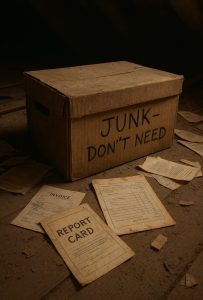
There was a box in the attic labeled “Junk – Don’t Need.”
Inside it were expired coupons, old bills, and—at the very bottom—Lila’s childhood report cards.

Every grade was there.
Every teacher comment.
Every “Excellent work!” and “Pleasure to have in class.”

But one thing was missing from every single page:
Her name.

No “Lila.”
No “Evans.”
No trace of the child who had earned those grades with tears, silence, and invisible strength.

This is the story of what it means to grow up unseen.
And what it looks like to finally reclaim your place in your own life.
Growing Up “Lucky” But Unseen

Lila was adopted by her aunt at age three.

Her birth parents vanished into addiction.
Her aunt took her in out of obligation, not affection.

“You’re lucky I didn’t leave you in foster care,” she’d often say.
“So don’t ask for more than you’re given.”

And Lila didn’t.
She never asked for birthday parties.
Never asked for hugs.
Never asked to be called “daughter.”

She didn’t even ask to be called by name.

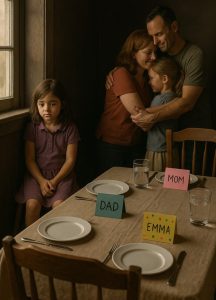
Because in that house, names were reserved for “real” family.

She became “the girl.”
“Her.”
“That one.”
How Invisibility Becomes Identity

The human heart has a fundamental need: to be known.
To be acknowledged.
To be called by name.

When that need is unmet, especially in childhood, a dangerous story takes root:

“If no one sees me, I must not exist.”

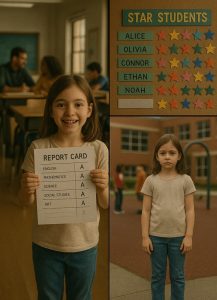
Lila excelled in school, hoping someone would notice.
Straight A’s. Star charts. Teacher’s pet.

But when she brought her report cards home, they were scanned—then tossed into a drawer.

Or worse:
Thrown into the junk box.

Not one “I’m proud of you.”
Not one “Well done.”

So she internalized the message:

“I have to work to be seen.
And even then—I might not matter.”
The Day She Found the Box

Lila was 38 when she returned to her childhood home.

The house was in foreclosure.
She was there to clear out old belongings before demolition.

She wasn’t expecting to feel anything.

But then—she found the box.

And inside it:
Her entire childhood, thrown in with outdated grocery ads.

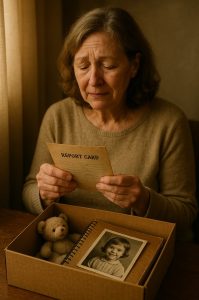
She sat on the floor and flipped through her report cards.

Each one glowing with praise.
Each one anonymous.

And for the first time, the pain hit her—not as an adult, but as the child who once stood in the hallway, holding that paper, hoping someone would say, “Lila, you did good.”

They never did.

Naming What Was Denied

She could’ve thrown the report cards away.

Instead, she did something radical.

She opened her purse.
Took out a black pen.
And in bold, capital letters, wrote across each page:

LILA EVANS.

She wasn’t just writing her name.
She was rewriting her history.

Not to deny what happened.
But to claim her place in the story she had been erased from.


Why Naming Matters in Healing

There’s a reason why therapists ask, “What did people call you?”
There’s a reason spiritual traditions include naming ceremonies.

Because being named means being known.
Being remembered.
Being anchored in belonging.

Neglect doesn’t just forget birthdays.
It forgets identities.

It tells a child:

  • “You’re not worth remembering.” 
  • “You’re not worth calling.” 
  • “You’re not really here.” 

But reclaiming your name is more than symbolic.
It’s spiritual.

It’s saying:

“I was always here.
You just refused to see me.
But now—I see myself.”

What Happens When You Reclaim Your Name

Lila didn’t suddenly stop grieving.

There were still triggers:

  • Hearing someone say “sweetheart” to their daughter 
  • Seeing other names embroidered on backpacks 
  • Filling out forms where “Next of Kin” left her wondering who to write 

But she started:

  • Signing her full name in birthday cards 
  • Speaking her story out loud in therapy 
  • Correcting people who mispronounced her name 
  • Getting a library card just to see her name in print 

Small things.
But each one a ritual of remembrance.

You Deserve to Be Known

If you grew up like Lila—unclaimed, unnamed, unnoticed—you might have:

  • A hard time asking for what you need 
  • A deep fear of taking up space 
  • An unconscious belief that if you disappear, no one will notice 

But hear this:

You do not have to stay invisible.

You are not “too much.”
You are not “replaceable.”
You are not “a guest” in this life.

You are here.
You matter.
You always did.
5 Ways to Reclaim Your Visibility

🧾 1. Say Your Name Out Loud

To yourself. In the mirror. In a journal.
Speak it with the reverence it was always owed.

✍️ 2. Sign Your Work

Every text. Every piece of art. Every email.
You are not anonymous anymore.

📛 3. Correct People

If they forget or mispronounce your name, gently correct them.
You deserve to be called properly.

📓 4. Write a Letter to “The Girl Without a Name”

Tell her everything she needed to hear.
Tell her she was never junk.

💌 5. Create Something That Carries Your Name

An email. A poem. A website. A piece of clothing.
Let the world feel your presence.

Conclusion: You Belong in Your Own Story

When Lila left that house, she didn’t take much.
Just a handful of old report cards.
And her name—written in bold across every single one.

She didn’t need anyone else to validate it anymore.

Because now, she knew.

She was not “junk.”
She was not “the girl.”
She was not invisible.

She was—and is—Lila Evans.

And that name?
It holds the history, the ache, the beauty of someone who survived being erased—and chose to rewrite herself back in.

💬 Let’s Talk

Did you grow up feeling unseen?
Were you the “quiet one”? The “good kid”? The “easy to ignore” child?

Drop a 🖋️ in the comments if you’re reclaiming your voice and your place in the world.
Tag someone who deserves to hear:

“You were never forgettable.
You just weren’t celebrated the way you deserved.”

Keywords used (naturally embedded):

  • childhood neglect 
  • emotional invisibility 
  • healing from childhood trauma 
  • inner child healing 
  • reparenting your identity 
  • reclaiming your name 
  • being unseen as a child 
  • adult survivors of emotional neglect 

The Smell of Burnt Toast: When Childhood Trauma Comes Back in a Moment—and How to Heal from It

It wasn’t a memory. It wasn’t even a thought.
It was a smell—burnt toast—and suddenly, Malik was no longer 41.

He was ten again. Back in that apartment where yelling lived in the walls, and fear clung to every corner.
He was hiding by the sink, humming lullabies to the faucet so he wouldn’t hear the sounds of rage in the next room.

One scent.
That’s all it took.

If you’ve ever been ambushed by a sound, a smell, a room, a tone of voice—and felt yourself swallowed whole by something you couldn’t explain—this story is yours too.

If you've ever been ambushed by a sound, a smell, a room, a tone of voice—and felt yourself swallowed whole by something you couldn’t explain—this story is yours too.
If you’ve ever been ambushed by a sound, a smell, a room, a tone of voice—and felt yourself swallowed whole by something you couldn’t explain—this story is yours too.

What a Smell Can Unlock

Malik wasn’t thinking about his childhood.
He was just trying to start his day.

A regular morning. A small-town diner.
Black coffee. Eggs. Toast—slightly browned.

But someone in the kitchen burned the bread.

And suddenly, he was back in his mother’s kitchen.
The lights dim. The air heavy. The smell of burnt toast clinging to the air like a warning.

Burnt toast meant Mom didn’t sleep.
Mom not sleeping meant Dad came home.
And Dad coming home meant bruises were coming.

The moment that smell reached his nose, his heart raced.
His palms sweated.
His jaw clenched.
He felt dizzy.

That’s the thing about trauma—it doesn’t ask permission.

The Hidden Power of Childhood Triggers

Trauma isn’t just a memory.
It’s a reaction your body stores.

The technical term is a “sensory trigger.”
Smells. Sounds. Touch. Even lighting.

For Malik, burnt toast wasn’t just a kitchen mistake.
It was an emotional alarm his brain had wired decades ago:
Something is wrong. Get small. Get safe. Don’t speak. Don’t move.

He didn’t even notice he had stopped eating.
Didn’t realize he was gripping the fork so tight his knuckles turned white.

He just sat there, 41 years old… and terrified.

Childhood Abuse Doesn’t Always Look Like Broken Bones

Malik’s father wasn’t violent every day.
Sometimes he was even… nice.

That made it worse.

Because unpredictability is where trauma grows deepest.

You never knew if the front door meant dinner or disaster.
You never knew if silence meant peace or punishment.

So Malik did what so many kids do:
He became invisible.
He got straight A’s.
He washed the dishes without being asked.
He apologized before speaking.

He became a ghost in his own house.

The Silent Promises We Make in Pain

Malik left home the day he turned 18.
He packed everything he owned into a trunk and drove until the city became trees.

He made himself a promise:

“I’ll never be like him.”

And he wasn’t.

He didn’t yell.
He didn’t drink.
He didn’t raise his voice at his kids.
He didn’t hit.

But he also didn’t let anyone love him.

He flinched at affection.
He sabotaged relationships before they got too close.
He never let anyone stay the night.
He never said “I love you” unless it was a joke.

Because the boy who learned that love could hurt had become a man who feared it might hurt again.

The Day the Spell Broke

What changed wasn’t therapy or some grand spiritual awakening.

It was a little boy in the diner.
Five years old. Lost in a maze of legs and coffee cups.

He ran into Malik’s table and said, “Sorry! Sorry!” before his dad swooped in and picked him up.

“Hey, you’re okay,” the father said.
“You’re safe. I got you.”

That’s it.

But it was everything.

Malik felt his throat tighten. His eyes sting. His breath catch.

Because no one had ever said those words to him.
Not once.
Not in the closet.
Not at the kitchen sink.
Not after the bruises.
Not before the nightmares.

He had never been told:
“You’re okay.”
“You’re safe.”
“I got you.”

Grief for the Childhood You Deserved

Later that night, Malik drove home.
Parked outside his apartment.
And just sat there.

The smell of burnt toast had faded, but the memory remained.
Only now, it wasn’t just fear—it was grief.

He cried in the dark.

Not just for what happened.
But for what never did.

The birthday parties.
The bedtime stories.
The words: “I love you. I’m proud of you. You’re enough.”

He wept for the boy who still lived inside him, waiting—just once—to be held and told,

“None of this was your fault.”

Why Triggers Are Invitations—Not Just Wounds

For years, Malik hated his triggers.
He thought they made him weak.
Embarrassing. Broken.

But now, he began to see them differently.

Burnt toast wasn’t a breakdown.
It was a message.

A flare shot up from his nervous system, saying:

“There’s something here you’ve buried.
You’re safe enough now to look at it.
You’re strong enough to feel it.”

That night, he did something brave.

He called his brother.
They hadn’t spoken in years.
He didn’t know what to say.
So he started with:

“Do you remember how the house smelled when Dad came home?”

There was silence.

Then:

“Yeah.
I do.”

And just like that—he wasn’t alone anymore.

How to Begin Healing When You’re Triggered

You don’t need to “get over” it.
You don’t need to “stay strong.”
You don’t need to perform wellness.

You just need to begin.

🔥 1. Pause When It Hits

Don’t push it away.
Don’t shame yourself.
You’re not broken.
You’re remembering.

🧠 2. Name It

“This is fear. This is grief. This is not now.”
Labeling the feeling helps your brain step out of survival mode.

💬 3. Talk to Someone

Call a friend. Write in a journal. Join a support group.
Even one conversation can make the difference.

🫂 4. Talk to Your Inner Child

You can be the adult that child needed.
Try saying:

“You’re safe. You’re not bad. You didn’t deserve it.”
“I’m here now. I’ve got you.”

Conclusion: You Are Not the Smell of Burnt Toast

Trauma doesn’t make sense.
It doesn’t care about time or logic or what looks “normal.”
It lives in the body.
And it asks, again and again:

“Am I safe yet?”

The answer, slowly, one memory at a time, can become:

“Yes.
You’re safe now.
I’ve got you.”

So the next time the smell hits—the sound, the voice, the street—pause.

And remember:
It’s not weakness.
It’s not failure.
It’s the doorway to healing.

Walk through it gently.
And maybe, just maybe…
make yourself some toast.
And eat it with peace.

💬 Let’s Talk

Have you ever been pulled back into the past by a smell, a sound, or a space?

What did your body remember before your brain caught up? Share this with someone who needs to hear:

“You’re not broken. You’re healing.”

The Birthday Balloon: How Childhood Neglect Steals Celebration—And What It Means to Finally Celebrate Yourself

Some children blow out birthday candles surrounded by laughter.
Others stand at the window with a balloon in their hand, wishing someone—anyone—would remember them.

This is the story of Eliora, a mother who gave her son magical birthdays but never celebrated her own.
Not because she didn’t care about birthdays—but because hers had been a wound, not a joy.

And maybe, like Eliora, you’ve spent years throwing perfect parties for others while secretly believing you were never worth celebrating.

If that’s you—this story is for your inner child.

The Forgotten Birthday

Eliora was seven the first time she realized birthdays didn’t mean the same thing for every child.

Her friends at school had balloons, cupcakes, and songs.
She had silence.
A cracked plate of rice.
And her father’s voice barking from the living room, “Turn that crap off.”

She had saved up for weeks—skipping lunch, returning soda cans—just to buy herself a single red balloon from the corner store.

It was the only gift she got.

That night, after her mother slapped her for knocking over a glass of water, Eliora took the balloon to the front porch.
She let it go.
Watched it drift into the dark sky.
And whispered, “Maybe next year.”

But next year never came.

How Children Turn Pain Into Belief

The worst thing about childhood neglect isn’t just the moment you’re forgotten.
It’s the story you start to believe because of it.

Eliora didn’t just think her birthday was skipped.
She thought:

  • “I’m not special.”
  • “I take up too much space.”
  • “I should be grateful for what I get.”

And those beliefs didn’t stop when she turned 18.
They followed her into adulthood.

They showed up in every relationship where she settled for less.
They echoed every time someone forgot her birthday and she said, “Oh, it’s no big deal.”
They lingered every time she went out of her way to make someone else feel seen—while refusing to ask for anything in return.

Because deep down, she believed she wasn’t worth the balloon.

The Cycle of Overgiving

Eliora became the mom who went all out for her son’s birthdays.

Cupcakes shaped like astronauts.
Handmade banners.
Elaborate scavenger hunts.
Every year, she would stay up late, painting signs and blowing up balloons until her fingers hurt.

People praised her.
“You’re such a good mom.”
“He’s so lucky.”
“You’re amazing!”

And she smiled.
Because giving made her feel useful. Needed. Seen.

But every time someone asked, “What do you want for your birthday?”
She’d wave them off.
“Oh no, I don’t celebrate.”

Because when you’ve grown up invisible, being celebrated feels suspicious.
Like you have to earn it.
Like you’re about to be punished for taking up space.

The Balloon That Broke the Spell

This year, Eliora’s son turned seven.

She stayed up late, as always—baking, decorating, wrapping.
Around 2:00 AM, she was inflating the last balloon when it popped.
Loud. Sudden.

And in that sound, she went back in time.

Back to the slap.
Back to the silence.
Back to the red balloon floating alone in the sky.

She dropped the balloon pump and fell to her knees in the kitchen.
Shaking.
Crying.

Not because the balloon popped.

But because the child inside her finally felt safe enough to weep.

Reparenting Yourself in the Quiet Hours

That night, Eliora sat on the cold kitchen floor, remembering the girl who waited at the window with a balloon she bought for herself.

And something shifted.

She walked to the fridge, took out one of her son’s cupcakes, lit a candle, and whispered:

“Happy birthday, baby Eliora.
I’m sorry you were alone.
I’m sorry they forgot.
But I see you now.
And I will never forget you again.”

She blew out the candle—not to wish for something—but to release the lie that she didn’t matter.

Why It’s So Hard to Celebrate Ourselves

If you’ve ever:

  • Downplayed your birthday
  • Avoided attention
  • Felt uncomfortable receiving praise
  • Over-gifted to others but froze when it came to yourself

Then you might be carrying a story like Eliora’s.

The belief that you are not the kind of person people show up for.

That belief is a lie.

But it’s a lie that sticks until you actively replace it with truth.

5 Ways to Reclaim the Celebration You Deserve

🎁 1. Name What You Never Got

Write down everything you wish someone had said or done for you on your birthday as a child.

Then give it to yourself. Today. In any form you can.

🎂 2. Throw a Birthday Party for Your Inner Child

Even if it’s just you and a cupcake—mark the day. Celebrate that little one who made it through.

🎈 3. Let Others Celebrate You

When someone offers kindness, accept it.
Say yes.
You don’t have to earn it.

📸 4. Take the Photo

You’re not “too old” or “too awkward.”
You’re visible. You exist.
You belong in the frame.

🧡 5. Forgive Yourself for Believing You Were Unworthy

The child who felt forgotten didn’t do anything wrong.
She survived.
And that’s worth celebrating.

Conclusion: The Red Balloon Still Floats

You may not have had the birthday you deserved.
You may still cry when others cheer.
But the story doesn’t end with silence.

Like Eliora, you can look that forgotten child in the eyes and say:

“You matter.
I remember you.
And I will never let you be erased again.”

So buy the cake.
Light the candle.
Hold your own hand.
And let the red balloon rise—this time, not as a symbol of loneliness, but of freedom.

💬 Let’s Talk

Did you grow up feeling like your birthday didn’t matter?

Have you spent your adult life pouring into others while quietly hiding your own needs?

Drop a 🎂 in the comments if you’re ready to start celebrating yourself, one year at a time.
Or share this with someone who never had a birthday song sung to them, but still deserves a standing ovation.

The Piano That Never Played

Character: Jonah, 37, music teacher
Setting: A quiet suburban house, winter evening

Jonah sat in his empty living room, eyes fixed on the dust-covered piano in the corner. He hadn’t touched it in over 15 years. Not since the night his father shattered more than just the keys.

Jonah sat in his empty living room, eyes fixed on the dust-covered piano in the corner
Jonah sat in his empty living room, eyes fixed on the dust-covered piano in the corner.

He used to believe music could save him.

At seven years old, he would sneak downstairs after midnight, placing his tiny fingers on the cool ivory keys, playing lullabies for the version of his mother that didn’t drink, and for the father he wished would just look at him without disgust.

But one night, the playing stopped.

That night, his father came home drunk, like always.
“What did I say about playing that damn thing when I’m home?”
Jonah had barely lifted his fingers when his father hurled the heavy ashtray across the room. It missed Jonah’s head by an inch, slamming into the piano, cracking the soundboard. The music died instantly.

So did Jonah’s belief that being good was enough.

For years, he thought if he were better—quieter, smarter, more obedient—his dad wouldn’t be angry. Maybe then his mom would stay sober. Maybe then someone would say, “I love you,” without a condition attached to it.

But none of it ever worked.

Instead, he grew up with a voice in his head louder than any piano:
You deserved it.
You were too much.
You should’ve known better.

He carried that voice into adulthood. Into relationships. Into every job interview he sabotaged. Every date he walked out of. Every compliment he swatted away like a mosquito that didn’t belong.

Until last week, when he saw a little boy in his music class flinch—just because Jonah raised his voice to ask for quiet. The child’s whole body shrank, like Jonah’s had all those years ago.

It shattered something in him.

That night, Jonah drove back to his childhood home. He stood in front of the old piano and wept—not for his father, not even for his mother—but for himself. For the boy who thought he had to earn love by erasing himself.

He didn’t forgive his parents. He wasn’t there yet.
But for the first time, he whispered the words:
“I’m sorry, Jonah. You didn’t do anything wrong.”
And the keys beneath his fingers—damaged, detuned—let out the softest note.

Like forgiveness finding its voice.

🧡 If you’ve ever blamed yourself for someone else’s cruelty, you’re not alone.
Drop a 🎹 if you’re learning to play your own song again.
Tag someone who needs to hear: It was never your fault.
#ForgiveYourself #HealingTogether #AChildhoodYouDidn’tDeserve