I Was the Easy One… So They Forgot Me

What Happens When You’re the Child Who Wasn’t a Crisis

From Grandpa Eli

Some children are born into storms. Others are born beside them.

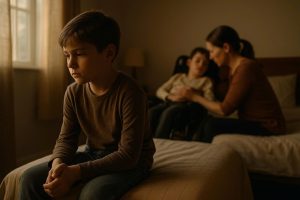
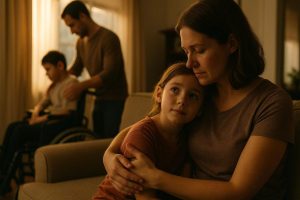
Maybe you grew up with a sibling who had special needs — a disability, a chronic illness, or emotional struggles that required constant attention. Your parents didn’t mean to forget you. They were surviving. The problem is… so were you.

And no one noticed.

Maybe you grew up with a sibling who had special needs — a disability, a chronic illness, or emotional struggles that required constant attention.

The Unspoken Hurt of the “Good” Child

You were the “easy one.”
The one who “understood.”
The one who didn’t cry as much. Didn’t cause problems. Did okay in school.

So when your sibling had a meltdown, you stayed quiet.
When they had to go to the hospital, you stayed home.
When your parents looked exhausted, you didn’t ask for anything.

And slowly, without meaning to, you stopped believing you had the right to ask.

Why That Kind of Neglect Hurts So Deeply

Neglect is not always loud.
Sometimes, it looks like praise:
“You’re so independent!”
“Thank you for being so mature.”
“You’re strong — you don’t need as much.”

But inside, a child is asking:

“If I fall apart too… will anyone catch me?”

When no one does, we begin to believe we don’t matter.
And that belief follows us into adulthood like a shadow.

How It Shows Up Later in Life

You may be an adult now. Maybe even a parent yourself. But that quiet ache from your childhood still shows up:

  • You feel guilty for needing rest or attention.
  • You don’t know how to ask for help.
  • You shrink in relationships, afraid to “take up space.”
  • You find yourself endlessly supporting others — while running on empty.

You learned early that your pain wasn’t urgent.
And so, you stopped trusting it even existed.

“But My Parents Were Good People…”

They probably were.
Most parents don’t mean to neglect any child.
But stress is a powerful blinder. Survival mode makes you choose. And when one child is in crisis, others fade into the background.

It doesn’t mean they didn’t love you.

It means they didn’t see how much it was costing you to be the “good one.”

You Deserve to Be Seen Too

Let me tell you this, my dear:
Being easy to raise doesn’t mean you were easy to hurt.

You mattered then.
You matter now.

And if you’re still waiting for someone to say:

“I see how strong you were. I see how much you carried.”
Let me be the one to say it.

Grandpa Eli sees you.
Not the helper. Not the fixer. Not the quiet one.

You.

How to Start Healing

You don’t need to blame your parents to begin healing.
You don’t need to confront anyone.
You just need to make this quiet promise to yourself:

“I will no longer abandon the parts of me that felt invisible.”

Here’s how you can begin:

  • Write a letter to your younger self, validating their quiet pain.
  • Talk to a therapist about the messages you internalized.
  • Practice receiving — compliments, help, kindness — without apology.
  • Stop proving your worth by how little you need.

What I’d Say to Your Parents, If They Were Listening

Dear parents raising a child with special needs:
You are doing something extraordinary. You are fighting for your child every day.

But don’t forget — you have more than one.

Your strong child still needs soft moments.
Your quiet child still needs to be asked, “How are you really?”
Your “easy” child still needs a lap to rest in.

Don’t assume they’re fine just because they’re not falling apart.

Don’t assume they’re fine just because they’re not falling apart.

A Final Word, From Grandpa Eli

To every adult who still wonders why they feel like a burden when they ask for love —
To every child who learned to disappear because their family couldn’t handle more —

You were never too much.
You were never not enough.
You were always worthy of care.

Come home to yourself now, dear one.
This time, don’t walk past the quiet child inside you.

Bend down.
Look them in the eyes.
And whisper, “You matter too.”

Why Love Feels So Hard When You Grew Up Without It

Some of us didn’t grow up with bruises or beatings. We grew up with emotional silence. No hugs, no warmth, no one saying, “Tell me what’s wrong — I’m here.”

Instead, we learned to hold it in. To be easy. To not ask for anything.

And now? As adults? Love feels confusing. Intimacy feels dangerous. Asking for support feels selfish.

Dear one, hear this: It wasn’t your job to earn love. It was your right to receive it.

When Emotional Neglect Is Disguised As a “Normal Childhood”

Maybe your parents weren’t cruel. Maybe they provided clothes, food, even toys. But they didn’t see you. They didn’t sit beside you when you were hurting. They didn’t ask how your heart was doing.

So you grew up:

  • Thinking love must be earned through performance
  • Feeling like a burden when you’re sad
  • Apologizing for having emotions
  • Chasing people who give you crumbs — because it’s all you knew

That’s not weakness. That’s adaptation. You were emotionally starved. And you survived.

The Hidden Wounds of Not Being Seen

Emotional neglect doesn’t leave bruises — it leaves beliefs. Beliefs like:

“I’m too much.”

“I have to prove my worth.”

“If I’m vulnerable, I’ll be rejected.”

You may find yourself overgiving, overthinking, or emotionally shutting down — and wonder what’s wrong with you.

Nothing is wrong with you. You were just never taught how to feel safe with love.

What Healing Might Look Like

Healing doesn’t mean blaming our parents. It means naming what was missing — and reclaiming what we needed.

Let me offer you this, with a heart full of understanding:

You were not needy, a child with needs.

You weren’t dramatic. You were hurting.

You weren’t invisible — you were unseen.

And now? You get to:

  1. Acknowledge what happened – Even if others dismiss it.
  2. Let go of shame – It never belonged to you.
  3. Speak kindly to yourself – As you would to a wounded child.
  4. Stop apologizing for existing – You deserve space. Love. Peace.
  5. Let real love in – The kind that sees you, hears you, stays.

Final Words from Grandpa Eli

If love feels hard, it’s not because you’re broken. It’s because your earliest lessons taught you that love had to be earned, chased, or feared.

But those lessons can be unlearned. The past shaped you — but it doesn’t own your future.

You’re not too much. You’re not a burden. You are healing. You are worthy. And you are not alone anymore.

 With all my heart, ~ Grandpa Eli

Does Your Childhood Still Control Your Life?

🌿 Does Your Childhood Still Control Your Life?

By Grandpa Eli

Hello there, dear one.

If you’ve ever caught yourself wondering, “Why do I keep struggling with the same fears, the same broken relationships, the same sadness I can’t name?”—you’re not alone. Many of us, especially those who walked through the stormy fields of childhood, carry quiet burdens into adulthood.

And sometimes… those burdens still whisper louder than anything else.

💔 The Hidden Cost of a Difficult Childhood

You see, not all wounds bleed on the outside.

Some children grow up in homes where love came with conditions.
Where silence replaced affection.
Where safety wasn’t promised—and kindness felt like a game of chance.

Even now, as grown men and women, those children still live inside us.
Still flinching. Still fearing. Still wondering:

“Was it my fault?”
“Am I too broken to be loved?”
“Why do I still hear their voice in my head?”

🧠 The Truth: Childhood Shapes the Brain—and the Soul

Research and experience both show this clearly:

  • Children raised in chaos often become adults who fear peace.

  • Kids who were criticized endlessly grow up doubting every decision.

  • Survivors of neglect may find it nearly impossible to trust—even when love finally arrives.

And worst of all?

Many people don’t even realize their childhood is still in charge.

They chalk it up to “bad luck” in relationships… or “just how I am.” But when we dig deeper, the past isn’t just influencing their present—it’s running the show.

🔁 The Cycle of Hurt: Why It Repeats

You might think:
“If someone knew how painful it was to be abused, they’d never do it to their own children.”

But often, the opposite happens.

Because children model what they see.
And if what they saw was coldness, control, or cruelty… that becomes their blueprint for “parenting.”

It doesn’t mean they’re bad. It means they’re unhealed.

And unhealed people often hurt others without meaning to.

🌱 So… Can You Ever Be Free?

Yes. A thousand times yes.

But here’s the truth:
Healing doesn’t begin with forgetting.
It doesn’t come from pretending it “wasn’t that bad.”

It starts with courage.

The courage to say:

“I want better. For myself. For the people I love. For the child I used to be.”

🪜 The 3 Steps to Freedom

Here’s what I’ve seen, in all my years listening to hurting hearts:

1. Understand

Name what happened. Don’t sugarcoat it.
If you were neglected, abused, controlled, or emotionally starved—say it out loud.
You can’t heal what you refuse to see.

2. Repair

This doesn’t mean “fix the past.”
It means tending to your inner wounds today:

  • Learning healthy coping strategies

  • Finding safe people

  • Telling the truth about what hurt

  • Forgiving yourself for surviving the only way you knew how

3. Grow

Growth means the past no longer holds the steering wheel.
You take back the keys.
You stop blaming yourself.
You become the adult you needed back then.

And let me tell you something, dear one… That adult?
They’re already inside you. Waiting.

💬 A Final Word, From Grandpa Eli

If no one has told you this in a while…

You are not broken.
You are not too late.
You are not the bad things that happened to you.

You’re still here. And that means healing is still possible.
Your childhood may have shaped you.
But it does not define you.

The pen is in your hand now. And you get to write the next chapter.

💌 If this stirred something in your heart…

Follow my blog or Facebook page for more gentle wisdom, stories, and healing tools for those walking out of painful pasts and into peaceful futures.

You are never alone.

With all my heart,
— Grandpa Eli

How the Past Still Affects You Today

Dear heart. Let’s sit down for a moment, just you and me. If your childhood was filled with pain, neglect, or fear — even if no one ever called it “abuse” — it can still leave deep marks on the grown-up you’ve become. I want to help you see those marks not as signs of weakness, but as a map — a guide — that can show you the way forward.

🌧 How the Past Still Affects You Today

  1. Your relationships may feel confusing or painful.
    You might struggle to trust people. Maybe you pull away when someone gets too close. Or you find yourself pleasing others just to feel safe. That’s not weakness. That’s your inner child trying to protect you the only way they know how. 
  2. You may feel responsible for everything — even the things that hurt you.
    When love was conditional as a child (“Be quiet or else…” / “Why can’t you be like your brother?”), you may have learned to blame yourself. That can carry into adulthood as shame, guilt, or a sense of never being “good enough.” 
  3. You may react too strongly — or not at all.
    Little things can feel like big explosions. Or big things can make you shut down completely. Why? Because your brain was wired in a storm, and it’s still trying to survive it. 
  4. You might feel stuck, unmotivated, or like something’s “wrong” with you.
    That’s not laziness or failure. That’s grief. That’s exhaustion from carrying a backpack full of invisible pain. You’ve been surviving so long, you forgot what thriving feels like. 
  5. You might be scared of becoming like your parents.
    Many adults who were mistreated as kids live in fear of repeating the cycle — or they do repeat it without meaning to. Hurt people often hurt people… until someone brave chooses to heal. 

🛠 How to Begin Healing

I’ve walked beside many wounded children in grown-up bodies, and here’s the gentle truth I’ve learned:

Healing is possible. But it’s not magic.
It’s a path — and that path usually begins in three stages:

1. Understanding

Name what happened. Not to blame — but to see clearly.

“I was neglected.”
“I was afraid all the time.”
“No one hugged me when I cried.”

When we name the pain, we stop letting it hide.
And when it stops hiding, we can stop blaming ourselves for it.

2. Repair

This is where we gently untangle the mess the past made inside us.
It might look like therapy. Or journaling. Or safe friendships.
It might look like reading books or joining support groups.
It definitely looks like learning how to treat yourself with the care you never got.

3. Growth

This is the sweet stage — where you start living for you, not for fear.
You begin setting boundaries.
You begin laughing more.
You begin parenting your children — and your inner child — in ways that heal.

🌱 Remember, Dear One…

You didn’t choose the pain.
But you get to choose what happens next.

And if no one has ever said this to you, let Grandpa Eli be the first:

I’m proud of you.
Not because you’ve got it all figured out — but because you’re still here.
You survived what others wouldn’t understand. And now, you’re searching for light.
That makes you mighty.

UNDERSTAND HEAL – OVERCOME A PAINFUL CHILDHOOD

🧓👣 A message from Grandpa Eli – a friend to every child who has ever been hurt

Some children grow up not with fairy tales, but with long, lonely days filled with fear, neglect, or harm caused by the very people who were supposed to protect them.

If you are one of those children – and if that frightened little one still trembles inside the grown-up you are today – then this message is for you…

1. 💡 Understand – Look back, not to hurt more, but to understand

Not everyone dares to revisit their childhood. Because in those memories, there might be tears, silence, or unanswered questions. But do you know something? Only when you truly understand what happened can you stop repeating it in your present life.

You were not to blame for being hurt. It wasn’t because you were bad or not good enough. The fault was with the grown-ups. And you – you deserved love all along.

2. 🛠 Heal – Begin your own journey of healing, little by little

No one can turn back time to give you a different childhood.
But you can choose to begin again – today.

Healing isn’t something that happens overnight. But it can begin with:

  • One moment of courage to speak what you’ve buried for years 
  • A letter you’ll never send, written to the one who hurt you 
  • A heartfelt conversation with someone who understands 
  • Or just one quiet moment, with your hand on your heart, whispering:
    “I’ve tried so hard. And I’m still here.” 

3. 🚪Overcome – Step into the life you truly deserve

Overcoming doesn’t mean forgetting.
It means living without letting the past imprison you any longer.

You have the right to live lightly, joyfully.
You have the right to love – and to be loved.
You have the right to choose kindness, to yourself and to others.
You can do it – even if no one ever taught you how before.
Because now, you can teach yourself.

👣 A FINAL WORD

Your childhood was not your choice.
But your path from this day forward – that is yours.

Grandpa Eli cannot erase the pain of the past.
But he has always believed this:

“Anyone brave enough to face their past… deserves a future brighter than they ever imagined.”

And if you ever need someone to listen –
Grandpa Eli is always here. 🍂

The Boy and the Birdcage

Peter was now seventeen. The greenhouse behind Elianna’s cottage had grown lush with color. Children from the village came after school, helping him water the plants, paint the pots, name the ferns. They called it Peter’s Garden of Second Chances.

But one afternoon, a new boy showed up. Thin as a willow switch. Eyes too old for his age. His name was Lucas.

He didn’t touch the plants. Didn’t smile. He sat on the edge of the greenhouse floor, arms locked tightly around his knees. Watching. Waiting.

Peter offered him a cactus—“You don’t have to water it every day,” he said with a wink. Lucas didn’t laugh.

That night, Peter found Lucas outside the gate, staring at the greenhouse from the dark.

“Do you want to come in?” Peter asked.

Lucas shook his head. “I’d break something.”

“Who told you that?”

Lucas didn’t answer. But Peter already knew.

Over the next few weeks, Lucas returned. Silent. Tense. He flinched whenever a door creaked or someone raised their voice in laughter. He never took off his sweater, even when the sun burned high.

Peter recognized the signs. He saw himself in Lucas—the hidden bruises, the shame worn like armor.

One afternoon, Peter found Lucas staring at a broken birdcage near the compost bin.

“That used to hang in the front,” Peter said. “A bird lived in it until it flew away. We left the cage open—just in case it ever wanted to come back.”

Lucas looked up, confused. “Why wouldn’t you keep it closed? So it won’t leave?”

Peter knelt beside him. “Because love isn’t a cage. It’s a door you leave open.”

Lucas said nothing. But a tear slipped down one cheek.

That night, Lucas stayed late. He planted a marigold. It was crooked and messy, but Peter left it that way.

“You know,” Peter said softly, “it’s not your fault. Whatever happened to you… it’s not because you weren’t good enough.”

Lucas didn’t answer. But the next day, he rolled up his sleeves.

There were scars. But he wasn’t hiding anymore.

Over the following months, Lucas became Peter’s shadow—not the haunted kind, but the kind that grows from walking beside someone who finally sees you.

And for the first time in a long time, Peter felt something shift in his chest. Not grief. Not guilt.

Hope.