I Was the Easy One… So They Forgot Me

What Happens When You’re the Child Who Wasn’t a Crisis

From Grandpa Eli

Some children are born into storms. Others are born beside them.

Maybe you grew up with a sibling who had special needs — a disability, a chronic illness, or emotional struggles that required constant attention. Your parents didn’t mean to forget you. They were surviving. The problem is… so were you.

And no one noticed.

Maybe you grew up with a sibling who had special needs — a disability, a chronic illness, or emotional struggles that required constant attention.

The Unspoken Hurt of the “Good” Child

You were the “easy one.”
The one who “understood.”
The one who didn’t cry as much. Didn’t cause problems. Did okay in school.

So when your sibling had a meltdown, you stayed quiet.
When they had to go to the hospital, you stayed home.
When your parents looked exhausted, you didn’t ask for anything.

And slowly, without meaning to, you stopped believing you had the right to ask.

Why That Kind of Neglect Hurts So Deeply

Neglect is not always loud.
Sometimes, it looks like praise:
“You’re so independent!”
“Thank you for being so mature.”
“You’re strong — you don’t need as much.”

But inside, a child is asking:

“If I fall apart too… will anyone catch me?”

When no one does, we begin to believe we don’t matter.
And that belief follows us into adulthood like a shadow.

How It Shows Up Later in Life

You may be an adult now. Maybe even a parent yourself. But that quiet ache from your childhood still shows up:

  • You feel guilty for needing rest or attention.
  • You don’t know how to ask for help.
  • You shrink in relationships, afraid to “take up space.”
  • You find yourself endlessly supporting others — while running on empty.

You learned early that your pain wasn’t urgent.
And so, you stopped trusting it even existed.

“But My Parents Were Good People…”

They probably were.
Most parents don’t mean to neglect any child.
But stress is a powerful blinder. Survival mode makes you choose. And when one child is in crisis, others fade into the background.

It doesn’t mean they didn’t love you.

It means they didn’t see how much it was costing you to be the “good one.”

You Deserve to Be Seen Too

Let me tell you this, my dear:
Being easy to raise doesn’t mean you were easy to hurt.

You mattered then.
You matter now.

And if you’re still waiting for someone to say:

“I see how strong you were. I see how much you carried.”
Let me be the one to say it.

Grandpa Eli sees you.
Not the helper. Not the fixer. Not the quiet one.

You.

How to Start Healing

You don’t need to blame your parents to begin healing.
You don’t need to confront anyone.
You just need to make this quiet promise to yourself:

“I will no longer abandon the parts of me that felt invisible.”

Here’s how you can begin:

  • Write a letter to your younger self, validating their quiet pain.
  • Talk to a therapist about the messages you internalized.
  • Practice receiving — compliments, help, kindness — without apology.
  • Stop proving your worth by how little you need.

What I’d Say to Your Parents, If They Were Listening

Dear parents raising a child with special needs:
You are doing something extraordinary. You are fighting for your child every day.

But don’t forget — you have more than one.

Your strong child still needs soft moments.
Your quiet child still needs to be asked, “How are you really?”
Your “easy” child still needs a lap to rest in.

Don’t assume they’re fine just because they’re not falling apart.

Don’t assume they’re fine just because they’re not falling apart.

A Final Word, From Grandpa Eli

To every adult who still wonders why they feel like a burden when they ask for love —
To every child who learned to disappear because their family couldn’t handle more —

You were never too much.
You were never not enough.
You were always worthy of care.

Come home to yourself now, dear one.
This time, don’t walk past the quiet child inside you.

Bend down.
Look them in the eyes.
And whisper, “You matter too.”
A Letter from Grandpa Eli

To the Child Inside You: Forgive Yourself

My dear,

If you’re reading this, it means you’re carrying something heavy. A weight not made of iron or stone, but of guilt… of memories… of blame you should never have held in your little hands.

I want to talk to that child inside you. The one who once wondered,
“Was it my fault?”
“Did I deserve this?”
“If only I had been better… quieter… stronger…”

Let me tell you a secret, whispered gently like the wind in the trees:
It was never your fault. Not even for a moment.

 This isn’t about forgiving them.This is about forgiving yourself.
This isn’t about forgiving them.
This is about forgiving yourself.

You were just a child. You didn’t choose the yelling. You didn’t cause the silence. You weren’t the reason they drank, or lashed out, or disappeared emotionally. The world got it upside down. And for too long, you’ve carried the burden of their brokenness on your innocent shoulders.

I know forgiveness is a complicated word. People often misunderstand it. They say, “You should forgive your abuser.” But I don’t believe you owe them anything.
This isn’t about forgiving them.

This is about forgiving yourself.

Forgive yourself for not knowing how to speak up.
Forgive yourself for trying so hard to please people who were impossible to please.
Forgive yourself for surviving in ways others may not understand—through silence, rebellion, perfectionism, or pretending everything was okay.

Forgive the child who simply wanted to be loved.

That child is still with you. And they are waiting—for your kindness, for your warmth, for your understanding.

So here’s what I want you to do today:

  1. Look in the mirror. Gently place your hand on your chest and say,
    “I forgive myself. I was just a child. I did nothing wrong.”
  2. Let go of the question “Why did this happen?” There may never be a satisfying answer. What matters more is: What will you do now to live free?
  3. Be the adult your younger self needed. Speak gently. Rest when you’re tired. Set boundaries. Celebrate small joys.

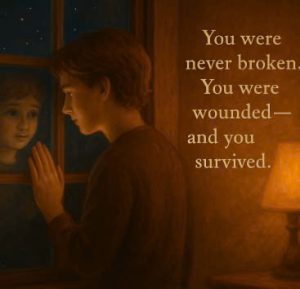
Dear one, you were never broken. You were wounded—but wounds can heal. Scars do not mean you’re damaged. They mean you survived.

You’re not alone anymore.

With warmth like a cup of cocoa in winter,
Grandpa Eli
🧡

You Don’t Have to Forgive to Heal – What Real Emotional Release Looks Like


You’ve heard it all before: “Forgive and forget.” “Just let it go.” “It’s the only way to move on.”

But what if I told you… you don’t have to forgive the person who hurt you in order to heal?

What if true healing isn’t about them at all—but about you reclaiming your power?

Forgiveness can be a beautiful thing. But when rushed, forced, or demanded, it becomes just another wound. So let’s redefine what healing looks like—on your terms.

  1. The Pressure to Forgive Too Soon

Too often, survivors are asked to make peace with monsters before they’ve even stopped bleeding.

Well-meaning friends, faith leaders, or even therapists might say, “You’ll feel better once you forgive.”

But when forgiveness is pushed before the pain has been witnessed, it only silences the truth.

You don’t owe forgiveness to the one who never apologized. You don’t owe absolution to someone who still denies what they did.

  1. What Forgiveness is Not

Let’s be clear:

  • Forgiveness is not saying “it was okay.”
  • Forgiveness is not reconciling.
  • Forgiveness is not forgetting.
  • Forgiveness is not pretending it didn’t change you.

Real healing says: It mattered. It hurt. And I’m allowed to grow beyond it—whether they’re sorry or not.

  1. The Healing That Doesn’t Require Forgiveness

Healing is:

  • Naming what happened.
  • Feeling the feelings you were never allowed to have.
  • Validating your pain without minimizing it.
  • Releasing the belief that it was your fault.

You can rage. You can cry. You can build boundaries so high they never touch you again.

That is healing.

  1. Forgiveness of Self Comes First

If there’s any forgiveness that truly matters, it’s this:

Forgiving yourself.

For the years you stayed silent. For the ways you coped that hurt you. For thinking you deserved it. For the self-blame you carried like a second skin.

You didn’t cause it. You were surviving. You did what you had to do.

Now you get to stop surviving and start healing.

  1. What Letting Go Really Looks Like

Letting go isn’t a moment. It’s a series of micro-decisions:

  • To stop explaining your pain to those who don’t want to understand.
  • To stop chasing closure from people incapable of giving it.
  • To stop believing that you are the broken one.

Letting go means saying: “I release you—not because you earned it, but because I deserve peace.”

You’re not freeing them. You’re freeing yourself.

  1. A Ritual for Release Without Forgiveness

Try this:

  1. Write a letter to the person who hurt you. Say everything.
  2. Don’t hold back. Let your truth rise.
  3. Burn it, tear it, bury it—whatever feels right.
  4. Whisper: “I don’t need to forgive to heal. But I do release this from my body.”

You may cry. That’s healing. You may feel nothing at first. That’s protection.

Repeat when needed. This is your journey.

Closing Words from Grandpa Eli

My dear one, You are not required to carry the weight of their sins just to seem “kind.” You don’t need to forgive to move forward. You need to feel. To grieve. To release.

When you are ready—on your own terms—you’ll know what needs to be forgiven and what simply needs to be released.

And whatever you choose… I’ll be here, cheering for your freedom.

💬 Has someone ever pushed you to forgive before you were ready? Share if you feel safe. Your story may help someone else feel seen.

#RedefineForgiveness #HealingWithoutForgiveness #SelfForgiveness #EmotionalRelease #YouDeservePeace