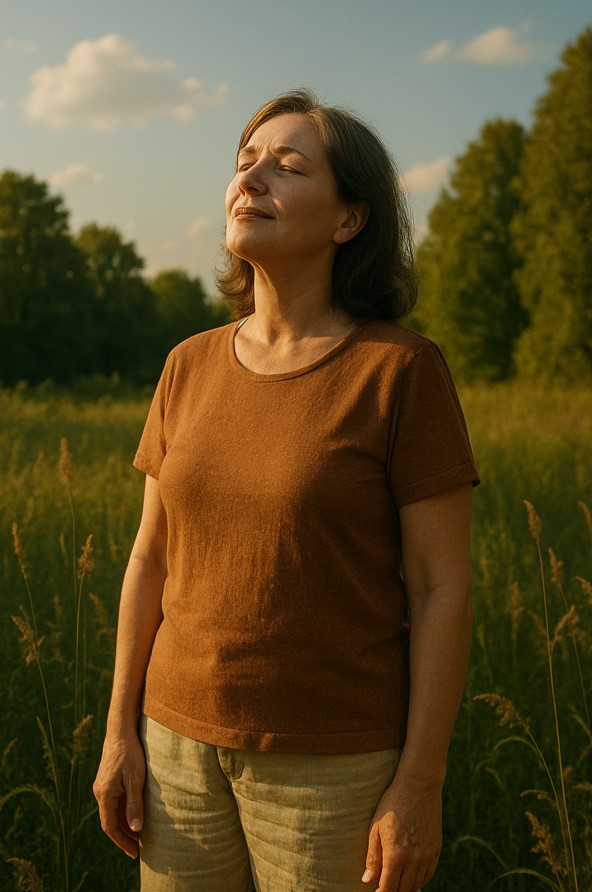
Why You’re Still Allowed to Try Again

From Grandpa Eli

Somewhere along the way—maybe in a quiet corner of childhood—you learned that mistakes weren’t safe.

Maybe someone rolled their eyes when you got it wrong.
Maybe someone only noticed you when you were perfect.
Maybe trying led to punishment, not praise.

So now, you freeze. You wait. You doubt.
Because somewhere inside, you’re still asking:
“What if I fail again?”
“What if I’m not enough?”

Oh, dear heart, I need you to know:

That fear was planted. But it’s not who you are.

Failure was never supposed to be shameful. It was supposed to be how we learn.
How we grow.
How we find our way back to ourselves.

Look at every tree. Every river. Every starlit sky.
Nothing in nature gets it right the first time.

You don’t need to be flawless.
You just need to be free.

Free to try.
Free to fail.
Free to rise again—on your own terms.

So here’s what I want you to say to that scared little voice inside:

“I can learn.”
“I can grow into someone new.”
“I can begin again, no matter what.”

And if no one ever cheered for you before—let me say this now:

I’m proud of you for trying.
And if you fall again? That’s okay. We’ll rise again—together.

With all the warmth in my old heart,
—Grandpa Eli


You Were Made to Rise: Turning Childhood Pain into Purpose

By Grandpa Eli

Come closer, dear heart.

I want to tell you a story.

There was a little boy who was often scolded, ignored, and shamed by the woman who should have been his greatest source of comfort. His name? Warren Buffett. Yes, that Warren Buffett. One of the most successful investors the world has ever known.

He and his sister were verbally abused for years. But strangely, their youngest sibling—born later—was loved and nurtured.

Why the difference? Why did the mother show kindness to one child and cruelty to the others?

No one knows. But here’s what matters: Warren did not stay in that pain. He used it. Transformed it. Rose above it.

And you can too.

What Happened to You Was Never Fair

Let’s get one thing straight: childhood abuse, neglect, or emotional abandonment are never justified.

If you were criticized more than comforted, If you were punished more than protected, If you were silenced when you needed to be seen…

Then yes, you carry wounds. But those wounds don’t have to be where your story ends.

They can be the place where something new begins.

The Hidden Gift in Pain

Now, I would never call your pain a “gift” lightly. I know how deep it runs. I know how long it lingers.

But sometimes, pain is what cracks us open just enough to let something divine grow.

Perhaps your heartbreak became the birthplace of your compassion. The sting of rejection might be what sharpened your empathy. And through silence, you may have learned how to truly listen.

Every scar has a lesson. Every wound can become wisdom.

But only if you choose to rise.

Purpose Isn’t Found. It’s Forged.

Some people wait for purpose to knock on their door. But child, real purpose is built. Brick by brick. Out of tears, trials, and tiny victories.

You build it when you:

  • Choose kindness, even when you were raised in cruelty.
  • Speak gently, though you were spoken to harshly.
  • Protect others, even if no one ever protected you.

That’s not just healing, it’s transformation. That’s the alchemy of a soul who refuses to repeat the past.

What You Needed Then, You Can Give Now

You know what it feels like to go unseen. So now you see others.

You know what it’s like to feel voiceless. So now you give voice to the silenced.

You know the darkness. And that is why you are called to become a light.

True to the life you deserved, to the love you needed, to the purpose you now create.

Your Pain Can Bless the World

I have seen it again and again: Children who were harmed become adults who heal. Not just themselves, but others.

Your story might be the medicine someone else needs. Your voice might be the echo they’ve been longing to hear.

From your broken places, you can build bridges. In the spaces where danger once lived, you now have the power to offer safety.

Pain wasn’t given to punish you — it was given to awaken purpose. Within that purpose lies possibility.

Final Words from Grandpa

When you rise—even slowly, even shakily—you remind the world of something sacred:

That hurt doesn’t have to have the final word. That love can grow where none was planted. That even cracked hearts can bloom.

You were not made to carry the weight of your childhood forever. You were made to rise.

And I am so proud to see you trying.

With all the belief in my bones,

—Grandpa Eli

When the Past Becomes a Prison

When the Past Becomes a Prison
—from Grandpa Eli

There is a quiet prison many people live in.

It has no bars, no guards, no chains—yet it holds millions hostage. Its walls are built not from stone, but from memory. Its gates are sealed by a single emotion: blame.

Blame is seductive. It gives structure to suffering. It points a finger at those who failed us and offers the illusion of justice: “This is why I am the way I am.” And often, it is not a lie. Many of us were indeed shaped by the absence of love, the cruelty of words, or the violence of silence. 

But blame, like a fire left unattended, will consume everything in its path—including the future.

For a while, it feels empowering. It gives language to what once had none. It provides clarity in a world that felt unbearably confusing. But slowly, it turns inward. It becomes more than a story of what happened—it becomes a barrier between who we are and who we might become.

The longer we hold onto blame, the more it holds onto us.

We start to live not forward, but backward—tethered to moments that no longer exist, apologies that will never be spoken. The mind replays these scenes as if resolution might rise from repetition.

But the truth is painful in its simplicity: healing begins only when we stop demanding that the past fix itself.

We cannot row toward tomorrow while staring at the dock of yesterday. We cannot build new love on foundations cracked by old resentments. We cannot live freely while carrying the chains of unmet justice.

This is not a call to forget. It is a call to choose.

To choose presence over pain. Responsibility over retribution. Peace over permission.

Letting go of blame is not surrendering the truth of what happened. It is choosing to stop feeding it your joy.

It is an act of radical self-respect.
It is the moment you decide: “I deserve to be free, even if they never say sorry.”

The world will not hand you closure. But you can create peace.

By shifting the story.
By loosening your grip on what cannot change.
By claiming what always belonged to you—your power to write the next chapter.

Because the past may influence who we are.
But only we can decide who we become.

You Hold the Pen Now

You Hold the Pen Now
—from Grandpa Eli

There comes a moment in every wounded life when the past begins to blur, not because the pain has faded, but because the mind grows weary of replaying the same unanswered questions.

For many, childhood was not a place of safety but a season of survival. The home, which should have been a shelter, became a battlefield. Affection was conditional. Praise was rare. Silence was heavy. And love, if it existed at all, came at a price—obedience, perfection, invisibility.

As children, we adjusted. We learned to read the room before we read books. We became skilled in the art of shrinking—our voices, our needs, our very selves—because smallness, we were told without words, was safer.

These lessons sink deep.

Even as adults, we carry them. They follow us into relationships, into workplaces, into the private chambers of our self-worth. We perform rather than connect. We apologize for taking up space. We mistrust joy. We fear softness. We question our right to be loved without earning it.

And yet, despite all of it, there remains a truth that waits patiently for our permission to rise.

We did not write the beginning. But we hold the pen now.

This is where the narrative begins to shift.

The pain of the past is not invalidated by this truth. Rather, it is honored. What happened mattered. What was missing mattered. But if we are to grow—if we are to live instead of merely survive—we must recognize that healing is not about erasing the story; it is about reclaiming authorship.

Letting go of blame is not denial. It is a declaration of freedom.

We are no longer confined to the margins written by those who misunderstood us, feared us, or failed to love us. We are not bound to repeat the cycles they couldn’t break. We are not forever cast as the fragile character in someone else’s unfinished script.

To hold the pen is to begin again—not because we forget the past, but because we refuse to let it define what comes next.

Growth may be quiet. It may look like saying “no” without guilt. It may look like resting when your childhood told you rest was laziness. It may look like speaking kindly to the mirror, rewriting the language your parents never learned.

It may begin slowly. But it begins with you.

You hold the pen now.

Write with courage. Write with compassion. Write the story you needed as a child—and still deserve as an adult.

And above all, write like your life depends on it.

Because in many ways, it does.

How to Limit the Power of a Painful Past

The past is a place of reference, not residence.” – Grandpa Eli

If you’re reading this, chances are your childhood wasn’t easy.

Maybe you grew up in a home where love was conditional—or absent altogether.
>
Maybe you were criticized more than you were comforted.
>
Maybe you learned early on how to survive… but never how to feel safe.

And now, as an adult—perhaps even a parent—you’re starting to feel just how tightly the past still clings to your present.

You may…

  • Doubt your worth. 
  • Make choices out of fear rather than faith. 
  • Struggle to believe you’re truly lovable or capable. 

You’re not alone.
These are the invisible echoes of a wounded childhood.
But the good news is: they don’t have to control your future.

Let’s explore how.

1. See the past clearly—but don’t live in it.

You don’t need to deny it or sugarcoat it.
You can say:
“Yes, that happened. It hurt. It shaped me.”
But it doesn’t get to speak for your whole identity.
It’s a chapter, not the whole book.

And you don’t have to forget in order to move on.
You only have to stop letting it define what’s possible.

2. Look for the hidden strengths inside the wounds.

That pain taught you something—about survival, empathy, awareness.
There’s power buried in your past:

  • The ability to break the cycle. 
  • The courage to choose differently. 
  • The wisdom to raise your child in love, not fear. 

You don’t have to repeat the story you came from.
You get to create a new one.

3. Choose differently—daily.

The past says, “You’ll never be good enough.”
You say: “Watch me grow.”
The past says, “This is just who I am.”
You say: “Who I was isn’t who I have to be.”

Every small choice—pausing instead of yelling, hugging instead of judging, listening instead of controlling—is a line in the new chapter you’re writing.

Even if it feels awkward. Even if it feels slow.
Healing happens in the repetition.

So, What Now?

The past will always be a part of you.
It’s etched in memory, in scars, in reflexes.
But it doesn’t have to be the author of your future.

🧓 Grandpa Eli’s message is simple:
You can pick up the pen.
>
You can write a new chapter—brighter, stronger, more free.

You are not your wounds.
>
You are what rises from them.

UNDERSTAND HEAL – OVERCOME A PAINFUL CHILDHOOD

🧓👣 A message from Grandpa Eli – a friend to every child who has ever been hurt

Some children grow up not with fairy tales, but with long, lonely days filled with fear, neglect, or harm caused by the very people who were supposed to protect them.

If you are one of those children – and if that frightened little one still trembles inside the grown-up you are today – then this message is for you…

1. 💡 Understand – Look back, not to hurt more, but to understand

Not everyone dares to revisit their childhood. Because in those memories, there might be tears, silence, or unanswered questions. But do you know something? Only when you truly understand what happened can you stop repeating it in your present life.

You were not to blame for being hurt. It wasn’t because you were bad or not good enough. The fault was with the grown-ups. And you – you deserved love all along.

2. 🛠 Heal – Begin your own journey of healing, little by little

No one can turn back time to give you a different childhood.
But you can choose to begin again – today.

Healing isn’t something that happens overnight. But it can begin with:

  • One moment of courage to speak what you’ve buried for years 
  • A letter you’ll never send, written to the one who hurt you 
  • A heartfelt conversation with someone who understands 
  • Or just one quiet moment, with your hand on your heart, whispering:
    “I’ve tried so hard. And I’m still here.” 

3. 🚪Overcome – Step into the life you truly deserve

Overcoming doesn’t mean forgetting.
It means living without letting the past imprison you any longer.

You have the right to live lightly, joyfully.
You have the right to love – and to be loved.
You have the right to choose kindness, to yourself and to others.
You can do it – even if no one ever taught you how before.
Because now, you can teach yourself.

👣 A FINAL WORD

Your childhood was not your choice.
But your path from this day forward – that is yours.

Grandpa Eli cannot erase the pain of the past.
But he has always believed this:

“Anyone brave enough to face their past… deserves a future brighter than they ever imagined.”

And if you ever need someone to listen –
Grandpa Eli is always here. 🍂

The Report Card with No Name: When Childhood Neglect Erases You—and How to Write Yourself Back into the Story

Introduction:

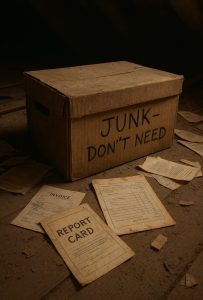
There was a box in the attic labeled “Junk – Don’t Need.”
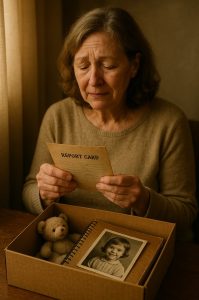
Inside it were expired coupons, old bills, and—at the very bottom—Lila’s childhood report cards.

Every grade was there.
Every teacher comment.
Every “Excellent work!” and “Pleasure to have in class.”

But one thing was missing from every single page:
Her name.

No “Lila.”
No “Evans.”
No trace of the child who had earned those grades with tears, silence, and invisible strength.

This is the story of what it means to grow up unseen.
And what it looks like to finally reclaim your place in your own life.
Growing Up “Lucky” But Unseen

Lila was adopted by her aunt at age three.

Her birth parents vanished into addiction.
Her aunt took her in out of obligation, not affection.

“You’re lucky I didn’t leave you in foster care,” she’d often say.
“So don’t ask for more than you’re given.”

And Lila didn’t.
She never asked for birthday parties.
Never asked for hugs.
Never asked to be called “daughter.”

She didn’t even ask to be called by name.

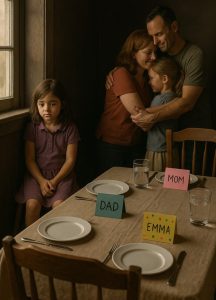
Because in that house, names were reserved for “real” family.

She became “the girl.”
“Her.”
“That one.”
How Invisibility Becomes Identity

The human heart has a fundamental need: to be known.
To be acknowledged.
To be called by name.

When that need is unmet, especially in childhood, a dangerous story takes root:

“If no one sees me, I must not exist.”

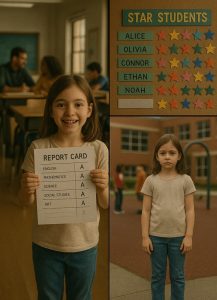
Lila excelled in school, hoping someone would notice.
Straight A’s. Star charts. Teacher’s pet.

But when she brought her report cards home, they were scanned—then tossed into a drawer.

Or worse:
Thrown into the junk box.

Not one “I’m proud of you.”
Not one “Well done.”

So she internalized the message:

“I have to work to be seen.
And even then—I might not matter.”
The Day She Found the Box

Lila was 38 when she returned to her childhood home.

The house was in foreclosure.
She was there to clear out old belongings before demolition.

She wasn’t expecting to feel anything.

But then—she found the box.

And inside it:
Her entire childhood, thrown in with outdated grocery ads.

She sat on the floor and flipped through her report cards.

Each one glowing with praise.
Each one anonymous.

And for the first time, the pain hit her—not as an adult, but as the child who once stood in the hallway, holding that paper, hoping someone would say, “Lila, you did good.”

They never did.

Naming What Was Denied

She could’ve thrown the report cards away.

Instead, she did something radical.

She opened her purse.
Took out a black pen.
And in bold, capital letters, wrote across each page:

LILA EVANS.

She wasn’t just writing her name.
She was rewriting her history.

Not to deny what happened.
But to claim her place in the story she had been erased from.


Why Naming Matters in Healing

There’s a reason why therapists ask, “What did people call you?”
There’s a reason spiritual traditions include naming ceremonies.

Because being named means being known.
Being remembered.
Being anchored in belonging.

Neglect doesn’t just forget birthdays.
It forgets identities.

It tells a child:

  • “You’re not worth remembering.” 
  • “You’re not worth calling.” 
  • “You’re not really here.” 

But reclaiming your name is more than symbolic.
It’s spiritual.

It’s saying:

“I was always here.
You just refused to see me.
But now—I see myself.”

What Happens When You Reclaim Your Name

Lila didn’t suddenly stop grieving.

There were still triggers:

  • Hearing someone say “sweetheart” to their daughter 
  • Seeing other names embroidered on backpacks 
  • Filling out forms where “Next of Kin” left her wondering who to write 

But she started:

  • Signing her full name in birthday cards 
  • Speaking her story out loud in therapy 
  • Correcting people who mispronounced her name 
  • Getting a library card just to see her name in print 

Small things.
But each one a ritual of remembrance.

You Deserve to Be Known

If you grew up like Lila—unclaimed, unnamed, unnoticed—you might have:

  • A hard time asking for what you need 
  • A deep fear of taking up space 
  • An unconscious belief that if you disappear, no one will notice 

But hear this:

You do not have to stay invisible.

You are not “too much.”
You are not “replaceable.”
You are not “a guest” in this life.

You are here.
You matter.
You always did.
5 Ways to Reclaim Your Visibility

🧾 1. Say Your Name Out Loud

To yourself. In the mirror. In a journal.
Speak it with the reverence it was always owed.

✍️ 2. Sign Your Work

Every text. Every piece of art. Every email.
You are not anonymous anymore.

📛 3. Correct People

If they forget or mispronounce your name, gently correct them.
You deserve to be called properly.

📓 4. Write a Letter to “The Girl Without a Name”

Tell her everything she needed to hear.
Tell her she was never junk.

💌 5. Create Something That Carries Your Name

An email. A poem. A website. A piece of clothing.
Let the world feel your presence.

Conclusion: You Belong in Your Own Story

When Lila left that house, she didn’t take much.
Just a handful of old report cards.
And her name—written in bold across every single one.

She didn’t need anyone else to validate it anymore.

Because now, she knew.

She was not “junk.”
She was not “the girl.”
She was not invisible.

She was—and is—Lila Evans.

And that name?
It holds the history, the ache, the beauty of someone who survived being erased—and chose to rewrite herself back in.

💬 Let’s Talk

Did you grow up feeling unseen?
Were you the “quiet one”? The “good kid”? The “easy to ignore” child?

Drop a 🖋️ in the comments if you’re reclaiming your voice and your place in the world.
Tag someone who deserves to hear:

“You were never forgettable.
You just weren’t celebrated the way you deserved.”

Keywords used (naturally embedded):

  • childhood neglect 
  • emotional invisibility 
  • healing from childhood trauma 
  • inner child healing 
  • reparenting your identity 
  • reclaiming your name 
  • being unseen as a child 
  • adult survivors of emotional neglect 
The Closet

Character: Maria, 28, HR assistant
Setting: A corporate office, present day

Maria had a panic attack in the supply closet.
Not because of the stress of work. Not because her boss raised his voice.
But because the scent of old wood and paper took her back.

Back to when she was six.
Back to when the hallway closet was her “safe place.”

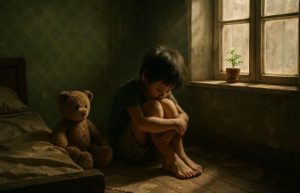
Whenever her stepfather started drinking, her mother would whisper, “Go, baby, go,” and Maria would crawl into the closet behind the coats. She could still feel the scratch of the wool jacket on her face, the musty air, and her own heartbeat pounding like a war drum.

Sometimes she stayed there for hours.
No flashlight. No sound. Just the hope that it would all pass.

But it didn’t.

When her stepfather broke the kitchen table in a rage and her mother screamed like she was being torn in half, Maria did what she always did. She stayed quiet. She stayed hidden.
Because somewhere along the line, she learned that if you don’t speak, you don’t get hurt.

And that belief followed her into adulthood like a shadow.

At 28, Maria never spoke up in meetings.
When someone interrupted her, she smiled and let it happen.
When her boyfriend made jokes that sliced her self-worth, she laughed to avoid being “dramatic.”

She thought she was surviving.
But she was still hiding in that closet—just taller now, wearing heels, with a clipboard in her hand.

Until yesterday.

A new intern walked into her office. His voice cracked when he said, “Sorry, I made a mistake… please don’t get mad.”
He flinched when she reached for the stapler. Flinched.

Something inside Maria shattered.

She sat him down, handed him a glass of water, and said something she had never said to herself:
“It’s okay. You’re safe now. No one’s going to hurt you here.”

Then she walked straight to the supply closet and closed the door behind her—not to hide this time, but to face it.

She cried harder than she had in 20 years.
For the little girl who learned silence as survival.
For the teenager who thought love meant enduring cruelty.
For the woman who forgot she had a voice.

Maria didn’t leave the closet broken.
She left with her head held higher, her steps steadier, and a whisper rising from within:

“I deserved more. And I still do.”

💬 If you were ever taught to stay silent to stay safe, I see you. I hear you.
Drop a 🧥 emoji if you ever had a “closet.”
Share this if someone you love still thinks they’re only lovable when they’re invisible.
#FromSilenceToStrength #YouWereNeverTheProblem #AChildDeservingMore

You Were Never Meant to Carry This Alone

Keyword focus: healing from childhood trauma, inner child healing

You Were Never Meant to Carry This Alone

There are certain wounds that don’t bleed, but they live inside us. They sit silently in the back of our minds, shaping the way we see ourselves and the world around us. And often, they begin when we are too small to understand, too vulnerable to fight back, too young to even know it’s not normal. This is what it means to carry the burden of childhood trauma.

If no one told you this before, let me tell you now: you were never meant to carry this alone.

There are certain wounds that don’t bleed, but they live inside us.

A Backpack of Stones

Imagine a small child with a backpack. And every time someone yelled, ignored, insulted, shamed, or abandoned them, a stone was placed in that pack. At first it was just a few. Then more. Then even more. Until one day, the child could barely stand. But they kep

But it was. And it still is.

Because trauma that isn’t healed, doesn’t go away. It grows roots in our nervous system. It whispers in our relationships. It controls how we love, trust, speak, and even how we see ourselves in the mirror.

The Myth of Self-Reliance

Many people who grew up in pain learned to be strong too soon. They became their own protectors. They learned how to read a room in seconds. How to shrink, how to disappear, how to keep the peace.

But strength forged in fear is not peace. And independence built on survival is not freedom.

You may think you’re supposed to figure it out on your own. That you have no right to complain. That it’s too late to change anything now.

But none of that is true.

Healing Begins When We Speak the Unspoken

One of the most powerful steps in healing from childhood trauma is breaking the silence. Speaking the truth of what happened to you. Even if it’s just whispered into a journal. Even if your voice shakes. Even if you’re afraid it makes you weak.

It doesn’t make you weak. It makes you human.

Because the pain that is hidden cannot be healed. The shame that is buried will continue to rot. But the moment you let light in, even a little, the healing begins.

You may need to grieve. You may feel angry. You may feel sad about the childhood you deserved but never got. All of that is valid.

You Were Not Meant to Heal Alone

It’s a beautiful, radical thing to let someone in.

Whether it’s a therapist, a friend, a support group, or even words in a book that understand your pain—you begin to remember that you were never supposed to walk through this in isolation.

Healing is not a solo journey. It is a communal act of remembering, of witnessing, of holding one another when the weight becomes too much.

Your inner child still lives within you. And they don’t need you to be perfect. They just need you to show up, hold their hand, and promise, “We are not alone anymore.”

A Future Not Defined by the Past

You are not broken. You are someone who learned how to survive. You built walls to protect yourself. You carried weight that was never yours. And you made it here.

But survival is not the same as living.

Now, you are allowed to put the backpack down. Slowly. Gently. You are allowed to say, “I deserve softness.” You are allowed to feel joy without guilt. Love without fear. Rest without shame.

You were never meant to carry this alone. And now, you don’t have to.

Let this be the first step. Or the fiftieth. Let this be your reminder: healing from childhood trauma is possible. And your inner child is still waiting for you—not to rescue them, but to sit beside them and say, “We made it. And we’re safe now.”

You Don’t Have to Forgive to Heal – What Real Emotional Release Looks Like


You’ve heard it all before: “Forgive and forget.” “Just let it go.” “It’s the only way to move on.”

But what if I told you… you don’t have to forgive the person who hurt you in order to heal?

What if true healing isn’t about them at all—but about you reclaiming your power?

Forgiveness can be a beautiful thing. But when rushed, forced, or demanded, it becomes just another wound. So let’s redefine what healing looks like—on your terms.

  1. The Pressure to Forgive Too Soon

Too often, survivors are asked to make peace with monsters before they’ve even stopped bleeding.

Well-meaning friends, faith leaders, or even therapists might say, “You’ll feel better once you forgive.”

But when forgiveness is pushed before the pain has been witnessed, it only silences the truth.

You don’t owe forgiveness to the one who never apologized. You don’t owe absolution to someone who still denies what they did.

  1. What Forgiveness is Not

Let’s be clear:

  • Forgiveness is not saying “it was okay.”
  • Forgiveness is not reconciling.
  • Forgiveness is not forgetting.
  • Forgiveness is not pretending it didn’t change you.

Real healing says: It mattered. It hurt. And I’m allowed to grow beyond it—whether they’re sorry or not.

  1. The Healing That Doesn’t Require Forgiveness

Healing is:

  • Naming what happened.
  • Feeling the feelings you were never allowed to have.
  • Validating your pain without minimizing it.
  • Releasing the belief that it was your fault.

You can rage. You can cry. You can build boundaries so high they never touch you again.

That is healing.

  1. Forgiveness of Self Comes First

If there’s any forgiveness that truly matters, it’s this:

Forgiving yourself.

For the years you stayed silent. For the ways you coped that hurt you. For thinking you deserved it. For the self-blame you carried like a second skin.

You didn’t cause it. You were surviving. You did what you had to do.

Now you get to stop surviving and start healing.

  1. What Letting Go Really Looks Like

Letting go isn’t a moment. It’s a series of micro-decisions:

  • To stop explaining your pain to those who don’t want to understand.
  • To stop chasing closure from people incapable of giving it.
  • To stop believing that you are the broken one.

Letting go means saying: “I release you—not because you earned it, but because I deserve peace.”

You’re not freeing them. You’re freeing yourself.

  1. A Ritual for Release Without Forgiveness

Try this:

  1. Write a letter to the person who hurt you. Say everything.
  2. Don’t hold back. Let your truth rise.
  3. Burn it, tear it, bury it—whatever feels right.
  4. Whisper: “I don’t need to forgive to heal. But I do release this from my body.”

You may cry. That’s healing. You may feel nothing at first. That’s protection.

Repeat when needed. This is your journey.

Closing Words from Grandpa Eli

My dear one, You are not required to carry the weight of their sins just to seem “kind.” You don’t need to forgive to move forward. You need to feel. To grieve. To release.

When you are ready—on your own terms—you’ll know what needs to be forgiven and what simply needs to be released.

And whatever you choose… I’ll be here, cheering for your freedom.

💬 Has someone ever pushed you to forgive before you were ready? Share if you feel safe. Your story may help someone else feel seen.

#RedefineForgiveness #HealingWithoutForgiveness #SelfForgiveness #EmotionalRelease #YouDeservePeace