The Piano That Never Played

Character: Jonah, 37, music teacher
Setting: A quiet suburban house, winter evening

Jonah sat in his empty living room, eyes fixed on the dust-covered piano in the corner. He hadn’t touched it in over 15 years. Not since the night his father shattered more than just the keys.

Jonah sat in his empty living room, eyes fixed on the dust-covered piano in the corner
Jonah sat in his empty living room, eyes fixed on the dust-covered piano in the corner.

He used to believe music could save him.

At seven years old, he would sneak downstairs after midnight, placing his tiny fingers on the cool ivory keys, playing lullabies for the version of his mother that didn’t drink, and for the father he wished would just look at him without disgust.

But one night, the playing stopped.

That night, his father came home drunk, like always.
“What did I say about playing that damn thing when I’m home?”
Jonah had barely lifted his fingers when his father hurled the heavy ashtray across the room. It missed Jonah’s head by an inch, slamming into the piano, cracking the soundboard. The music died instantly.

So did Jonah’s belief that being good was enough.

For years, he thought if he were better—quieter, smarter, more obedient—his dad wouldn’t be angry. Maybe then his mom would stay sober. Maybe then someone would say, “I love you,” without a condition attached to it.

But none of it ever worked.

Instead, he grew up with a voice in his head louder than any piano:
You deserved it.
You were too much.
You should’ve known better.

He carried that voice into adulthood. Into relationships. Into every job interview he sabotaged. Every date he walked out of. Every compliment he swatted away like a mosquito that didn’t belong.

Until last week, when he saw a little boy in his music class flinch—just because Jonah raised his voice to ask for quiet. The child’s whole body shrank, like Jonah’s had all those years ago.

It shattered something in him.

That night, Jonah drove back to his childhood home. He stood in front of the old piano and wept—not for his father, not even for his mother—but for himself. For the boy who thought he had to earn love by erasing himself.

He didn’t forgive his parents. He wasn’t there yet.
But for the first time, he whispered the words:
“I’m sorry, Jonah. You didn’t do anything wrong.”
And the keys beneath his fingers—damaged, detuned—let out the softest note.

Like forgiveness finding its voice.

🧡 If you’ve ever blamed yourself for someone else’s cruelty, you’re not alone.
Drop a 🎹 if you’re learning to play your own song again.
Tag someone who needs to hear: It was never your fault.
#ForgiveYourself #HealingTogether #AChildhoodYouDidn’tDeserve
A Letter from Grandpa Eli

To the Child Inside You: Forgive Yourself

My dear,

If you’re reading this, it means you’re carrying something heavy. A weight not made of iron or stone, but of guilt… of memories… of blame you should never have held in your little hands.

I want to talk to that child inside you. The one who once wondered,
“Was it my fault?”
“Did I deserve this?”
“If only I had been better… quieter… stronger…”

Let me tell you a secret, whispered gently like the wind in the trees:
It was never your fault. Not even for a moment.

 This isn’t about forgiving them.This is about forgiving yourself.
This isn’t about forgiving them.
This is about forgiving yourself.

You were just a child. You didn’t choose the yelling. You didn’t cause the silence. You weren’t the reason they drank, or lashed out, or disappeared emotionally. The world got it upside down. And for too long, you’ve carried the burden of their brokenness on your innocent shoulders.

I know forgiveness is a complicated word. People often misunderstand it. They say, “You should forgive your abuser.” But I don’t believe you owe them anything.
This isn’t about forgiving them.

This is about forgiving yourself.

Forgive yourself for not knowing how to speak up.
Forgive yourself for trying so hard to please people who were impossible to please.
Forgive yourself for surviving in ways others may not understand—through silence, rebellion, perfectionism, or pretending everything was okay.

Forgive the child who simply wanted to be loved.

That child is still with you. And they are waiting—for your kindness, for your warmth, for your understanding.

So here’s what I want you to do today:

  1. Look in the mirror. Gently place your hand on your chest and say,
    “I forgive myself. I was just a child. I did nothing wrong.”
  2. Let go of the question “Why did this happen?” There may never be a satisfying answer. What matters more is: What will you do now to live free?
  3. Be the adult your younger self needed. Speak gently. Rest when you’re tired. Set boundaries. Celebrate small joys.

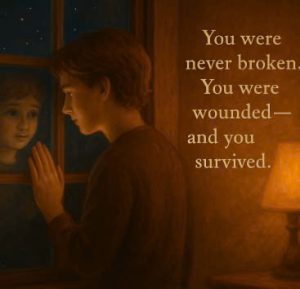
Dear one, you were never broken. You were wounded—but wounds can heal. Scars do not mean you’re damaged. They mean you survived.

You’re not alone anymore.

With warmth like a cup of cocoa in winter,
Grandpa Eli
🧡