The Love I Never Felt: How Emotional Neglect Shapes Our Adult Lives

By Grandpa Eli

“But I Had a Roof Over My Head…”

Not every child who suffers leaves with visible scars.

Some grow up in homes with dinner on the table. Clothes in the closet. Even smiles in family photos.

But something important was missing.
Something silent. Invisible. And just as damaging as a slap:

Emotional presence. Warmth. Connection.

This, my dear one, is what we call emotional neglect — and it’s far more common than most people realize.

In today’s blog, we’ll walk through:

  • What emotional neglect really is.

  • Why it’s so often misunderstood.

  • How it leaves lifelong marks on our sense of self.

  • And most importantly — how we can begin to heal.

What Is Emotional Neglect?

Emotional neglect happens when a child’s emotional needs are consistently ignored, dismissed, or unacknowledged.

It’s not always malicious.
In fact, many parents who neglect emotionally are loving in their own way — they simply never learned how to be emotionally available.

But to a child, the result is the same:

  • Feeling invisible.

  • Feeling unworthy of love.

  • Learning to suppress emotions just to survive.

A child’s logic is heartbreakingly simple:

“If no one sees me… maybe I’m not worth seeing.”

“They Were Good Parents. I Must Be the Problem.”

This is one of the cruelest traps emotional neglect sets.

When a parent isn’t violent or overtly abusive, the child assumes the fault must be within themselves.

“They fed me. Gave me clothes. So why do I feel so empty?”
“Maybe I’m too sensitive. Maybe I just ask for too much.”

These beliefs become core wounds — deep-rooted stories that follow us into adulthood.

And they shape everything.

How Childhood Neglect Follows Us Into Adulthood

You might not even realize it’s happening.

But emotional neglect can show up in adulthood as:

  • Chronic low self-worth

  • Fear of vulnerability

  • Difficulty identifying or expressing emotions

  • Being “overly independent”

  • People-pleasing to earn love

  • Feeling numb, disconnected, or emotionally flat

  • Attracting emotionally unavailable partners

  • A deep fear of being “too much”

Sound familiar?

That’s not because something’s wrong with you.
It’s because your inner child is still waiting to be seen.

The Three Most Common Myths About Emotional Neglect

Myth 1: “If I wasn’t hit or screamed at, I wasn’t abused.”
Truth: Abuse isn’t just what’s done to you. It’s also what was withheld from you.

Myth 2: “They did their best, so I shouldn’t feel hurt.”
Truth: Compassion for their struggle doesn’t erase your pain. Both can exist.

Myth 3: “I should be over it by now.”
Truth: Time doesn’t heal what’s never been acknowledged.

How We Begin To Heal

🧓 Let me tell you something important, dear one:

“You didn’t make it up.”
“You weren’t too needy.”
“You just needed what every child needs: love, attention, and to be seen.”

Healing from emotional neglect is possible. But it begins with naming the wound.
Let’s explore some healing steps together:

Step 1: Acknowledge What Was Missing

Write it down. Say it aloud. Tell a trusted friend or therapist.

“I wasn’t hugged.”
“No one asked how I felt.”
“They never said they were proud of me.”

Validation isn’t pity. It’s power.

Step 2: Stop Minimizing Your Pain

“It could’ve been worse”
“At least they stayed”

These thoughts don’t serve your healing.
Your pain deserves space — no matter what others had it “worse.”

Step 3: Reconnect with Your Inner Child

That little one inside you is still waiting to be seen.

  • Talk to them.

  • Write to them.

  • Be the parent to yourself that you never had.

Step 4: Seek Safe, Supportive Relationships

Find people who make you feel seen. Heard. Valued.
Whether through therapy, support groups, or soulful friendships — connection heals what neglect created.

Step 5: Redefine Love and Worth

Love is not something you have to earn.
Your worth is not tied to your achievements or usefulness.
You are lovable because you exist.

Let that sink in. Again and again. Until it becomes truth.

Final Words from Grandpa Eli

Dear one, emotional neglect is invisible to the world — but deeply felt by the soul.

It wasn’t your fault.
You didn’t imagine it.
And you’re not alone.

There’s nothing wrong with you.
You’re healing.

And if you’re still searching for that warm voice to tell you that you matter —
🧓 Let me be that voice:

You matter.
I see you.
And I’m proud of the person you’re becoming.

With all my heart,
~ Grandpa Eli
 

I Tucked Her In at Night: A Story of Childhood Role Reversal

“I Tucked Her In at Night”

From: A child who had to parent their own parent

Dear Grandpa Eli,

I don’t really remember being little.

I mean, I know I was — there are pictures of me in footie pajamas, holding a stuffed bear with one eye. But even then, I remember watching over Mom. Making sure she didn’t cry too long. Or sleep too long. Or drink too much.

Other kids got tucked in at night.
But I was the one doing the tucking.

I’d help her to bed after she passed out on the couch. I’d take off her shoes, pull a blanket over her shoulders. Once, I even sang her a lullaby. I was five.

People say kids are resilient. But I think sometimes we’re just… good at hiding.
Good at pretending we’re not scared.
Good at smiling for teachers and saying, “I’m fine,” when no one packed our lunch again.

Every morning before school, I checked to see if she was breathing. That was my routine. That — and pouring cereal with water because the milk was gone.

When other kids asked what my mom did for work, I made things up. “She’s a nurse,” I said once. She wasn’t. She didn’t leave the house for days. Except to buy wine.

When she was sober, she could be magic.
She’d braid my hair and call me “her little sunshine.”
But when the bottle came out, the sunshine disappeared.

Sometimes she’d cry and say, “You’re the only thing keeping me going.”
I didn’t know if that was supposed to be a compliment.
It felt like a cage.

One time, I told the school counselor that I felt tired all the time. She said maybe I needed to sleep more. I wanted to say:
“I sleep just fine. It’s waking up to this that’s exhausting.”

But I didn’t.
Because if someone found out, I was afraid they’d take me away.
And as broken as Mom was… she was still mine.

Now I’m twelve. I still flinch when someone knocks on the door.
I still freeze when someone yells.
I still feel guilty when I rest — like I should be checking on someone, fixing something, apologizing for something I didn’t even do.

Grandpa Eli,
Is it okay if I say I’m tired?
Even if I don’t look like it on the outside?

Is it okay to be a kid…
Even if I never learned how?

Sometimes I look in the mirror and try to see me — just me — not the caretaker. Not the peacekeeper. Not the one keeping everyone from falling apart.

Do you think she ever saw me?

Do you?


Reply from Grandpa Eli

Oh my precious one,

I see you.

I see the five-year-old with tiny hands pulling blankets over a grown woman. I see the tired eyes behind the “I’m fine.” I see the strength it took to become a parent before you even lost your baby teeth.

And yes — I see you. Not the caretaker. Not the peacemaker.
You. The child who deserved to be held, not to be holding everything together.

Sweetheart, what happened to you was not okay.

You should never have had to carry so much. You should have been the one being sung to, not the one whispering lullabies to a woman drowning in her pain. You should have been eating warm dinners, not cereal with water. You should have had one job: to be a child.

But instead, you were handed a silent contract — to become her hope, her helper, her emotional anchor. And no one asked if your tiny heart could carry all that weight.

You asked if it’s okay to be tired.
Let me be the one to give you the answer your soul has waited years to hear:

Yes. It is okay to be tired.
It is okay to rest.
It is okay to cry.
It is okay to not be okay.

You don’t have to earn rest. You don’t have to apologize for your exhaustion. You don’t have to stay in “alert mode” just because love once depended on it.

You are allowed to lay down the weight.

And you know what else?

You don’t have to save anyone to be worthy of being saved.

I want you to hear this: You were never meant to be her solution.
That was never your job. Not then. Not now.

You’re twelve, and yet you speak like someone who’s lived a hundred years. But buried beneath that armor is still a child. A child who wants to laugh freely. To play. To mess up without fear. To eat cereal with milk and not count every drop.

That child still lives inside you — and they’re waiting.

Let them out, bit by bit. Let them be loud. Let them rest. Let them be seen.
Because I see them. And I love them. Just as they are.

You are not invisible to me.
You are unforgettable.

And I am so, so proud of you.

With the gentlest arms and the warmest lap,
— Grandpa Eli

UNDERSTAND HEAL – OVERCOME A PAINFUL CHILDHOOD

🧓👣 A message from Grandpa Eli – a friend to every child who has ever been hurt

Some children grow up not with fairy tales, but with long, lonely days filled with fear, neglect, or harm caused by the very people who were supposed to protect them.

If you are one of those children – and if that frightened little one still trembles inside the grown-up you are today – then this message is for you…

1. 💡 Understand – Look back, not to hurt more, but to understand

Not everyone dares to revisit their childhood. Because in those memories, there might be tears, silence, or unanswered questions. But do you know something? Only when you truly understand what happened can you stop repeating it in your present life.

You were not to blame for being hurt. It wasn’t because you were bad or not good enough. The fault was with the grown-ups. And you – you deserved love all along.

2. 🛠 Heal – Begin your own journey of healing, little by little

No one can turn back time to give you a different childhood.
But you can choose to begin again – today.

Healing isn’t something that happens overnight. But it can begin with:

  • One moment of courage to speak what you’ve buried for years 
  • A letter you’ll never send, written to the one who hurt you 
  • A heartfelt conversation with someone who understands 
  • Or just one quiet moment, with your hand on your heart, whispering:
    “I’ve tried so hard. And I’m still here.” 

3. 🚪Overcome – Step into the life you truly deserve

Overcoming doesn’t mean forgetting.
It means living without letting the past imprison you any longer.

You have the right to live lightly, joyfully.
You have the right to love – and to be loved.
You have the right to choose kindness, to yourself and to others.
You can do it – even if no one ever taught you how before.
Because now, you can teach yourself.

👣 A FINAL WORD

Your childhood was not your choice.
But your path from this day forward – that is yours.

Grandpa Eli cannot erase the pain of the past.
But he has always believed this:

“Anyone brave enough to face their past… deserves a future brighter than they ever imagined.”

And if you ever need someone to listen –
Grandpa Eli is always here. 🍂

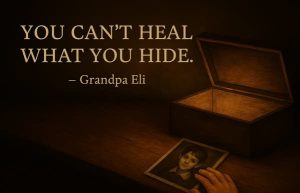
You Can’t Heal What You Hide: Why Facing Your Troubled Childhood Matters

By Grandpa Eli

You were just a child.
And you didn’t get the love you needed.
Maybe there was shouting. Silence. A parent who hurt you—or wasn’t there at all.
Now, as an adult, part of you wants to forget it all.

That’s understandable.
But, my dear, that’s not healing. That’s hiding.

 Why Facing Your Troubled Childhood Matters
Why Facing Your Troubled Childhood Matters

1. 🧠 The mind never really forgets.

You may think you’ve moved on.
You may have a job, a family, and a life that looks “normal” from the outside.
But deep inside, your inner child is still there—waiting, hoping someone will finally listen.

The memories might be locked in a box,
but the feelings?
They leak out in unexpected ways:

  • You panic when someone raises their voice.
  • You over-apologize, even when it’s not your fault.
  • You feel empty, even on “happy” days.
    That’s not weakness. That’s woundedness.

2. ⚠️Unhealed pain becomes silent sabotage

Research shows that adults with traumatic childhoods are:

  • More likely to suffer from anxiety, depression, and addiction.
  • More prone to self-doubt, shame, and trust issues.
  • More likely to repeat the cycle—with their own children.

You’re not broken.
You’re burdened.

And you don’t have to carry that burden alone.

3. 🧩 Pretending it didn’t happen keeps you incomplete.

You can’t erase your past—but you can rewrite your relationship with it.

Your childhood matters.
It shaped your beliefs about love, safety, and self-worth.
Trying to “move on” without understanding it is like trying to rebuild a house without checking the cracked foundation.

You deserve more than survival.
You deserve wholeness.

4. 🌱 Healing is not forgetting—it’s becoming.

When you finally turn to face the past—not with fear, but with compassion—you take back your power.

You begin to see:

  • It wasn’t your fault.
  • You did the best you could to survive.
  • The love you didn’t get then—you can give yourself now.

That’s not weakness.
That’s healing.

🕯️ A gentle invitation

If you’ve been locking the past in a box, maybe it’s time to open it—just a little.

Not to suffer again…
But to remember who you were.
To comfort that child inside.
To tell them:

“You mattered then. You matter now. And I will take care of you.”

You can’t heal what you pretend never hurt.
But you can heal.
You can grow.
You can begin again.