This Ends With Me – Becoming the Cycle Breaker Your Family Never Had

Keywords: generational trauma, breaking the cycle, parenting after trauma, conscious parenting, emotional resilience

Somewhere, someone has to say it: “This ends with me.”

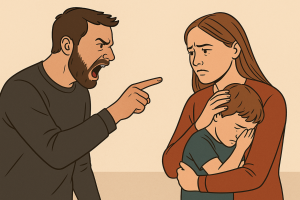
The yelling. The silent treatment. The fear in small footsteps. The shame tangled into bedtime.

It traveled through generations, passed down like a cruel inheritance. But here you are—tired, tender, trembling—and choosing differently.

You, my dear, are the cycle breaker. And though it may be the hardest role in the family… it is also the most sacred.

  1. What the Cycle Looks Like

Maybe you grew up walking on eggshells. Maybe you were never hugged. Maybe you only felt noticed when you were achieving—or when you failed.

And now, as a parent, partner, or even just a grown-up looking back… you see the patterns. The same wounds trying to make a home in you. The same voices now echoing in your own.

But you noticed. And that awareness? That’s where the break begins.

  1. Why It’s So Hard to Break Free

The pain we lived in childhood becomes our blueprint. Even when we hated it. Even when we swore we’d never repeat it.

Stress hits… and suddenly, we hear our parents in our voice. We withdraw, we raise our voices, we freeze. And afterward, the guilt eats us alive.

But here’s what I want you to hear:

You are not failing. You are interrupting. And interruptions are messy.

  1. Choosing to Parent Differently

Cycle breaking doesn’t mean perfect parenting. It means conscious parenting.

It means:

  • Apologizing when you mess up.
  • Letting your child say “no” and still be safe.
  • Saying “I love you” even when you’re angry.
  • Allowing space for big feelings—not punishing them.

It’s giving your child what you never had. And giving yourself what you always needed.

  1. Healing While You Lead

Many cycle breakers are still bleeding. Still triggered. Still afraid of becoming “just like them.”

So let me remind you: You don’t have to be fully healed to start healing the future. You just have to be willing.

Take breaks. Cry in the laundry room if you have to. But keep choosing:

  • Therapy.
  • Journaling.
  • Saying, “This isn’t how it has to be.”

Every tiny choice to respond instead of react is rebellion. Every hug you give is a revolution.

  1. Reparenting Yourself Along the Way

As you parent your children, or simply grow into your truest self, you may find parts of you still stuck in the past.

A scared child still bracing for criticism. An angry teen still trying to be seen. A broken soul still aching for approval.

Love them. Speak to them gently. Say:

  • “You didn’t deserve that.”
  • “I see you now.”
  • “We’re doing it differently.”

Because cycle breaking doesn’t just heal forward—it heals backward too.

  1. What Legacy Really Means

Legacy isn’t the wealth you leave. It’s the warmth.

It’s your child saying, “I feel safe.” It’s your partner feeling seen instead of shamed. It’s you… waking up one day, realizing the voices in your head have grown quieter.

You are not weak for wanting better. You are strong for choosing better with shaking hands.

Closing Words from Grandpa Eli

My dear one, You are the first light after a long line of storms. You are the soft voice where there used to be screams. You are the one who chose not to pass the pain forward.

You are the cycle breaker. And because of you, everything can change.

💬 If you’re walking this road—leave a 🌱 in the comments. Let the others know: we’re not doing this alone. #CycleBreaker #BreakTheChain #ConsciousParenting #GenerationalHealing #ThisEndsWithMe
A Letter With No Stamp

Lucas had stopped flinching.

He still didn’t laugh much. But he had begun to hum—softly—when planting carrots, and once, Peter caught him tracing his finger along the petals of a peony like it was a secret worth keeping.

Then one rainy evening, Lucas said it.

“I think I want to see my father.”

Peter didn’t answer right away. He looked at the muddy windows of the greenhouse, where drops slid down like tiny rivers breaking loose. “Why?” he finally asked.

“I want him to know… he didn’t win.”

They worked on the letter together. Lucas’s hands shook at first. He kept crossing things out. Then he stopped. He wrote:

I’m not writing this so you’ll say sorry.

I’m writing this so I can stop carrying what you should have never put on me.

I’m not afraid of you anymore.

They didn’t mail it. That wasn’t the point.

Later that week, Peter took Lucas on a walk through the forest trail behind the greenhouse. They stopped at an old bench—weathered, quiet, and covered in moss.

That’s where Grandpa Eli waited.

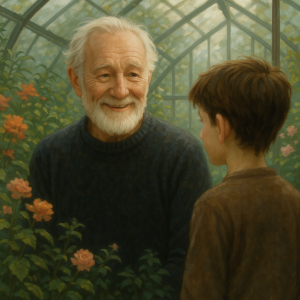
He wore his usual navy sweater, hands clasped gently on his lap, eyes twinkling with the kind of kindness that made people speak without fear.

Lucas sat down, wordless.

“You don’t need to tell me what happened,” Eli said. “You’ve lived it already. But if you want to, I’ll listen.”

And Lucas did.

I’m writing this so I can stop carrying what you should have never put on me.


For the first time, he spoke every word—the names, the bruises, the nights he pretended sleep so his father would stop yelling. He didn’t cry. He didn’t tremble.

When he finished, Grandpa Eli nodded.

“You’ve done the hardest part,” he said. “You remembered… and you stayed.”

That night, Lucas tore the letter in half. Then he burned it in the firepit.

Peter didn’t stop him.

Because sometimes, forgiveness isn’t about letting someone off the hook.

It’s about unhooking yourself.


Peter – The Boy With No Shadow

Peter was ten when he realized he didn’t cast a shadow.

Not a real one, at least. His feet touched the ground like any other child’s, but something inside him hovered—untethered, hidden. “You’re too sensitive,” his father barked when Peter cried. “Useless, like your mother,” he added, tossing a plate against the wall. The sound echoed louder than the plate itself.

At night, Peter wrapped himself in silence. He didn’t cry anymore. The tears had dried years ago, replaced by a quiet agreement with himself: Survive. Don’t be seen. Don’t upset them.

He often watched the neighbor’s garden through the fence. Mrs. Callahan’s boy, Henry, ran barefoot chasing butterflies, laughing so loud it scared the birds. Peter marveled—not at the butterflies, but at the audacity of joy.

One day, after a particularly harsh beating over a dropped dish, Peter packed a small backpack. Notebooks. His lucky marble. A photo he’d found under a floorboard of himself at age two, held in his mother’s arms—smiling. She didn’t smile anymore.

He walked away. Not toward any specific place, but away. The road was wide. So was the world.

Peter spent weeks drifting between towns, doing chores at farms for a bowl of stew or a warm barn. He never spoke much. When people asked about his family, he would say they were “gone,” and in a way, they were.

But life, as it often does, placed someone in his path.

Her name was Elianna, a retired schoolteacher with hair like silver thread and eyes like winter turning into spring. She found Peter sitting on the steps of the old town library.

“You look like a boy with something heavy in his bag,” she said.

Peter shrugged. “It’s just books.”

“No,” she smiled gently. “I meant the invisible kind.”

And for the first time in his young life, Peter talked. About the yelling. The silence. The fear. About how he once believed he was bad, rotten, the reason his father drank, the reason his mother hid behind curtains even in daylight.

Elianna didn’t flinch. “What happened to you wasn’t your fault,” she said, placing a hand over his trembling one. “You were a child. You deserved love, not bruises.”

That night, Peter wrote his father a letter. He didn’t know if he’d ever send it. But he wrote it not to hurt, not to accuse—but to say: You no longer control my breath, my steps, or my future.

Years later, Peter returned to his hometown—not to see his parents, who had long moved away—but to build a greenhouse on the old Callahan plot. He filled it with orange orchids and resilient succulents. “For children,” he said, “who forgot they could bloom.”

He still didn’t cast a shadow.

Because Peter had become his own light.


You Can’t Heal What You Hide: Why Facing Your Troubled Childhood Matters

By Grandpa Eli

You were just a child.
And you didn’t get the love you needed.
Maybe there was shouting. Silence. A parent who hurt you—or wasn’t there at all.
Now, as an adult, part of you wants to forget it all.

That’s understandable.
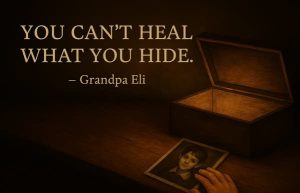
But, my dear, that’s not healing. That’s hiding.

 Why Facing Your Troubled Childhood Matters
Why Facing Your Troubled Childhood Matters

1. 🧠 The mind never really forgets.

You may think you’ve moved on.
You may have a job, a family, and a life that looks “normal” from the outside.
But deep inside, your inner child is still there—waiting, hoping someone will finally listen.

The memories might be locked in a box,
but the feelings?
They leak out in unexpected ways:

  • You panic when someone raises their voice.
  • You over-apologize, even when it’s not your fault.
  • You feel empty, even on “happy” days.
    That’s not weakness. That’s woundedness.

2. ⚠️Unhealed pain becomes silent sabotage

Research shows that adults with traumatic childhoods are:

  • More likely to suffer from anxiety, depression, and addiction.
  • More prone to self-doubt, shame, and trust issues.
  • More likely to repeat the cycle—with their own children.

You’re not broken.
You’re burdened.

And you don’t have to carry that burden alone.

3. 🧩 Pretending it didn’t happen keeps you incomplete.

You can’t erase your past—but you can rewrite your relationship with it.

Your childhood matters.
It shaped your beliefs about love, safety, and self-worth.
Trying to “move on” without understanding it is like trying to rebuild a house without checking the cracked foundation.

You deserve more than survival.
You deserve wholeness.

4. 🌱 Healing is not forgetting—it’s becoming.

When you finally turn to face the past—not with fear, but with compassion—you take back your power.

You begin to see:

  • It wasn’t your fault.
  • You did the best you could to survive.
  • The love you didn’t get then—you can give yourself now.

That’s not weakness.
That’s healing.

🕯️ A gentle invitation

If you’ve been locking the past in a box, maybe it’s time to open it—just a little.

Not to suffer again…
But to remember who you were.
To comfort that child inside.
To tell them:

“You mattered then. You matter now. And I will take care of you.”

You can’t heal what you pretend never hurt.
But you can heal.
You can grow.
You can begin again.

💔 Breaking the Cycle: You Don’t Have to Be the Parent You Had

By Grandpa Eli

You know what’s strange and sad?
Many people who were hurt as children end up hurting their own children—even when they promised themselves they’d never do it.

Breaking the Cycle
Breaking the Cycle You Don’t Have to Be the Parent You Had

You’d think that someone who knew the pain of being screamed at, ignored, beaten, or constantly criticized would never want their kids to feel that way.
But the truth is: hurt people often hurt people.
And the cycle goes on—unless someone brave decides to stop it.

If you’re reading this, maybe that someone is you.

Why Do We Repeat What Hurt Us?

As a professor of human behavior, I’ve spent a lifetime studying this. And as Grandpa Eli, a friend to all children, I’ve spent even more time just listening. Here’s what I’ve learned:

🪞 We learn by watching.
When we’re little, we soak up everything—especially how our parents behave. That becomes our idea of “normal,” even if it was harmful. That’s called modeling.

🤷‍♂️ Sometimes, we just don’t know better.
If no one ever taught us what gentle, respectful parenting looks like, how are we supposed to do it? Many people don’t realize their childhood wasn’t normal until they see how others live.

💣 Abuse is powerful.
It doesn’t just bruise the skin—it warps the way we think. It can make us believe we’re unlovable, weak, or out of control. Those beliefs can creep into how we parent, too.

But You Know What? You Can Stop It.

No, you can’t rewrite your past.
But you can refuse to pass it on.

You are not doomed to repeat what was done to you.
You’re not stuck. You’re not broken beyond repair.
You may be tired, triggered, overwhelmed—but you are not powerless.

The cycle breaks when a parent says:
“This stops with me.”

How to Begin the Healing

🌱 Start by looking back—with courage.
Don’t pretend it didn’t happen. Pretending doesn’t heal anything.
Instead, say: “Yes, that hurt me. That shaped me. But it does not own me.”

🛠 Learn new tools.
If no one ever taught you how to calm down without yelling, or how to set boundaries without shame, that’s okay. Parenting is a skill. You can learn it, just like cooking or riding a bike.

🧠 Understand your triggers.
Maybe your child’s whining makes your blood boil because no one ever allowed you to express your needs. Recognizing the link is the first step to undoing it.

💬 Talk to someone.
A therapist, a support group, or even just a trusted friend who understands. You’re not weak for asking for help. You’re wise.

❤️ Forgive the past—but not always the people.
You don’t have to forget. You don’t have to excuse it.
But you can stop carrying it around like a backpack of stones.

One Day, Your Child Will Thank You

Not because you were perfect.
But because you were different.

Because when your hands felt like forming a fist, you paused.
Because when your voice wanted to scream, you chose to breathe.
Because you saw the storm coming—and built a shelter instead of another storm.

You are breaking the cycle.
That’s the most powerful kind of love.

With warmth in every wrinkle,
Grandpa Eli
🧣 The friend who shows up when your heart needs someone to listen.