I Tucked Her In at Night: A Story of Childhood Role Reversal

“I Tucked Her In at Night”

From: A child who had to parent their own parent

Dear Grandpa Eli,

I don’t really remember being little.

I mean, I know I was — there are pictures of me in footie pajamas, holding a stuffed bear with one eye. But even then, I remember watching over Mom. Making sure she didn’t cry too long. Or sleep too long. Or drink too much.

Other kids got tucked in at night.
But I was the one doing the tucking.

I’d help her to bed after she passed out on the couch. I’d take off her shoes, pull a blanket over her shoulders. Once, I even sang her a lullaby. I was five.

People say kids are resilient. But I think sometimes we’re just… good at hiding.
Good at pretending we’re not scared.
Good at smiling for teachers and saying, “I’m fine,” when no one packed our lunch again.

Every morning before school, I checked to see if she was breathing. That was my routine. That — and pouring cereal with water because the milk was gone.

When other kids asked what my mom did for work, I made things up. “She’s a nurse,” I said once. She wasn’t. She didn’t leave the house for days. Except to buy wine.

When she was sober, she could be magic.
She’d braid my hair and call me “her little sunshine.”
But when the bottle came out, the sunshine disappeared.

Sometimes she’d cry and say, “You’re the only thing keeping me going.”
I didn’t know if that was supposed to be a compliment.
It felt like a cage.

One time, I told the school counselor that I felt tired all the time. She said maybe I needed to sleep more. I wanted to say:
“I sleep just fine. It’s waking up to this that’s exhausting.”

But I didn’t.
Because if someone found out, I was afraid they’d take me away.
And as broken as Mom was… she was still mine.

Now I’m twelve. I still flinch when someone knocks on the door.
I still freeze when someone yells.
I still feel guilty when I rest — like I should be checking on someone, fixing something, apologizing for something I didn’t even do.

Grandpa Eli,
Is it okay if I say I’m tired?
Even if I don’t look like it on the outside?

Is it okay to be a kid…
Even if I never learned how?

Sometimes I look in the mirror and try to see me — just me — not the caretaker. Not the peacekeeper. Not the one keeping everyone from falling apart.

Do you think she ever saw me?

Do you?


Reply from Grandpa Eli

Oh my precious one,

I see you.

I see the five-year-old with tiny hands pulling blankets over a grown woman. I see the tired eyes behind the “I’m fine.” I see the strength it took to become a parent before you even lost your baby teeth.

And yes — I see you. Not the caretaker. Not the peacemaker.
You. The child who deserved to be held, not to be holding everything together.

Sweetheart, what happened to you was not okay.

You should never have had to carry so much. You should have been the one being sung to, not the one whispering lullabies to a woman drowning in her pain. You should have been eating warm dinners, not cereal with water. You should have had one job: to be a child.

But instead, you were handed a silent contract — to become her hope, her helper, her emotional anchor. And no one asked if your tiny heart could carry all that weight.

You asked if it’s okay to be tired.
Let me be the one to give you the answer your soul has waited years to hear:

Yes. It is okay to be tired.
It is okay to rest.
It is okay to cry.
It is okay to not be okay.

You don’t have to earn rest. You don’t have to apologize for your exhaustion. You don’t have to stay in “alert mode” just because love once depended on it.

You are allowed to lay down the weight.

And you know what else?

You don’t have to save anyone to be worthy of being saved.

I want you to hear this: You were never meant to be her solution.
That was never your job. Not then. Not now.

You’re twelve, and yet you speak like someone who’s lived a hundred years. But buried beneath that armor is still a child. A child who wants to laugh freely. To play. To mess up without fear. To eat cereal with milk and not count every drop.

That child still lives inside you — and they’re waiting.

Let them out, bit by bit. Let them be loud. Let them rest. Let them be seen.
Because I see them. And I love them. Just as they are.

You are not invisible to me.
You are unforgettable.

And I am so, so proud of you.

With the gentlest arms and the warmest lap,
— Grandpa Eli

The Journey to Heal Childhood Wounds

Childhood should be a time full of love, protection, and security. However, for many people, it’s a period marked by abandonment, abuse, or simply a lack of affection. These traumas don’t just leave scars in memory; they deeply affect our psychology, physical health, and how we interact with the world as adults.

Impact on Children

Children who experience abuse or neglect often:

  • Have low self-esteem
  • Are prone to anxiety, depression, and guilt
  • Struggle to form or maintain close relationships
  • Find it difficult to express emotions and trust others

Consequences in Adulthood

When these wounds aren’t healed, they can lead to:

  • Loss of control over life, avoiding responsibility
  • Psychological disorders, addiction, or self-destructive behaviors
  • Feelings of unworthiness, loneliness, and a deep emptiness

Important Statistics

According to the Australian Institute of Family Studies:

  • High rates of anxiety, depression, PTSD
  • Eating disorders: anorexia, binge eating, obesity
  • Addiction to alcohol and drugs
  • Higher risk of hepatitis, diabetes, stroke

Invisible Wounds

Many people don’t realize they carry emotional scars caused by unhealthy parenting styles: control, emotional coldness, criticism, comparisons, neglect…

The outcomes include:

  • Avoidance of interaction, fear of conflict
  • Living in chronic self-doubt and loneliness

The Way Out

Based on the “Wounded Childhood” series:

  1. Understand: Have the courage to face and acknowledge the truth
  2. Heal: Seek support from professionals, peer groups, or begin a journey of self-discovery
  3. Overcome: Let go of the past and choose a brighter, more deserving future

A Message from “Grandpa Buddha”

“You are not at fault for being hurt. But you are responsible for your own healing.”

And remember:

  • The journey may be long and painful
  • But it is worth it
  • And you are not alone: many others are walking this path with you

The Smell of Burnt Toast: When Childhood Trauma Comes Back in a Moment—and How to Heal from It

It wasn’t a memory. It wasn’t even a thought.
It was a smell—burnt toast—and suddenly, Malik was no longer 41.

He was ten again. Back in that apartment where yelling lived in the walls, and fear clung to every corner.
He was hiding by the sink, humming lullabies to the faucet so he wouldn’t hear the sounds of rage in the next room.

One scent.
That’s all it took.

If you’ve ever been ambushed by a sound, a smell, a room, a tone of voice—and felt yourself swallowed whole by something you couldn’t explain—this story is yours too.

If you've ever been ambushed by a sound, a smell, a room, a tone of voice—and felt yourself swallowed whole by something you couldn’t explain—this story is yours too.
If you’ve ever been ambushed by a sound, a smell, a room, a tone of voice—and felt yourself swallowed whole by something you couldn’t explain—this story is yours too.

What a Smell Can Unlock

Malik wasn’t thinking about his childhood.
He was just trying to start his day.

A regular morning. A small-town diner.
Black coffee. Eggs. Toast—slightly browned.

But someone in the kitchen burned the bread.

And suddenly, he was back in his mother’s kitchen.
The lights dim. The air heavy. The smell of burnt toast clinging to the air like a warning.

Burnt toast meant Mom didn’t sleep.
Mom not sleeping meant Dad came home.
And Dad coming home meant bruises were coming.

The moment that smell reached his nose, his heart raced.
His palms sweated.
His jaw clenched.
He felt dizzy.

That’s the thing about trauma—it doesn’t ask permission.

The Hidden Power of Childhood Triggers

Trauma isn’t just a memory.
It’s a reaction your body stores.

The technical term is a “sensory trigger.”
Smells. Sounds. Touch. Even lighting.

For Malik, burnt toast wasn’t just a kitchen mistake.
It was an emotional alarm his brain had wired decades ago:
Something is wrong. Get small. Get safe. Don’t speak. Don’t move.

He didn’t even notice he had stopped eating.
Didn’t realize he was gripping the fork so tight his knuckles turned white.

He just sat there, 41 years old… and terrified.

Childhood Abuse Doesn’t Always Look Like Broken Bones

Malik’s father wasn’t violent every day.
Sometimes he was even… nice.

That made it worse.

Because unpredictability is where trauma grows deepest.

You never knew if the front door meant dinner or disaster.
You never knew if silence meant peace or punishment.

So Malik did what so many kids do:
He became invisible.
He got straight A’s.
He washed the dishes without being asked.
He apologized before speaking.

He became a ghost in his own house.

The Silent Promises We Make in Pain

Malik left home the day he turned 18.
He packed everything he owned into a trunk and drove until the city became trees.

He made himself a promise:

“I’ll never be like him.”

And he wasn’t.

He didn’t yell.
He didn’t drink.
He didn’t raise his voice at his kids.
He didn’t hit.

But he also didn’t let anyone love him.

He flinched at affection.
He sabotaged relationships before they got too close.
He never let anyone stay the night.
He never said “I love you” unless it was a joke.

Because the boy who learned that love could hurt had become a man who feared it might hurt again.

The Day the Spell Broke

What changed wasn’t therapy or some grand spiritual awakening.

It was a little boy in the diner.
Five years old. Lost in a maze of legs and coffee cups.

He ran into Malik’s table and said, “Sorry! Sorry!” before his dad swooped in and picked him up.

“Hey, you’re okay,” the father said.
“You’re safe. I got you.”

That’s it.

But it was everything.

Malik felt his throat tighten. His eyes sting. His breath catch.

Because no one had ever said those words to him.
Not once.
Not in the closet.
Not at the kitchen sink.
Not after the bruises.
Not before the nightmares.

He had never been told:
“You’re okay.”
“You’re safe.”
“I got you.”

Grief for the Childhood You Deserved

Later that night, Malik drove home.
Parked outside his apartment.
And just sat there.

The smell of burnt toast had faded, but the memory remained.
Only now, it wasn’t just fear—it was grief.

He cried in the dark.

Not just for what happened.
But for what never did.

The birthday parties.
The bedtime stories.
The words: “I love you. I’m proud of you. You’re enough.”

He wept for the boy who still lived inside him, waiting—just once—to be held and told,

“None of this was your fault.”

Why Triggers Are Invitations—Not Just Wounds

For years, Malik hated his triggers.
He thought they made him weak.
Embarrassing. Broken.

But now, he began to see them differently.

Burnt toast wasn’t a breakdown.
It was a message.

A flare shot up from his nervous system, saying:

“There’s something here you’ve buried.
You’re safe enough now to look at it.
You’re strong enough to feel it.”

That night, he did something brave.

He called his brother.
They hadn’t spoken in years.
He didn’t know what to say.
So he started with:

“Do you remember how the house smelled when Dad came home?”

There was silence.

Then:

“Yeah.
I do.”

And just like that—he wasn’t alone anymore.

How to Begin Healing When You’re Triggered

You don’t need to “get over” it.
You don’t need to “stay strong.”
You don’t need to perform wellness.

You just need to begin.

🔥 1. Pause When It Hits

Don’t push it away.
Don’t shame yourself.
You’re not broken.
You’re remembering.

🧠 2. Name It

“This is fear. This is grief. This is not now.”
Labeling the feeling helps your brain step out of survival mode.

💬 3. Talk to Someone

Call a friend. Write in a journal. Join a support group.
Even one conversation can make the difference.

🫂 4. Talk to Your Inner Child

You can be the adult that child needed.
Try saying:

“You’re safe. You’re not bad. You didn’t deserve it.”
“I’m here now. I’ve got you.”

Conclusion: You Are Not the Smell of Burnt Toast

Trauma doesn’t make sense.
It doesn’t care about time or logic or what looks “normal.”
It lives in the body.
And it asks, again and again:

“Am I safe yet?”

The answer, slowly, one memory at a time, can become:

“Yes.
You’re safe now.
I’ve got you.”

So the next time the smell hits—the sound, the voice, the street—pause.

And remember:
It’s not weakness.
It’s not failure.
It’s the doorway to healing.

Walk through it gently.
And maybe, just maybe…
make yourself some toast.
And eat it with peace.

💬 Let’s Talk

Have you ever been pulled back into the past by a smell, a sound, or a space?

What did your body remember before your brain caught up? Share this with someone who needs to hear:

“You’re not broken. You’re healing.”

The Closet We Never Outgrow: How Childhood Fear Teaches Us to Stay Silent—And What It Takes to Speak Again

For some people, closets are for coats.
For others, they’re for secrets.
And for many who’ve lived through childhood trauma, they were a place to hide from storms that had names like Dad or Mom.

This is the story of Maria—an HR assistant, a “model employee,” a grown woman—who found herself frozen in the supply closet of her office one afternoon.
Not because of a fire. Not because of a panic attack.
But because the air smelled like old wood and paper.

And that smell transported her 25 years back—into the tiny hallway closet where she once hid from violence, believing that silence meant survival.

This isn’t just her story.
It’s for anyone who learned too young that being invisible felt safer than being loved.

When the Closet Becomes a Refuge

Maria was six the first time she was told to hide.
Her mother whispered, “Go, baby, go,” as the front door slammed and her stepfather’s drunken footsteps stomped down the hall.

Maria ran.

She knew the way.
Down the hallway. Past the bathroom. Into the coat closet—wedged between her mother’s church dress and an old vacuum.

She waited there in the dark, holding her breath while screams and crashes shook the floorboards.
Sometimes for minutes.
Sometimes for hours.

In that space of mothballs and silence, Maria made a home.
She imagined her own version of safety: a mother who didn’t cry, a man who didn’t rage, a world that didn’t shatter every Saturday night.

But closets weren’t magical. They were just wooden tombs that taught her how to disappear.

How Childhood Teaches Us Silence Is Safer

As Maria grew older, she never talked about the closet.

She didn’t tell friends.
She didn’t mention it in college essays.
She didn’t cry when her therapist asked about her childhood.

She just smiled.
Told people she “grew up fast.”
That she was “independent.”

And she was.

She graduated early. Held down two jobs.
Worked her way into HR leadership before 30.
She was praised for being “calm under pressure,” “unshakable,” “professional.”

No one saw that beneath the professionalism was a girl still hiding.

Because Maria learned young that speaking up had consequences.
That asking for too much made people leave.
That expressing pain made you the problem.

So she stayed quiet.
Even when coworkers interrupted her in meetings.
Even when her partner mocked her weight in public.
Even when she felt the need to scream.

The Supply Closet Breakdown

It wasn’t a dramatic moment.
Just another Tuesday.
She was gathering office supplies before a training when she stepped into the closet and closed the door behind her.

And then it hit her.
The scent. The stillness. The shape of the doorknob.
It wasn’t a closet anymore—it was a portal.

She couldn’t breathe.

Her body remembered what her brain had buried:
The screams.
The pounding.
The silence that followed.

Maria dropped the clipboard and sank to the floor, shaking.

But this time, she wasn’t six.
And she wasn’t alone.

When Another Child Helps You Meet Your Own

Just the day before, a new intern had walked into her office.
Nervous. Apologetic.
He’d made a mistake on a document. His voice trembled.
When Maria raised her voice—gently—he flinched.

It stopped her cold.

Because she knew that flinch.
She was that flinch.

So she sat him down.
Handed him a glass of water.
And said something she’d never said out loud—not even to herself:

“It’s okay.
You’re safe now.
Nobody’s going to hurt you here.”

Those words came back to her now, sitting on the floor of the supply closet.
And they weren’t for the intern anymore.
They were for her.

Reclaiming the Voice You Buried to Survive

Maria didn’t need to shout.
She didn’t need a confrontation or a grand apology.
She just needed to feel what she had once been forced to silence.

She whispered:

“I’m not hiding anymore.
I was never bad.
I was just scared.”

It wasn’t a lightning bolt.
But it was a beginning.

That afternoon, she told her manager she wanted to lead next quarter’s diversity training.
That night, she told her partner they needed to talk—about respect, about boundaries, about whether love should feel like walking on eggshells.

And the next morning?
She walked into the supply closet, grabbed what she needed, and walked out.

Just like that.

No panic.
No past chasing her.
Just a woman with a purpose—no longer hiding between the coats.

What the Closet Represents in So Many of Our Lives

Psychologically, the “closet” isn’t always physical.
It can be:

  • The fake smile at the family table
  • The years of people-pleasing
  • The way we apologize before we even speak
  • The unspoken rule that “nice” girls and boys don’t make noise

We carry our closets with us.

We shrink ourselves in relationships.
We silence our needs in workplaces.
We ignore red flags because we were taught love is earned, not given.

But the truth is this:

You don’t have to hide anymore.

How to Begin Speaking Again

You may not be ready to shout.
You may not even be ready to whisper.

But here are small ways to begin unlocking the door:

🧩 1. Notice the Flinch

Where in life are you shrinking?
Who do you fear upsetting—and why?

🪞 2. Speak Kindly to the Child Inside

Try saying:

“I’m sorry you had to hide.”
“You didn’t deserve the fear.”
“You’re allowed to speak now.”

✍️ 3. Write the Letter You Never Sent

To your younger self. To your abuser. To the world.
Even if you never send it—write it. Name what was never named.

🗣️ 4. Say One Thing Today

Tell a friend how you really feel.
Set a boundary.
Even if your voice shakes.

Conclusion: From Supply Closet to Safe Space

Maria’s journey didn’t end in that closet.
It began there.

Because healing doesn’t always start in a therapist’s office.
Sometimes, it starts with the courage to enter the room you once feared—and leave it with your head high.

So if you’re still hiding, still quiet, still apologizing for having needs—this is for you:

You were never the problem.
You were never too much.
You were just a child in a world that couldn’t love you the way you deserved.

But now?
Now you get to be the one who opens the door.

And walks out.

💬 Let’s Talk

Have you ever carried your “closet” into adulthood?
Are you still learning how to speak, set boundaries, and take up space?

Drop a 🧥 in the comments if you’re learning to live outside the silence.
Or share this with someone who needs to hear:

“You don’t have to hide anymore. You never did.”

The Piano That Never Played: How Childhood Trauma Silenced a Gift—And What It Took to Hear Music Again

Introduction:

There are moments in life when silence is louder than any sound.
For Jonah, a gifted music teacher, that moment happened when he was seven years old.
It wasn’t just the piano that broke that night—it was something inside him.
This is not just his story. It’s the story of anyone who has buried their gifts, blamed themselves for being hurt, and forgotten what it feels like to take up space without apology.

The Innocence of Music—and the Beginning of Silence

Jonah first discovered the piano like most children discover wonder: accidentally.

His mother worked nights. His father drank. And the only consistent presence in his home was a secondhand upright piano that stood quietly in the living room.

At night, when the world was asleep, Jonah would tiptoe downstairs, place his small fingers on the cool keys, and play.
He didn’t know the names of the notes.
He didn’t read music.
But somehow, the melodies came.

In those moments, he wasn’t afraid.
He wasn’t invisible.
He was alive.

Until the night the music stopped.

The Night That Changed Everything

It was winter. Jonah had just learned to play a simple lullaby by ear. He was proud. Proud in the way only a child can be when they’ve done something magical and want to be seen.

He was playing softly—just enough for the notes to dance in the dark—when his father stormed in, drunk.

“What did I tell you about making noise?”
“Stupid little show-off.”

And then came the sound Jonah would never forget:
A heavy ashtray flying across the room, slamming into the side of the piano with a thud that echoed like thunder.
The soundboard cracked.
The music stopped.
So did Jonah.

That night, the piano became a tomb. And Jonah buried a piece of himself inside it.

What Happens When a Child Blames Themselves

The most damaging thing about abuse isn’t always the action itself.
It’s the meaning the child assigns to it.
Jonah didn’t think, “My father has a problem.”
He thought, “I was too loud.”
“I was too much.”
“I ruined it.”

So he became small.
He stopped talking in class.
He never raised his hand.
When people praised him, he panicked.
Because somewhere deep inside, he believed that being noticed meant being punished.

This is how trauma rewrites your story—without your permission.

Growing Up With the Wrong Story

As Jonah grew older, he carried his talents like contraband.

He still played piano, but never in public.
He studied music theory but lied when asked if he could perform.
He graduated with honors—but sat in the back row during the ceremony.
His motto became: Don’t be seen, and you can’t be hurt.

Ironically, he became a music teacher.
But he only taught children.
Why?
Because kids didn’t expect perfection.
They didn’t judge.
And he knew how to make children feel safe—because he never had that himself.

The Day the Past Came Rushing Back

It wasn’t therapy.
It wasn’t a book.
It wasn’t some magical epiphany.

It was a moment.

One of his students—a six-year-old named Oliver—flinched when Jonah raised his voice to get the class’s attention.
A tiny, involuntary motion.
But Jonah saw it.
He knew that flinch.
He remembered that flinch.

He went home that night and stood in front of his childhood piano—now sitting dusty in his living room, untouched for years.
The crack was still there.
So was the silence.
But something inside Jonah stirred.

He sat down.
Placed his hands on the keys.
And for the first time in decades—he played.

It wasn’t perfect.
Some notes were flat.
The keys stuck.
But as the music filled the room, so did something else: grief.

And then, tears.

Why Self-Forgiveness Is the First Note of Healing

That night, Jonah didn’t forgive his father.
He wasn’t ready.
But he did forgive himself.

He said, out loud:

“I’m sorry, Jonah.
You were just a child.
You did nothing wrong.
You only wanted to be heard.”

That’s where healing begins.

Not with perfect closure.
Not with confrontation.
But with self-forgiveness.

When you finally stop asking, “What did I do wrong?” and start saying, “It wasn’t my fault.”

How Childhood Trauma Silences Our Gifts

So many of us bury our talents because of pain.
We were too loud. Too expressive. Too emotional.
And someone made us believe we had to shrink to be safe.

So we hide.

We stop singing.
We put away the paintbrush.
We delete our writing.
We silence the part of us that made us feel most alive.

But that part?
It never leaves.
It waits.

And it returns when we’re ready to come home to ourselves.

What Jonah’s Story Teaches Us

Jonah’s story isn’t just about music.
It’s about reclaiming what was stolen.
It’s about letting go of the lies planted in childhood.
It’s about learning that we were never too much.
We were simply too beautiful for a world that wasn’t ready to receive us.

If you have a “piano” inside you—a gift, a joy, a voice—you’ve locked away because of fear or pain…

Maybe today is the day you sit down and play again.

Even if your hands tremble.
Even if you cry.
Even if no one else hears.

Conclusion: From Silence to Song

You were never the problem.
You were never too loud.
You were never too bright.
You were never too much.

You were a child trying to survive.

And now?
Now you get to live.
Not for anyone else.
Not for approval.
But for yourself.

Pick up your instrument.
Paint your canvas.
Speak your truth.
Dance like no one’s watching—but know that you matter even if they are.

Because the silence ends now.

💬 Let’s Talk

Have you ever buried a part of yourself to stay safe?
Did you have to unlearn shame in order to reclaim your gifts?

A Letter to Grandpa Eli💔

From a Child Just Trying to Survive

Dear Grandpa Eli,

I don’t know where to begin, because inside me feels like a tangled mess of ropes. I’ve tried to stay quiet, but every night I lie awake, choking on my own tears. I’m writing this letter because I don’t know who else I can talk to.

Grandpa, why do people hurt each other?
Why did my mom and dad choose to unleash their anger on me?
I tried to be good. I tried not to be a burden, not to upset anyone…
But the more I tried, the more I seemed to disappear.

I’m so tired, Grandpa.
Every time my mother screams, or my father breaks things, I get so scared I can’t breathe. I curl up like a shadow, waiting for the storm to pass. But sometimes… it doesn’t. Sometimes the storm stays, like a dark cloud that eats away at me, piece by piece.

There were moments I thought… maybe if I disappeared, everyone would feel lighter.
Maybe I’m the problem. Maybe I’m the reason they’re always so angry or sad.
People always say: “It’s not the child’s fault.”
But Grandpa… why do I still feel like it’s mine?

I used to believe that if I tried harder—if I got better grades, if I behaved more perfectly—my parents would love me more. But the older I get, the more I realize…
Love doesn’t come from how much I try.
And that thought breaks me.

I don’t know who to trust anymore.
I don’t trust grown-ups.
I don’t trust family.
I don’t even trust myself.

But Grandpa Eli…
I still want to trust you.
You’re like the light at the end of a dark alley, where I can finally stop and breathe for a moment. I’m writing this letter in hopes you’ll tell me that…
It wasn’t my fault.
I didn’t deserve any of it.
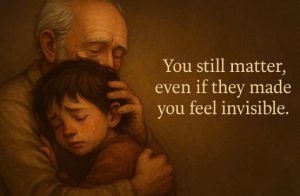
I still matter, even if I was ignored, yelled at, or forgotten.

You still matter, even if they made you feel invisible.

Please tell me, in that warm voice of yours, like a soft summer breeze:

“You were not the reason adults hurt you.”
“You deserve love.”
“You can forgive yourself and begin again.”

Grandpa, I long for a hug.
For someone to sit beside me—not to scold, not to lecture—but just to listen and not walk away.

I don’t know if tomorrow will be any better,
but today, at least I said what I’ve been holding in for so long.

Thank you for reading this.

From the child who once thought they were the problem,
Your Grandchild 🧸

The Invisible Backpack – How Unhealed Childhood Pain Weighs Down Our Adult Lives

There’s a story I tell the children when their hearts are heavy: that everyone walks through life carrying a backpack. Some hold snacks and books. Others? Stones. And not small ones either—stones shaped like shame, guilt, silence, and fear. The heartbreaking truth is, most of us who were wounded as children are still carrying those stones into adulthood.

The past doesn’t disappear just because we grow taller. Pain unspoken becomes pain unprocessed—and pain unprocessed becomes weight. Today, dear reader, let’s gently unpack that bag together.

  1. The Backpack You Never Chose

You didn’t ask for the yelling. You didn’t ask for the silence. You didn’t ask to be made to feel small, or invisible, or like love had conditions.

But somewhere along the way, your child-self began collecting these invisible stones. Maybe you thought: If I’m quiet, they won’t get angry. Or If I’m perfect, they’ll stay. Each thought became a pebble. Each wound, a rock.

You grew up. But the bag never came off.

  1. How Childhood Pain Echoes into Adulthood

You’re not “too sensitive.” You’re not broken. You’re just tired from carrying what no child should’ve had to bear.

Unhealed trauma often shows up in the smallest, quietest ways:

  • Apologizing too much.
  • Sabotaging love before it can leave you.
  • Shutting down during conflict.
  • Avoiding closeness out of fear it’ll turn into control.

If this is you, you’re not alone. These are not flaws—they’re echoes.

  1. Why We Keep Carrying It

The tragedy is, we think letting go means saying it didn’t matter. That if we set it down, we’re saying it was okay.

But carrying pain doesn’t honor it. Healing does.

Many of us are loyal to the pain because we were never given permission to speak it. We weren’t believed. We were told to “get over it.” And so we carried it silently, like a shameful secret sewn into our skin.

But what if we believed this instead:

You don’t have to forget. You don’t have to excuse it. But you can stop carrying it around like a backpack of stones.

  1. Laying Down the First Stone

Healing isn’t one big moment. It’s one quiet decision at a time:

  • Writing a letter to your inner child.
  • Saying, “I deserved better.”
  • Letting a therapist help you unzip the backpack.
  • Setting down one stone: guilt, blame, silence…

Just one. That’s how we start.

You don’t need to drop the whole bag today. But can you loosen one strap?

  1. What Healing Can Feel Like

It’s not immediate. But it’s real. Suddenly, you’ll notice:

  • Your breath deepens.
  • You don’t shrink around anger.
  • You speak your truth and feel safe.
  • You feel lighter—not because the past disappeared, but because it stopped owning your future.

Healing is not forgetting. It’s remembering without reliving. It’s honoring your pain without feeding it every day. It’s being the adult your younger self needed.

Closing Words from Grandpa Eli

My dear child, You are not weak for being tired. You are not dramatic for remembering. You are not broken for needing help to set it down.

You are brave for carrying it this far. But now… maybe it’s time to rest.

Tell me, what’s the first stone you’d like to put down? 💬 Comment below. Let’s carry it together—for the last time.


A Letter With No Stamp

Lucas had stopped flinching.

He still didn’t laugh much. But he had begun to hum—softly—when planting carrots, and once, Peter caught him tracing his finger along the petals of a peony like it was a secret worth keeping.

Then one rainy evening, Lucas said it.

“I think I want to see my father.”

Peter didn’t answer right away. He looked at the muddy windows of the greenhouse, where drops slid down like tiny rivers breaking loose. “Why?” he finally asked.

“I want him to know… he didn’t win.”

They worked on the letter together. Lucas’s hands shook at first. He kept crossing things out. Then he stopped. He wrote:

I’m not writing this so you’ll say sorry.

I’m writing this so I can stop carrying what you should have never put on me.

I’m not afraid of you anymore.

They didn’t mail it. That wasn’t the point.

Later that week, Peter took Lucas on a walk through the forest trail behind the greenhouse. They stopped at an old bench—weathered, quiet, and covered in moss.

That’s where Grandpa Eli waited.

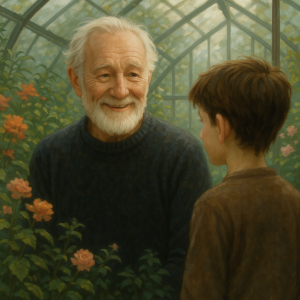
He wore his usual navy sweater, hands clasped gently on his lap, eyes twinkling with the kind of kindness that made people speak without fear.

Lucas sat down, wordless.

“You don’t need to tell me what happened,” Eli said. “You’ve lived it already. But if you want to, I’ll listen.”

And Lucas did.

I’m writing this so I can stop carrying what you should have never put on me.


For the first time, he spoke every word—the names, the bruises, the nights he pretended sleep so his father would stop yelling. He didn’t cry. He didn’t tremble.

When he finished, Grandpa Eli nodded.

“You’ve done the hardest part,” he said. “You remembered… and you stayed.”

That night, Lucas tore the letter in half. Then he burned it in the firepit.

Peter didn’t stop him.

Because sometimes, forgiveness isn’t about letting someone off the hook.

It’s about unhooking yourself.


The Boy and the Birdcage

Peter was now seventeen. The greenhouse behind Elianna’s cottage had grown lush with color. Children from the village came after school, helping him water the plants, paint the pots, name the ferns. They called it Peter’s Garden of Second Chances.

But one afternoon, a new boy showed up. Thin as a willow switch. Eyes too old for his age. His name was Lucas.

He didn’t touch the plants. Didn’t smile. He sat on the edge of the greenhouse floor, arms locked tightly around his knees. Watching. Waiting.

Peter offered him a cactus—“You don’t have to water it every day,” he said with a wink. Lucas didn’t laugh.

That night, Peter found Lucas outside the gate, staring at the greenhouse from the dark.

“Do you want to come in?” Peter asked.

Lucas shook his head. “I’d break something.”

“Who told you that?”

Lucas didn’t answer. But Peter already knew.

Over the next few weeks, Lucas returned. Silent. Tense. He flinched whenever a door creaked or someone raised their voice in laughter. He never took off his sweater, even when the sun burned high.

Peter recognized the signs. He saw himself in Lucas—the hidden bruises, the shame worn like armor.

One afternoon, Peter found Lucas staring at a broken birdcage near the compost bin.

“That used to hang in the front,” Peter said. “A bird lived in it until it flew away. We left the cage open—just in case it ever wanted to come back.”

Lucas looked up, confused. “Why wouldn’t you keep it closed? So it won’t leave?”

Peter knelt beside him. “Because love isn’t a cage. It’s a door you leave open.”

Lucas said nothing. But a tear slipped down one cheek.

That night, Lucas stayed late. He planted a marigold. It was crooked and messy, but Peter left it that way.

“You know,” Peter said softly, “it’s not your fault. Whatever happened to you… it’s not because you weren’t good enough.”

Lucas didn’t answer. But the next day, he rolled up his sleeves.

There were scars. But he wasn’t hiding anymore.

Over the following months, Lucas became Peter’s shadow—not the haunted kind, but the kind that grows from walking beside someone who finally sees you.

And for the first time in a long time, Peter felt something shift in his chest. Not grief. Not guilt.

Hope.

Peter – The Boy With No Shadow

Peter was ten when he realized he didn’t cast a shadow.

Not a real one, at least. His feet touched the ground like any other child’s, but something inside him hovered—untethered, hidden. “You’re too sensitive,” his father barked when Peter cried. “Useless, like your mother,” he added, tossing a plate against the wall. The sound echoed louder than the plate itself.

At night, Peter wrapped himself in silence. He didn’t cry anymore. The tears had dried years ago, replaced by a quiet agreement with himself: Survive. Don’t be seen. Don’t upset them.

He often watched the neighbor’s garden through the fence. Mrs. Callahan’s boy, Henry, ran barefoot chasing butterflies, laughing so loud it scared the birds. Peter marveled—not at the butterflies, but at the audacity of joy.

One day, after a particularly harsh beating over a dropped dish, Peter packed a small backpack. Notebooks. His lucky marble. A photo he’d found under a floorboard of himself at age two, held in his mother’s arms—smiling. She didn’t smile anymore.

He walked away. Not toward any specific place, but away. The road was wide. So was the world.

Peter spent weeks drifting between towns, doing chores at farms for a bowl of stew or a warm barn. He never spoke much. When people asked about his family, he would say they were “gone,” and in a way, they were.

But life, as it often does, placed someone in his path.

Her name was Elianna, a retired schoolteacher with hair like silver thread and eyes like winter turning into spring. She found Peter sitting on the steps of the old town library.

“You look like a boy with something heavy in his bag,” she said.

Peter shrugged. “It’s just books.”

“No,” she smiled gently. “I meant the invisible kind.”

And for the first time in his young life, Peter talked. About the yelling. The silence. The fear. About how he once believed he was bad, rotten, the reason his father drank, the reason his mother hid behind curtains even in daylight.

Elianna didn’t flinch. “What happened to you wasn’t your fault,” she said, placing a hand over his trembling one. “You were a child. You deserved love, not bruises.”

That night, Peter wrote his father a letter. He didn’t know if he’d ever send it. But he wrote it not to hurt, not to accuse—but to say: You no longer control my breath, my steps, or my future.

Years later, Peter returned to his hometown—not to see his parents, who had long moved away—but to build a greenhouse on the old Callahan plot. He filled it with orange orchids and resilient succulents. “For children,” he said, “who forgot they could bloom.”

He still didn’t cast a shadow.

Because Peter had become his own light.