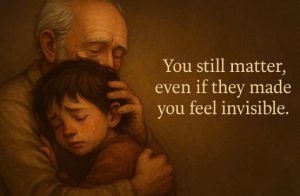
By Grandpa Eli
“But I Had a Roof Over My Head…”
Not every child who suffers leaves with visible scars.
Some grow up in homes with dinner on the table. Clothes in the closet. Even smiles in family photos.
But something important was missing.
Something silent. Invisible. And just as damaging as a slap:
Emotional presence. Warmth. Connection.
This, my dear one, is what we call emotional neglect — and it’s far more common than most people realize.
In today’s blog, we’ll walk through:
- What emotional neglect really is.
- Why it’s so often misunderstood.
- How it leaves lifelong marks on our sense of self.
- And most importantly — how we can begin to heal.
What Is Emotional Neglect?
Emotional neglect happens when a child’s emotional needs are consistently ignored, dismissed, or unacknowledged.
It’s not always malicious.
In fact, many parents who neglect emotionally are loving in their own way — they simply never learned how to be emotionally available.
But to a child, the result is the same:
- Feeling invisible.
- Feeling unworthy of love.
- Learning to suppress emotions just to survive.
A child’s logic is heartbreakingly simple:
“If no one sees me… maybe I’m not worth seeing.”
“They Were Good Parents. I Must Be the Problem.”
This is one of the cruelest traps emotional neglect sets.
When a parent isn’t violent or overtly abusive, the child assumes the fault must be within themselves.
“They fed me. Gave me clothes. So why do I feel so empty?”
“Maybe I’m too sensitive. Maybe I just ask for too much.”
These beliefs become core wounds — deep-rooted stories that follow us into adulthood.
And they shape everything.
How Childhood Neglect Follows Us Into Adulthood
You might not even realize it’s happening.
But emotional neglect can show up in adulthood as:
- Chronic low self-worth
- Fear of vulnerability
- Difficulty identifying or expressing emotions
- Being “overly independent”
- People-pleasing to earn love
- Feeling numb, disconnected, or emotionally flat
- Attracting emotionally unavailable partners
- A deep fear of being “too much”
Sound familiar?
That’s not because something’s wrong with you.
It’s because your inner child is still waiting to be seen.
The Three Most Common Myths About Emotional Neglect
Myth 1: “If I wasn’t hit or screamed at, I wasn’t abused.”
Truth: Abuse isn’t just what’s done to you. It’s also what was withheld from you.
Myth 2: “They did their best, so I shouldn’t feel hurt.”
Truth: Compassion for their struggle doesn’t erase your pain. Both can exist.
Myth 3: “I should be over it by now.”
Truth: Time doesn’t heal what’s never been acknowledged.
How We Begin To Heal
🧓 Let me tell you something important, dear one:
“You didn’t make it up.”
“You weren’t too needy.”
“You just needed what every child needs: love, attention, and to be seen.”
Healing from emotional neglect is possible. But it begins with naming the wound.
Let’s explore some healing steps together:
Step 1: Acknowledge What Was Missing
Write it down. Say it aloud. Tell a trusted friend or therapist.
“I wasn’t hugged.”
“No one asked how I felt.”
“They never said they were proud of me.”
Validation isn’t pity. It’s power.
Step 2: Stop Minimizing Your Pain
“It could’ve been worse”
“At least they stayed”
These thoughts don’t serve your healing.
Your pain deserves space — no matter what others had it “worse.”
Step 3: Reconnect with Your Inner Child
That little one inside you is still waiting to be seen.
- Talk to them.
- Write to them.
- Be the parent to yourself that you never had.
Step 4: Seek Safe, Supportive Relationships
Find people who make you feel seen. Heard. Valued.
Whether through therapy, support groups, or soulful friendships — connection heals what neglect created.
Step 5: Redefine Love and Worth
Love is not something you have to earn.
Your worth is not tied to your achievements or usefulness.
You are lovable because you exist.
Let that sink in. Again and again. Until it becomes truth.
Final Words from Grandpa Eli
Dear one, emotional neglect is invisible to the world — but deeply felt by the soul.
It wasn’t your fault.
You didn’t imagine it.
And you’re not alone.
There’s nothing wrong with you.
You’re healing.
And if you’re still searching for that warm voice to tell you that you matter —
🧓 Let me be that voice:
You matter.
I see you.
And I’m proud of the person you’re becoming.
With all my heart,
~ Grandpa Eli