
Introduction:
Noah hadn’t looked in a mirror in over a year.
Not once.
He shaved by feel. Brushed his teeth with eyes closed.
He avoided bathroom stalls with glass. Turned away from reflective windows.
He lived in the world—but did everything he could not to see himself in it.
Because once, long ago, someone taught him that his face was a problem.
That being seen was dangerous.
That looking in the mirror would only confirm what he feared most:
“I am not enough.”
If you’ve ever avoided mirrors—not out of vanity, but out of pain—this story is for you.

When the Mirror Becomes a Weapon
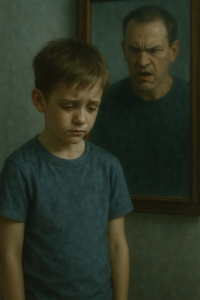
Noah was seven when his father dragged him to the mirror for the first time.
He had cried—something small, something honest—and his father snarled,
“You want to cry? Fine. Look at yourself while you do it.”
He stood there, nose to glass, tears running down his cheeks, as his dad shouted behind him,
“Look at this. This is what a pathetic boy looks like.”
“No girl will ever want you.”
“This is why you’ll never be a man.”
It didn’t happen once.
It happened again. And again.
Each time Noah showed vulnerability, his father used the mirror to reflect it back with shame.
Eventually, Noah believed him.
When You Learn to Look Away
By high school, Noah had mastered invisibility.
He wore hoodies two sizes too big.
Kept his head down.
Never smiled in photos.
If someone complimented his eyes, he changed the subject.
Inside, he was kind. Funny. Brilliant.
Outside, he was a ghost.
People called him “humble.”
They didn’t know he couldn’t look at himself without hearing his father’s voice.
By the time he reached university, Noah avoided mirrors like they might shatter from the sight of him.
Because to look was to confirm the lie.
The lie that said:
“You’re wrong.
You’re weak.
You’re not lovable.”

How Shame Buries the Self
Shame is different from guilt.
Guilt says, “I did something bad.”
Shame says, “I am something bad.”
And when shame begins in childhood, especially from a parent, it burrows deep.
Noah didn’t just avoid mirrors.
He avoided vulnerability.
He never asked for help.
He rejected affection—even when he longed for it.
He thought he had outgrown the pain.
But trauma doesn’t live in logic.
It lives in the body.
In the flinch.
In the silence.
In the eyes that can’t meet their own reflection.
The Moment He Finally Looked
It was a random morning.
The dorm bathroom was empty.
Noah had finished brushing his teeth, eyes closed, as usual.
But then a voice behind him:
“Hey, you’ve got something on your face.”
He startled. Looked up.
And for the first time in over 400 days—he saw himself.
He froze.
His first thought wasn’t: “I look fine.”
It was: “I can’t do this.”
But something inside him said:
“Just breathe.”
So he did.
And slowly, painfully, he met his own eyes in the mirror.
And for the first time, he didn’t look away.

The Grief of Recognition
He didn’t see a failure.
He didn’t see a boy who deserved shame.
He saw a child still waiting to be told he was okay.
His lips trembled. His jaw clenched. His chest ached.
Not because he was ugly.
But because he had spent years hating a face that only ever wanted love.
He whispered:
“You didn’t deserve it.
You were just a kid.
You didn’t do anything wrong.”
And then—he cried.
Not from vanity.
Not from sadness.
But from the relief of being seen without judgment for the first time in his life.

What Happens When We Start Looking Again
Looking in the mirror after trauma isn’t about fixing your hair or liking your appearance.
It’s about facing the one who was told to disappear.
It’s about saying:
- “You’re allowed to take up space.”
- “You don’t have to hide anymore.”
- “You’re not broken—you were hurt.”
This is the beginning of self-love.
Not bubble baths and mantras.
But truth-telling.
Eye contact with your younger self.
Gentle, wordless permission to exist.
How to Reclaim the Mirror
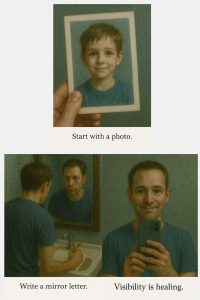
🪞 1. Start with a Photo
If looking in the mirror is too much, try a childhood photo.
Look into that child’s eyes.
Say what you wish someone had told them.
🧡 2. Use the Mirror as a Portal—Not a Critic
Instead of analyzing flaws, try affirming truths:
“You’re here.”
“You made it.”
“I see you.”
✍️ 3. Write a Mirror Letter
Write a letter to the version of you who stopped looking.
What would you say now?
📸 4. Take the Picture
You don’t need to love how you look.
You just need to honor that you exist.
Visibility is healing.
🤝 5. Share the Story
With a friend. With a journal.
Even with your reflection.
Because shame dies in safe connection.
Conclusion: You Were Never the Problem
Noah didn’t become obsessed with his reflection.
He didn’t post selfies or start modeling.
But now, he brushes his teeth with his eyes open.
He shaves while looking in the mirror.
And every once in a while,
he smiles at the person looking back.
Not because he’s “fixed.”
But because he’s free.
The freedom to see yourself is a birthright.
Not a reward.
You were never the problem.
You were just a child made to feel invisible.
And now, finally—you get to look.
You get to stay.
You get to be seen.

💬 Let’s Talk
Have you ever avoided mirrors—not because of vanity, but because of shame?
Are you learning, like Noah, to reclaim the right to be seen?
Drop a 👁️ in the comments if you’re learning to look again—with kindness.
Tag someone who deserves to know:
“You are not what they said.
You’re worthy of your own reflection.”

Keywords used (naturally embedded): childhood shame and self-image, emotional abuse from parents, healing self-esteem after trauma, mirror avoidance and PTSD, inner child healing, body-based trauma recovery, learning to see yourself again, reparenting and self-acceptance