Failure Isn’t the End—It’s How You Begin Again By Grandpa Eli

Hello again, my precious one.

Come, rest with me a moment. If your heart is heavy with the fear of trying—if your hands are trembling with the thought of failing again—then let me tell you something I wish someone had told you long ago:

Failure is not a verdict. It is a doorway.

And you, sweet child, are still allowed to walk through it.

Continue reading “Failure Isn’t the End—It’s How You Begin Again By Grandpa Eli”

Why You’re Not Broken: Releasing the Fear of Failing from Childhood By Grandpa Eli

Hello, dear one. Grandpa Eli here.

If you grew up in a home where encouragement was scarce, where no one clapped when you tried your best, where praise was a language left unspoken—then perhaps you carry an old, familiar ache. A fear so quiet, it feels like part of your bones: the fear of failing.

Let me tell you something that might sound strange at first: that fear? It isn’t really yours.

It was planted in you. By adults who didn’t know how to nurture. By a family that may have been too hurt or too distracted to see your little hands reaching, your heart quietly hoping.

And because you didn’t get what you needed, you may have learned to stop trying.

Where Fear Begins

Children are tender creatures. They don’t need perfect parents. But they do need safe spaces to stumble and try again. When you fall and someone helps you up with a smile, you learn: “Trying is good. Mistakes are okay.”

But if every stumble was met with a scowl—or worse, silence—you may have begun to believe, “Trying is dangerous. Mistakes make me unlovable.”

That’s not the truth, little one. That’s a wound.

The Lie of “Not Good Enough”

Many adults who fear failure were children who only received attention when they succeeded. And even then, it may have been muted: “Why not better?” “Why not perfect?”

So now, you wait. You wait to feel ready. You wait to be certain. You wait until it’s safe.

But safety never comes. Because what you’re truly waiting for isn’t certainty. It’s permission. Permission to be human.

Failure Is Not an Enemy

Let me whisper this truth into the place where your fear lives:

Failure is not the opposite of success. It is the teacher of it.

Every person you admire failed more times than they succeeded. Not because they were better than you—but because they were allowed to keep trying.

You never got that freedom. But you can claim it now.

Today, You Get to Begin Again

You are no longer a child under their roof. You are no longer small and voiceless. You don’t need anyone’s permission to try.

You get to decide. Try the thing. Make the mistake. Let yourself fall. Because here’s what they never taught you: you can get back up.

And every time you do, you rewrite the story they gave you.

Reclaiming What Was Yours All Along

Courage is not the absence of fear. It is the act of standing anyway. And trying again. And again.

When you release the belief that failure is shameful, you open your heart to a different kind of life:

  • One where mistakes are part of learning
  • Where growth matters more than perfection
  • Where your worth isn’t tied to results

Dear one, you are allowed to try things and not be great at them. You are allowed to fail. You are still worthy.

You Were Never Broken

That voice in your head—the one that says you’re not good enough, that you shouldn’t even try? That’s not your voice. It was put there.

But now, you get to choose a new one. One that says:

  • I can try.
  • I can learn.
  • I can rise.

You are not broken. You were just waiting to remember who you really are.

Take My Hand

If you were never told this before, let me say it now:

I’m proud of you for being here. For even considering the idea that failure doesn’t mean you’re bad or weak or unlovable.

You are already further than you think. You are already healing.

And if you fall again? I’ll be here, smiling, saying: “Good. You’re trying. Let’s try again together.”

With warmth and belief in you,

—Grandpa Eli

Our Parents May Have Hurt You—But You Hold the Pen Now By Grandpa Eli

Hello, my dear,

Let me tell you a story—not just any story, but one you already know.

It begins in a house where a child learned to shrink. Where laughter felt dangerous. Where love was conditional.

That child may have been you.

And if so, my heart aches with yours. Because too many of us grew up in homes that taught us to survive, not to thrive. Homes where “being good” meant being silent, small, or invisible. Where mistakes were punished, not understood. Where love had rules. And protection came with conditions.

But here’s where the story can change—if you let it.

Continue reading “Our Parents May Have Hurt You—But You Hold the Pen Now By Grandpa Eli”

When Blame Feels Safer Than Healing: A Letter to the Grown-Up Child Still Hurting By Grandpa Eli

Hello there, dear heart.

If you’re here reading these words, it tells me something important: you’ve been hurt. Not just once, not just by circumstance—but by the very people who were supposed to love and protect you. Your parents.

I want to sit beside you for a little while—not with judgment, but with understanding. Because if there’s one thing I’ve learned in all my long years, it’s this:

Blaming your parents might feel safe, but it will never heal you.

Let me explain why.

Continue reading “When Blame Feels Safer Than Healing: A Letter to the Grown-Up Child Still Hurting By Grandpa Eli”

The Day You Realize It Wasn’t Your Fault: A Letter to the Blameless Child Within By Grandpa Eli

She was in her late forties when she sat down across from me. Polished, successful, composed — but her voice cracked when she said:

“I think… I think I believed it was my fault. That if I’d been easier to love, maybe my parents would’ve loved me better.”

And in that moment, she wasn’t a grown woman anymore. She was a little girl — waiting for someone to say, “It wasn’t you.”

So let me say it now.

To the child inside you — the one who still whispers in the quiet: “Maybe it was me” — this letter is for you.

Continue reading “The Day You Realize It Wasn’t Your Fault: A Letter to the Blameless Child Within By Grandpa Eli”

Don’t Look in the Mirror: How Childhood Shame Warps Self-Image—And What It Means to Finally Be Seen

Introduction:

Noah hadn’t looked in a mirror in over a year.

Not once.

He shaved by feel. Brushed his teeth with eyes closed.
He avoided bathroom stalls with glass. Turned away from reflective windows.
He lived in the world—but did everything he could not to see himself in it.

Because once, long ago, someone taught him that his face was a problem.
That being seen was dangerous.
That looking in the mirror would only confirm what he feared most:

“I am not enough.”

If you’ve ever avoided mirrors—not out of vanity, but out of pain—this story is for you.

When the Mirror Becomes a Weapon

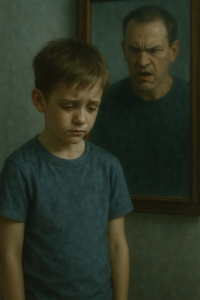
Noah was seven when his father dragged him to the mirror for the first time.

He had cried—something small, something honest—and his father snarled,

“You want to cry? Fine. Look at yourself while you do it.”

He stood there, nose to glass, tears running down his cheeks, as his dad shouted behind him,

“Look at this. This is what a pathetic boy looks like.”
“No girl will ever want you.”
“This is why you’ll never be a man.”

It didn’t happen once.

It happened again. And again.
Each time Noah showed vulnerability, his father used the mirror to reflect it back with shame.

Eventually, Noah believed him.
When You Learn to Look Away

By high school, Noah had mastered invisibility.
He wore hoodies two sizes too big.
Kept his head down.
Never smiled in photos.
If someone complimented his eyes, he changed the subject.

Inside, he was kind. Funny. Brilliant.
Outside, he was a ghost.

People called him “humble.”
They didn’t know he couldn’t look at himself without hearing his father’s voice.

By the time he reached university, Noah avoided mirrors like they might shatter from the sight of him.

Because to look was to confirm the lie.
The lie that said:

“You’re wrong.
You’re weak.
You’re not lovable.”

How Shame Buries the Self

Shame is different from guilt.
Guilt says, “I did something bad.”
Shame says, “I am something bad.”

And when shame begins in childhood, especially from a parent, it burrows deep.

Noah didn’t just avoid mirrors.
He avoided vulnerability.
He never asked for help.
He rejected affection—even when he longed for it.

He thought he had outgrown the pain.
But trauma doesn’t live in logic.
It lives in the body.
In the flinch.
In the silence.
In the eyes that can’t meet their own reflection.

The Moment He Finally Looked

It was a random morning.
The dorm bathroom was empty.
Noah had finished brushing his teeth, eyes closed, as usual.

But then a voice behind him:

“Hey, you’ve got something on your face.”

He startled. Looked up.

And for the first time in over 400 days—he saw himself.

He froze.

His first thought wasn’t: “I look fine.”
It was: “I can’t do this.”

But something inside him said:

“Just breathe.”

So he did.
And slowly, painfully, he met his own eyes in the mirror.

And for the first time, he didn’t look away.

The Grief of Recognition

He didn’t see a failure.
He didn’t see a boy who deserved shame.

He saw a child still waiting to be told he was okay.

His lips trembled. His jaw clenched. His chest ached.

Not because he was ugly.
But because he had spent years hating a face that only ever wanted love.

He whispered:

“You didn’t deserve it.
You were just a kid.
You didn’t do anything wrong.”

And then—he cried.
Not from vanity.
Not from sadness.
But from the relief of being seen without judgment for the first time in his life.

What Happens When We Start Looking Again

Looking in the mirror after trauma isn’t about fixing your hair or liking your appearance.

It’s about facing the one who was told to disappear.

It’s about saying:

  • “You’re allowed to take up space.”
  • “You don’t have to hide anymore.”
  • “You’re not broken—you were hurt.”

This is the beginning of self-love.
Not bubble baths and mantras.
But truth-telling.
Eye contact with your younger self.
Gentle, wordless permission to exist.

How to Reclaim the Mirror

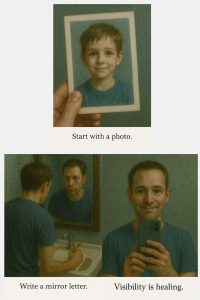
🪞 1. Start with a Photo

If looking in the mirror is too much, try a childhood photo.
Look into that child’s eyes.
Say what you wish someone had told them.

🧡 2. Use the Mirror as a Portal—Not a Critic

Instead of analyzing flaws, try affirming truths:

“You’re here.”
“You made it.”
“I see you.”

✍️ 3. Write a Mirror Letter

Write a letter to the version of you who stopped looking.
What would you say now?

📸 4. Take the Picture

You don’t need to love how you look.
You just need to honor that you exist.
Visibility is healing.

🤝 5. Share the Story

With a friend. With a journal.
Even with your reflection.

Because shame dies in safe connection.
Conclusion: You Were Never the Problem

Noah didn’t become obsessed with his reflection.
He didn’t post selfies or start modeling.

But now, he brushes his teeth with his eyes open.

He shaves while looking in the mirror.

And every once in a while,
he smiles at the person looking back.

Not because he’s “fixed.”
But because he’s free.

The freedom to see yourself is a birthright.
Not a reward.

You were never the problem.
You were just a child made to feel invisible.

And now, finally—you get to look.
You get to stay.
You get to be seen.

💬 Let’s Talk

Have you ever avoided mirrors—not because of vanity, but because of shame?

Are you learning, like Noah, to reclaim the right to be seen?

Drop a 👁️ in the comments if you’re learning to look again—with kindness.
Tag someone who deserves to know:

“You are not what they said.
You’re worthy of your own reflection.”

Keywords used (naturally embedded): childhood shame and self-image, emotional abuse from parents, healing self-esteem after trauma, mirror avoidance and PTSD, inner child healing, body-based trauma recovery, learning to see yourself again, reparenting and self-acceptance

The Suitcase by the Door: How Childhood Abandonment Teaches You to Leave Before You’re Left—And What It Means to Stay

Introduction:

Some people unpack when they move in.
Others keep a suitcase by the door—just in case.
Sam was one of the latter.
For 32 years, he kept a small, weathered suitcase ready to go.
Not because he liked traveling.
Not because he feared emergencies.
But because, once, when he was 11, his mother dropped him off at a neighbor’s house and never came back.
If you’ve ever felt safer being alone than being loved, if you’ve ever left first just to avoid being left again—this story may be your own.

The Day She Didn’t Come Back

Sam remembered it vividly.
His mom said it would be “just a weekend.”
She gave him a tight smile, kissed his forehead, and promised to return Monday.
He waited by the window.
And waited.
Monday passed.
Tuesday.
A week.
A month.
Eventually, the neighbors called social services.
And Sam entered the system with one story etched into his heart:
“People leave. Always.”

How Abandonment Shapes a Child

When a child is left behind—physically or emotionally—they don’t just mourn the absence.
They internalize it.
Sam thought:
“I must’ve done something wrong.”

“I was too much, or not enough.”

“I’m not worth staying for.”

And so, he built his life around two unspoken rules:
Never depend on anyone.

Always be ready to leave.

He lived out of his suitcase during every foster placement, never unpacking, never settling in.
It wasn’t about rebellion.
It was about protection.

How Abandonment Affects Adult Relationships

Sam became an adult with a job, a car, and his own place.
He worked night shifts at a hospital. Quiet. Reliable. Always on time.
But he never:
Bought a couch

Adopted a pet

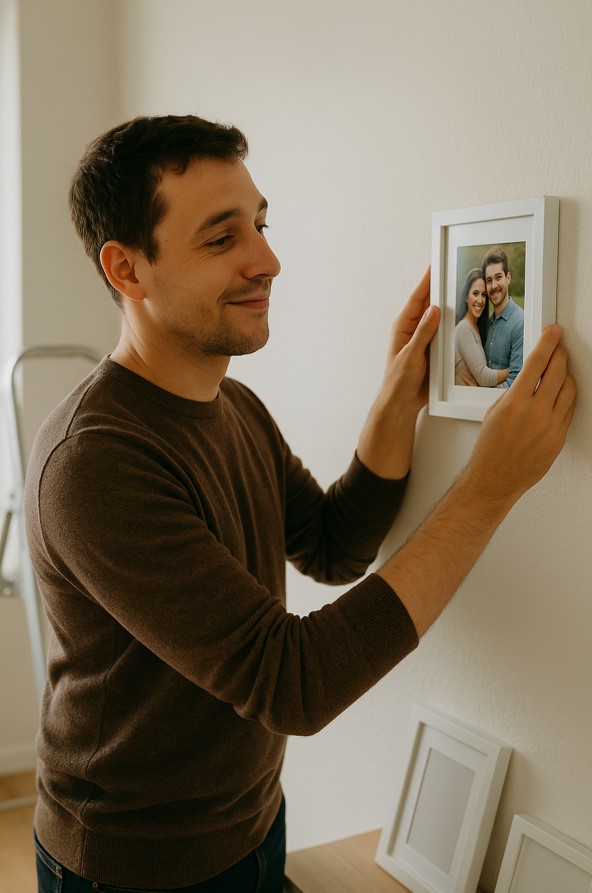
Hung photos

Invited people to stay

He dated, but only casually.
The minute someone got too close, he pulled away.
If they said “I love you,” he laughed.
If they offered help, he said, “I’m fine.”
Because intimacy felt dangerous.
Love felt like risk.
So he kept a suitcase by the door—just like when he was 11.
Not because someone might kick him out.
But because he couldn’t believe anyone would want him to stay.

The Moment That Changed Everything

It was a regular night shift.
Sam was mopping the pediatric floor when a little boy ran out of a hospital room, crying.
He couldn’t have been older than six.
Alone. Scared.
Sam knelt down, gently offered him a chocolate milk from the staff fridge, and asked if he was okay.
The boy sniffled and said:
“You’re the only one who didn’t leave.”
Sam froze.
That sentence—six words—hit like a freight train.
Because deep down, he had been waiting his whole life for someone to say the same to him.

Coming Home to Himself

Sam went home that morning and stared at the suitcase by his door.
It was old. Frayed. Still zipped.
A time capsule of a boy who never dared unpack.
He sat beside it and wept.
For the birthday parties he missed.
For the goodbyes that never came.
For the arms that never held him when he was scared.
For the lie that told him he was easier to leave than to love.
Then, he unzipped it.
Inside:
A sweatshirt that no longer fit

A toothbrush still in its wrapper

A note to himself that read: “Don’t get too comfortable.”

He took it all out.
Then, for the first time in 32 years,
he put the suitcase in the closet.

Why It’s So Hard to Stay

If you’ve ever sabotaged good relationships, ghosted kind people, or said “I don’t need anyone” while secretly aching for connection—please hear this:
You are not cold.
You are not broken.
You are bracing.
Children who experience abandonment often grow up expecting love to vanish.
So they run before it can.
But staying—loving—trusting—those are muscles.
They can be rebuilt.
Slowly.
Gently.
One breath at a time.

5 Ways to Start Unpacking Your Emotional Suitcase

🧳 1. Identify Your Abandonment Beliefs
What do you believe about relationships?
Write them out. Are they true—or trauma talking?
✍️ 2. Write a Letter to the One Who Left
Even if you never send it.
Name the pain. Let your inner child speak.
🫂 3. Practice Micro-Commitments
Stay five minutes longer in conversation.
Text back instead of ghosting.
Let someone help you—even if it feels uncomfortable.
🧠 4. Challenge the Voice That Says “Leave”
Ask: “Is this danger… or just discomfort?”
Remind yourself: It’s okay to stay.
🧡 5. Reparent Yourself
Hold your younger self with compassion.
Say the words no one else did:
“You were not the reason they left.
You were always worth staying for.”

Conclusion: You Are Worth the Stay

The suitcase by the door was never about packing.
It was about a boy who didn’t believe he’d be chosen.
But Sam?
He’s choosing now.
Choosing to decorate.
To call people back.
To plant roots—even if they tremble.
Healing from abandonment doesn’t mean pretending it didn’t happen.
It means saying:
“That was real.
But it doesn’t get to control what I believe about love anymore.”
So if you still keep a metaphorical suitcase by your door, hear this:
You don’t have to go.
You can stay.
You belong.


💬 Let’s Talk

Have you ever felt like it was safer to leave than to be loved?
Have you ever kept people at arm’s length—not because you didn’t care, but because you cared too much?
Drop a 🧳 in the comments if you’re learning to unpack your old stories and stay.
Tag someone who deserves to hear:
“You are not too much.
You are not too late.
You are safe to be chosen.”

Keywords used (naturally embedded): abandonment trauma, childhood emotional neglect, how abandonment affects adult relationships, inner child healing, fear of intimacy, self-sabotage in relationships, reparenting after trauma, learning to trust again