

Introduction:
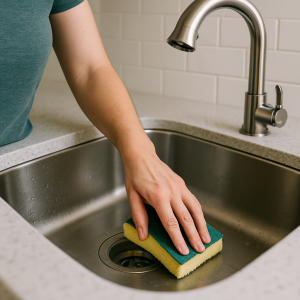
She scrubbed the sink for the third time that night.
It wasn’t dirty.
It never was.
But Chloe couldn’t stop.
Not because she loved cleanliness.
Not because she was obsessive.
But because, once upon a time, her survival depended on being spotless.
This is the story of how trauma disguises itself as tidiness.
Of how a little girl learned that being perfect kept her from being punished.
And what it means—years later—to let go of the bleach and finally say: “I’m enough, even with the mess.”

When Cleaning Becomes a Shield
Chloe was 31, a beloved elementary school teacher, admired by colleagues and parents alike.
Her students adored her.
Her apartment? Immaculate.
The floors gleamed. Her closet was color-coded. Every drawer had a label.
People called her “disciplined.”
“Organized.”
“Put together.”
But they didn’t see the truth behind her spotless countertops:
Fear.
Because perfection wasn’t a lifestyle.
It was a survival strategy she learned before she could read.
The Childhood Where Clean Meant “Safe”
Chloe’s mother was a woman of image.
Her house looked like a showroom.
Every dish had a place.
Every pillow sat at the right angle.
But the minute something was out of order—so was Chloe.
If her socks were mismatched?
She’d be forced to scrub the baseboards.
If she spilled juice?
She went to bed hungry.
And if she cried?
Her mother would whisper in her ear,
“Stop being disgusting.
No one will ever love a messy girl.”
Those words stuck.
So Chloe learned.
She kept her room like a museum.
She folded her clothes with military precision.
She scrubbed her hands until they bled—just to feel clean.

Perfectionism: The Polished Face of Pain
As Chloe got older, her obsession with cleanliness evolved.
She aced every test
Organized every event
Smiled at every insult
Stayed silent through every heartbreak
People said she was “easy to work with” and “never complained.”
But what they didn’t know was that Chloe didn’t have the luxury of complaining.
Not when, deep down, she still believed:
“If I’m not perfect, I’ll be punished.”
“If I make a mess, I’ll be left behind.”
And the scariest thought of all:
“If someone really sees me—they’ll walk away.”

The Night the Sink Sparkled—and She Broke
It was 2:00 AM.
Chloe had just finished grading papers, tidied her apartment, and wiped down her already-pristine kitchen.
But something inside her buzzed.
That old panic: “What if I missed a spot?”
She sprayed the sink again. Scrubbed hard. Harder.
And then—
The sponge slipped.
The glass fell.
And shattered.
She dropped to the floor, hands shaking.
She wasn’t crying over the broken glass.
She was crying over every birthday she scrubbed through.
Every hug she refused because she hadn’t cleaned the counters yet.
Every date she canceled to vacuum the hallway.
She sat on the cold tile and whispered:
“I don’t want to live like this anymore.”

What It Means to Feel Safe Enough to Be Messy
That night, Chloe didn’t call anyone.
She didn’t Google self-help.
She didn’t clean up the glass.
She did something far more radical.
She went to bed.
With dishes in the sink.
With a towel on the floor.
With her grief finally—finally—being heard.
The world didn’t end.
No one screamed.
No one left.
No one stopped loving her.
Because no one ever did.
She had just been hiding.

Perfection as a Trauma Response
We often praise perfectionism.
We reward the “overachievers,” the “always-on-time,” the “never-complains” ones.
But here’s the truth:
👉 Sometimes, perfectionism isn’t ambition.
👉 Sometimes, it’s protection.
Children who are neglected, shamed, or punished unpredictably often develop “hyper-vigilance.”
They scan for danger.
They fix problems before they start.
They clean to avoid being hit.
They get A’s to earn affection.
They become adults who confuse approval with love.
And believe that to deserve rest, they must first perform exhaustion.

Are You “The Clean One”? 5 Signs Your Perfection May Be a Shield
You feel intense guilt when things are “out of place.”
Even minor disorder makes you feel unsafe or ashamed.
You avoid vulnerability.
Letting people see you unprepared feels like a threat.
You equate productivity with worth.
If you’re not “doing something,” you feel lazy or unlovable.
You don’t know how to rest.
Even on vacation, you feel like you’re falling behind.
You have a strong inner critic.
Mistakes aren’t just errors—they’re evidence that you’re not enough.

How to Begin Letting Go of the Scrub Brush
🧡 1. Say the Thing You Were Never Told
Look in the mirror and say:
“You don’t have to be perfect to be loved.”
“Your worth is not in your spotless kitchen.”
“You are safe—even when things are undone.”
✍️ 2. Write a Letter to Your Younger Self
Tell her she didn’t need to scrub to deserve dinner.
She didn’t need straight A’s to deserve hugs.
She was always enough.
🛑 3. Leave One Thing “Undone”
On purpose.
And notice what happens (spoiler: nothing bad).
Start with small acts of imperfection to build tolerance.
🤝 4. Let Someone See the Mess
Emotionally or physically.
A friend. A therapist. A partner.
Let them know you’re tired.
Let them show you that love doesn’t leave just because your bed isn’t made.

Conclusion:
You Are Not Your Cleanliness
That night, Chloe cleaned less—and felt more.
It didn’t happen overnight.
But over time, she started:
Leaving dishes in the sink once in a while
Letting her students see her cry
Laughing at her own typos
And—most beautifully—letting people love her without performance
She’s still tidy.
Still responsible.
Still proud of her space.
But now, she knows:
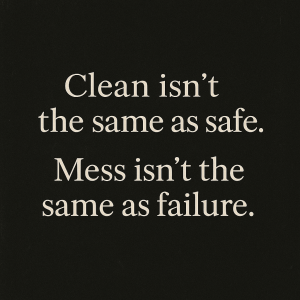
Clean isn’t the same as safe.
And mess isn’t the same as failure.

💬 Let’s Talk
Did you grow up thinking perfection kept you safe?
Are you learning, like Chloe, that you don’t have to scrub away your humanity to deserve love?
Drop a 🧽 in the comments if you’re learning to rest, let go, and live with the mess.
Tag someone who needs to hear:
“You are lovable—even when your floor is dirty.”
Keywords used (naturally embedded): childhood trauma and perfectionism, healing from emotional neglect, trauma response cleaning, perfectionism as survival, how to stop being a perfectionist, inner child healing,adult children of critical parents, reparenting your inner child